


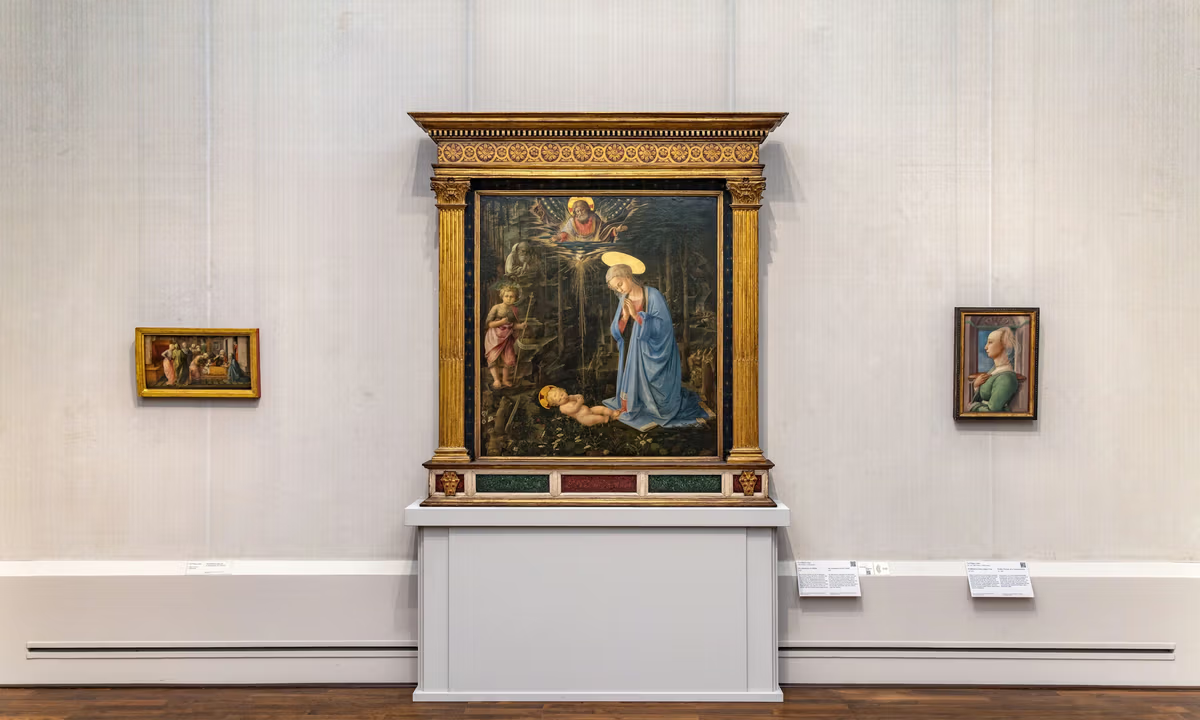
The Staatliche Museen zu Berlin (Berlin State Museums) has announced that Filippo Lippi’s 1459 painting The Adoration in the Forest will undergo a two-year restoration, funded by the Ernst von Siemens Kunststiftung und the Schoof’schen Stiftung. Berlin State Museums did not confirm the exact budget for the treatment, but said it was between €100,000-€500,000.
The Adoration in the Forest, now in the permanent collection of Berlin’s Gemäldegalerie, is a significant painting. The tempera-on-panel work, which shows the Virgin and newborn Christ child in a mountainous forest rather than a Bethlehem manger, was created to be the focal point of the private chapel of the Palazzo Medici, then the banking family’s imposing new Florentine palace. Later, after the painting entered the Berlin collections in the 1820s, it helped usher in a new appreciation for Quattrocento Florentine art.
Like many significant Berlin works, it took a circuitous path to its present spot in the German capital’s Kulturforum museum complex, including a post-Second World War turn in the US as de facto war booty. But it seemed no worse for wear as recently as 2023, when it was set for a reframing. Then the Berlin conservation team, aided by a new high-performance stereo microscope, detected that the varnish layer, likely from the 19th century, was not protecting the tempera paint but degrading it—and in spots actually lifting the paint right off the panel.
“It’s a huge project,” Gemäldegalerie conservator Anja Wolf told The Art Newspaper this week in the museum’s restoration studio, in front of the work itself. “You have to find a method to remove the varnish, and at the same time stabilise and consolidate the paint layer. And you have to work really precisely,” she said. Wolf added that it is the first time she has done a project quite like this.
Spots of paint are lifting off the panel of Filippo Lippi’s 1459 painting The Adoration in the Forest Photo: Staatliche Museen zu Berlin, Gemäldegalerie / Sandra Stelzig, 2023
Affected areas include the Virgin’s blue cloak, along with her skin, and sections of the gold leaf that lavishly served to brighten up the Medici chapel—a windowless space, decorated with a celebrated fresco cycle by another Florentine, Benozzo Gozzoli, a pupil of Fra Angelico. In his book about the family, Medici Money (2005), the Italian-based British author Tim Parks writes that Cosimo de’ Medici, the banker-politician who first turned the clan into a dominant force in Florence, used the chapel as a secret conference room.
Neville Rowley, the Gemäldegalerie’s curator for 14th- and 15th-century Italian painting and sculpture, sees Lippi (around 1406-69) as a broadly transitional figure. On the one hand, 1459 is “relatively late” to have gold leaf, he said; on the other hand, Lippi was an early advocate of oil paint. The restoration treatment will find out if, and to what extent, Lippi used the binding material here, along with egg tempera.
Though the main goal of the treatment is to save the painting, it will also result in giving the work a brighter appearance, Wolf said. More contrast between light and dark will impact, among other areas, the white flowers on the forest floor that now appear to be a faint grey. Sandro Botticelli was Filippo Lippi’s most celebrated pupil, and the floral motif anticipates the flowers at the bottom of Botticelli’s Primavera (around 1480) in Florence’s Galleria degli Uffizi. Back in Palazzo Medici, the palace chapel still has a version of The Adoration in the Woods, in the form of a Quattrocento copy.
Rowley, who included the Berlin version in his 2022 show about Donatello, is looking ahead to another Florentine show after the completion of the new restoration. Filippo Lippi’s son, Filippino Lippi, was in turn Botticelli’s pupil, and Rowley is eager to do an exhibition that will showcase The Adoration in the Forest while also highlighting “that dynasty of painters”.
