


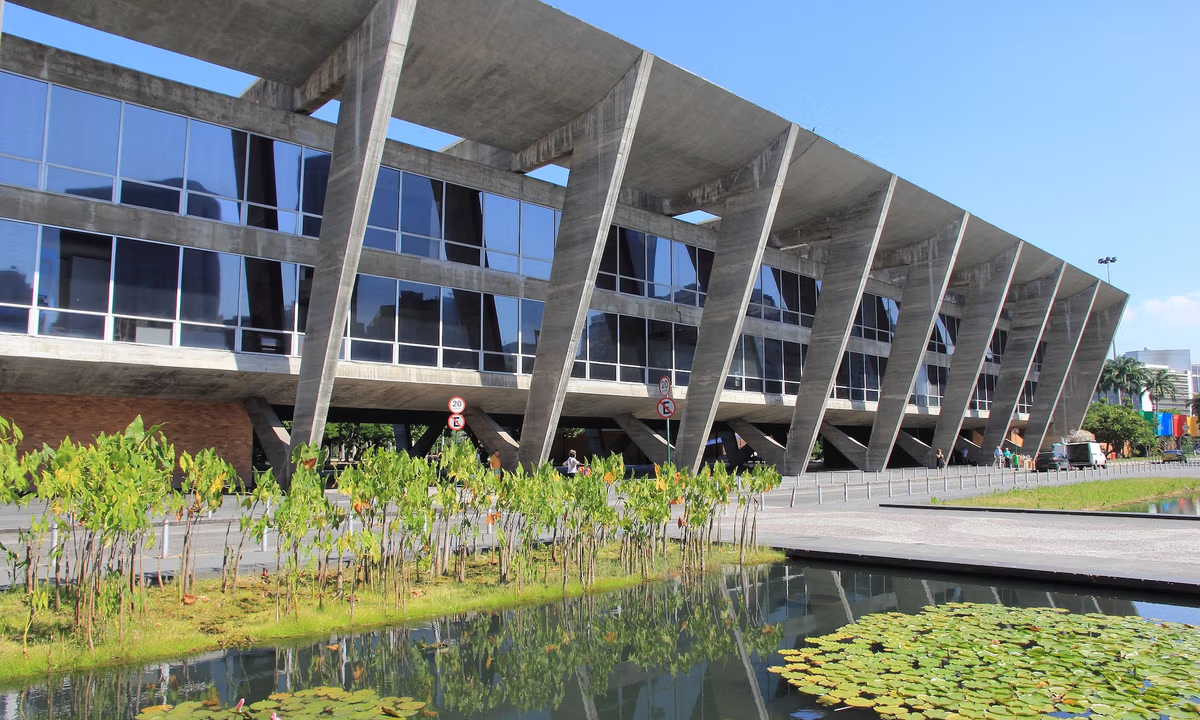
The former director of the Museu de Arte Moderna do Rio de Janeiro (Mam Rio) has been ordered to pay 100,000 reais (around $20,000) for breach of contract. Fábio Szwarcwald, who served as the museum’s director from 2020 to 2022, resigned shortly after publicly raising concerns over the safety of the building and collection, including stating that the museum had lacked fire insurance from 2006 until 2022. The museum argues that the statements, even if true, undermined its credibility with donors, artists and the art market.
During his tenure, Szwarcwald pushed for the museum to make urgent improvements in safety and infrastructure, including obtaining fire insurance coverage. In his first year as director, the museum’s operating costs rose from 14m reais ($2.8m) to 22m reais ($4.3m), causing tension between Szwarcwald and the museum’s board, which appointed a separate administrative director to control the museum’s finances.
Szwarcwald argued that the upgrades were necessary and that fundraising had also increased to around 20m reais ($3.9m) during that period, which justified higher spending for needed investments like risk management. He stated that funds were used for the modernisation of fire and electrical systems and for the installation of around 80 security cameras, as the museum previously had only 16 cameras across its campus. In an interview after his resignation, Szwarcwald said the board’s failure to move forward with an insurance plan was “the last straw”, and that he had spent a long time negotiating terms with insurers but his proposals were not approved.
The Mam Rio announced Szwarcwald’s request for resignation in a statement in September 2021, explaining that it had removed him from the executive board and had invited him to take up the role of director of institutional relations, a position “that seemed to the directors more consistent with his professional profile”. Paulo Albert Weyland Vieira was announced as the interim executive director before Szwarcwald officially left in February 2022; he has since transitioned into the full director role.
Before joining the Mam Rio, Szwarcwald worked in finance and was known as a prominent art collector. Because of his background in cultural philanthropy and fundraising, Szwarcwald was appointed director of the Escola de Artes Visuais do Parque Lage in 2017. During his tenure, the cultural centre gained widespread attention for disputes over Queermuseu, a group exhibition exploring queer themes that was cancelled and became a flashpoint in debates over censorship in Brazil.
According to the Rio de Janeiro justice court, even if the information disclosed by Szwarcwald about the Mam Rio were true, he violated a contractual confidentiality clause by publicly exposing internal issues and caused “significant reputational damage” through his statements. The same ruling established that Szwarcwald’s contract with the museum remained in effect until January 2022, even after his departure as director was announced, and ordered the museum to pay him the compensation that had been agreed to in his original contract.
Szwarcwald plans to appeal the fine, according to Brazilian media, arguing that the statements regarding the period during which the museum lacked fire insurance coverage do not violate the confidentiality clause. He adds that this fact, which was acknowledged by the Mam Rio, does not constitute a trade or industrial secret concerning the protection of the museum’s collection.
Szwarcwald did not respond to requests for comment. The Mam Rio also did not respond to requests for comment, and has previously stated it does not comment on ongoing legal matters.
The museum currently holds a collection spanning around 16,000 works, one of the largest in Brazil, including pieces by Constantin Brâncuși, Alberto Giacometti, Hélio Oiticica, Tarsila do Amaral and others. It previously caught fire in 1978; the museum’s proto-Brutalist concrete structure, designed by the Brazilian architect Affonso Eduardo Reidy, survived mostly unscathed, but its entire library and around 600 works, or nearly half of the collection at the time, were destroyed.
