


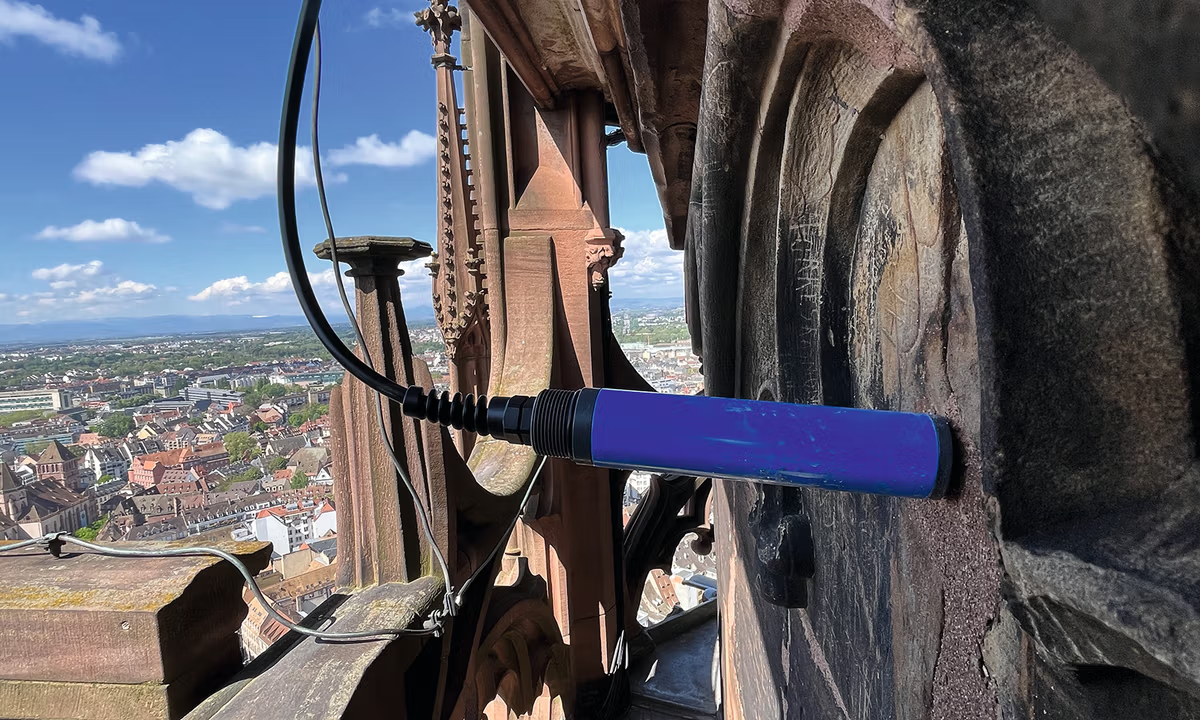
French conservation experts across multiple public and private institutions are developing an artificial intelligence model to predict the impact of climate change on cultural heritage, a tool that could prove invaluable to restorers and archaeologists.
Ann Bourgès, a senior conservation scientist at the French Ministry of Culture’s Centre for Research and Restoration of France’s Museums, says the idea arose in response to discussions within the European Commission four years ago.
“The consensus was that we need to be able to quantify the impact climate change is having,” she says. “And in order to quantify it, we need to be able to measure it. Until now, though, it’s been quite difficult to ascertain, from site to site, heritage object to heritage object, to precisely what extent the climate is causing it to deteriorate and how that might evolve over the next 50 or 100 years.”
In 2022, Bourgès and two other researchers (whose expertise covers the fields of conservation, geoscience, heritage, engineering and computer science) initiated two doctoral projects and recruited Adèle Cormier and David Roqui, who are currently in the final year of their PhDs.
The goal of the projects was to study three heritage sites in France and monitor the weather conditions they experience, using the findings to teach an AI model how to process and then correlate the data and come up with predictions of what will happen next to the sites.
Open-source methodology
The heritage sites have been chosen for the variety of materials, heritage diversity and climates they offer. Bourgès highlights that the sites are in no way representative of the whole of France. The point of the projects was to put in place a methodology that will then be made open-source and accessible to everyone. “It’s a kind of nucleus from which we’ll continue working,” she says.
Cormier has spent two years gathering precise climatic and material deterioration data on two of the sites. The first is the octagonal sandstone base of the spire of Strasbourg’s 13th-century cathedral, a fine example of Rayonnant Gothic architecture, which is subjected to harsh inland winters and brutal summers. The second is the Bibracte archaeological site near Autun in Burgundy—a fortified Gallic settlement first excavated in the late 19th century. A third coastal site will eventually be included in the wider project.
Roqui, meanwhile, has been working on using multimodal learning to teach an AI model to process not just measurements and numbers, but also to analyse photographs, audio and other kinds of information. Bourgès says this has meant teaching the AI how to recognise a fissure, for instance, “by telling it, ‘That’s a fissure—find other fissures in this image.’” The researcher can then ask it to identify from another image how much the fissure has grown within a specified period.
Two big challenges immediately became clear. The first was one of scale. Climate change is a global phenomenon, whereas a heritage site has its own microclimate, both outdoors and within. Bourgès’s team therefore needed to devise a tool that could take in big weather patterns and home in on impacts at a detailed level.
Second, the tool would need to be able to correlate different types of data, gathered in different ways. Temperature, humidity and carbon dioxide can be continuously monitored with specialist devices (such as rain gauges, anemometers, hygrometers) and coupled with weather satellite data. However, there are many ways to measure these factors and little standardisation in how commercial devices do so, which was a problem the team had not anticipated encountering.
Working out how much a degradation—a crack, say, or a crumble—has worsened, however, is a far more subjective exercise. Descriptions depend on perception and also language, so the team had to cleave to a precise taxonomy. Details in photographs, meanwhile, can change substantially, depending on the light and angle when the shot is taken. The project has therefore involved using a lot of thermal infrared imaging, which clearly exposes water ingress and salt accumulation.
Digital hub
The tool might yet be in its infancy, but everything the team has learned over the past three years will be made fully available on the national Espadon website, a project set up by the Ministry of Culture to digitise the nation’s heritage with augmented reality and give researchers access to all known data on any given building.
Ultimately, Bourgès says, “we want users to be able to use it to visualise how their specific site will be altered over time in relation to the local climate”. In this sense, the project is about much more than conservation; it is also political, she adds.
“It is a means to collate and make visible what the climate crisis is doing,” she explains. “That is, if you can show an image of how your wall, within 100 years, is going to lose half its render or its paint, people will get it. It’s a means for projecting ahead in order to better preserve, but it’s also a great teaching tool.”
Bourgès, who serves as secretary general of the French chapter of the International Council on Monuments and Sites, anticipates a wide appetite for this kind of tool. “Whether it’s conservators or archaeologists, people really want to know what to do. But to know what to do, you need to know what’s going to happen.”
The French government has put in place a national plan for monitoring the impact of climate change on the country’s treasures. So far, that has not involved the granular data-gathering that Cormier’s study entails. But the point of using AI is that it gets better with every new user.
