


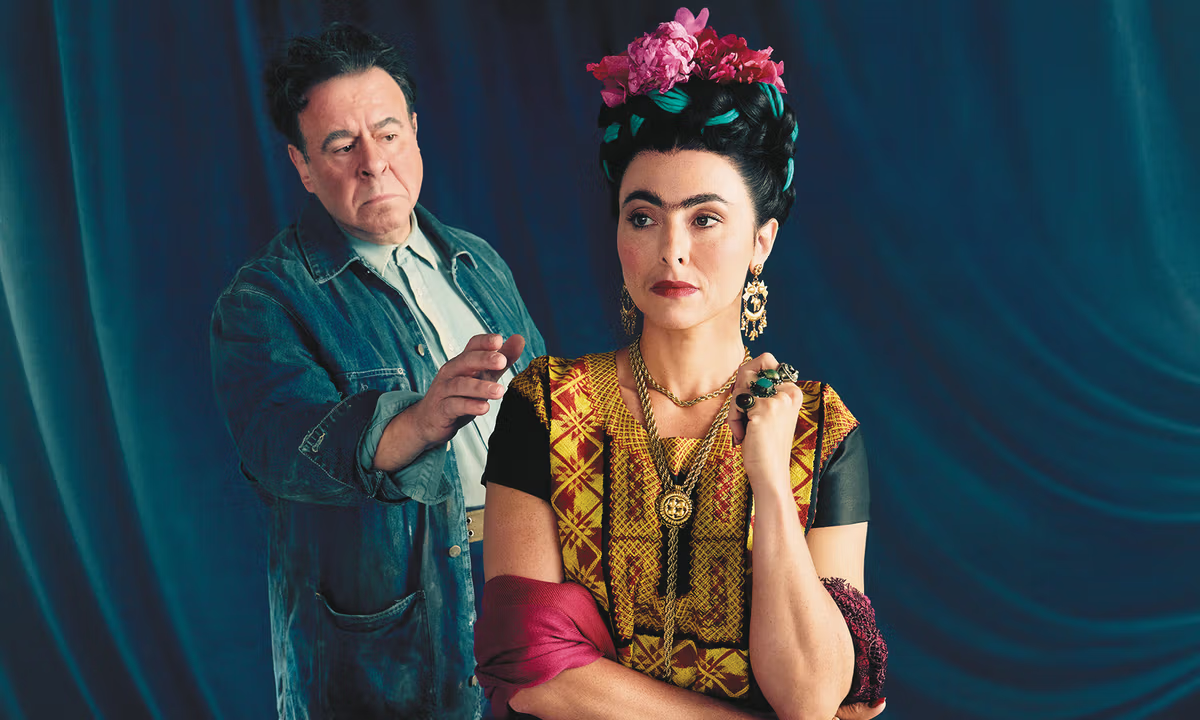
Fridamania is in full swing in New York this spring. The art-book publisher Rizzoli has just released a volume about Frida Kahlo’s new museum in Mexico City, located in her childhood home, written by the artist’s grandniece and great-grandnieces. And the Museum of Modern Art (MoMA) has a small but dramatic exhibition of works by both Kahlo and her longtime partner, Diego Rivera.
But the biggest event takes place at the Metropolitan Opera House. There, a much-anticipated new production of El Último Sueño de Frida y Diego—with music by Gabriela Lena Frank and libretto by Nilo Cruz, both Pulitzer Prize winners—opens on 14 May. In a unique twist, the opera’s set and costume designer, Jon Bausor, also co-curated the MoMA exhibition (in concert with the curator Beverly Adams, who specialises in Latin American art).
El Último Sueño was already more than a decade in the making by the time it premiered in San Diego in 2022. “My mom introduced Frida Kahlo’s artwork to me when I was five years old, but the idea of writing an opera about her didn’t originate with me,” Frank tells The Art Newspaper. For that, she credits the late conductor Joel Revzen, the artistic director of Arizona Opera in the early 2000s, who “caught wind of some of my art songs and felt I had an opera in me”. After the two met, they started looking for a librettist and found Cruz, who had recently won a Pulitzer. “He stood out,” Frank says. “He seemed like a lovely human being, and one thing he said was he didn’t want to do a biopic. He wanted to illuminate new corners of Frida’s life.”
Jon Bausor’s design features a giant red tree sprouting from a blue bed frame Photo: Jonathan Dorado; © The Museum of Modern Art, New York
Emotion over history
These new corners foreground grand emotion over historical accuracy and linear time—as is customary in opera. El Último Sueño tells the story of Kahlo’s spirit (sung in the Met’s production by the mezzo-soprano Isabel Leonard) rising up from the underworld on the Day of the Dead to reunite and reminisce with Rivera (baritone Carlos Álvarez), before helping him to cross over. In composing a score for this imagined realm, Frank says she wanted to incorporate Mexican music but in a very subtle way.
She used the marimba and hints of Mariachi but says her focus was always on “the dream world of the living, the dead and art. I wanted it to sound ancient and old, beauty coalescing with dissonance,” a nod to Kahlo’s life of both physical and emotional pain. Of course, the new corners of the Met Opera’s production are also highly visual. “The costumes and sets go deep into Frida’s paintings,” Frank says. “Into her broken body, into her veins. It’s visually very full of mystery.”
Bausor, the creator of this visual mystery, says he started working on the opera’s set and costume design a little more than two years ago. Commissioned by Peter Gelb, the Met Opera’s general manager, Bausor incorporated references from both Kahlo’s and Rivera’s art without copying them outright. The stage floor is cracked earth through which Kahlo rises from the underworld, while a large scaffolding alludes to Rivera’s famed work as a muralist. “Frida is an icon; to me, she is one of the first performance artists,” Bausor says. He describes his set as having a “dreamlike sadness” and a “ritualistic sense of memory and life”.
Like Frank’s music, Bausor’s visuals fuse seemingly contradictory themes—life and death, competition and collaboration, claustrophobia and expansiveness. “The opera is about a toxic relationship,” he says. “There’s a duality and paradox of pain and love, and everything that goes with it.”
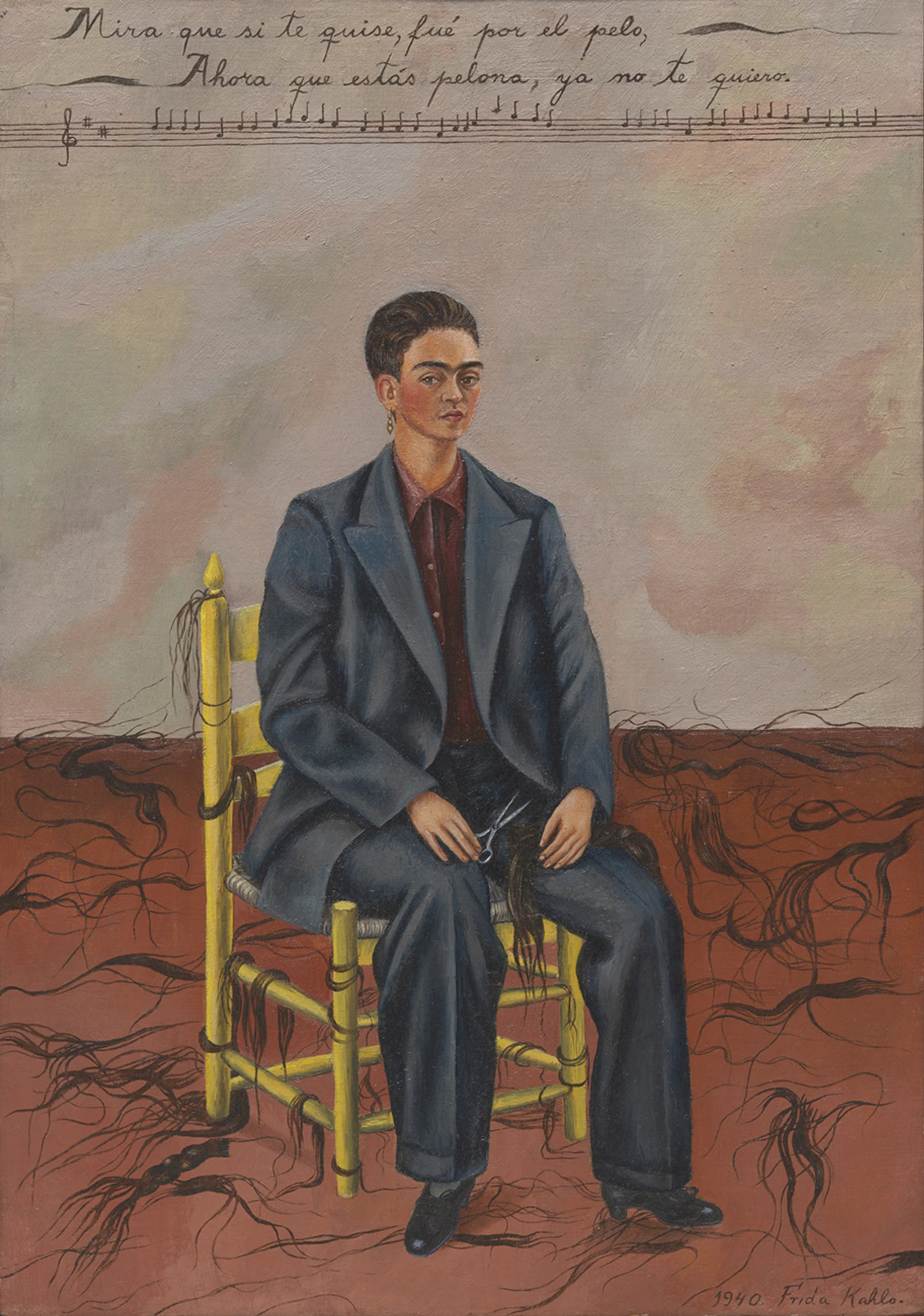
MoMA’s exhibition includes Frida Kahlo’s Self-Portrait with Cropped Hair (1940) Photo: Peter Butler; © 2025 Banco de México Diego Rivera Frida Kahlo Museums Trust, Mexico, D.F./Artists Rights Society (ARS), New York
At the concurrent MoMA exhibition, Frida and Diego: The Last Dream (until 12 September), Bausor has used some of the same visual language of paradox to highlight Kahlo and Rivera works from the museum’s collection. Some of these are hung on scaffolding in the middle of the gallery, while a giant red tree sprouts from a blue bedframe and grows into a large mirror on the ceiling.
On the gallery walls, paintings are surrounded by thick blue stage curtains. “The paintings are the divas,” Bausor says. “They’re larger-than-life characters with big ideas that have stood the test of time.” This is Bausor’s first foray into museum curation, and he has enjoyed every minute. “I would love to do it again,” he says. “It has given me a lot more opportunity to have a dialogue that can evolve. There’s a theatrical immersion people can have in the space that presents art like we present theatre.”
Collaborative approach
Adams, Bausor’s co-curator, is very pleased with the outcome. “MoMA has done collaborations with the Met Opera before—William Kentridge, for example—but we have usually stayed in our lanes, and there hasn’t been such a mixture of things,” she says. “We learned that they were going to do a new production of the opera about a year-and-a-half ago, and we invited the director, set designer, librettist and composer to come talk to us.”
Given the museum’s long history with both Kahlo and Rivera, it made perfect sense. This was Adams’s first time co-curating with a set designer. “He did an amazing job. It’s a space only a set designer or an artist could have created,” she says. “I was here as the facilitator. My job was to make sure the art that was there made sense and carried its weight.”
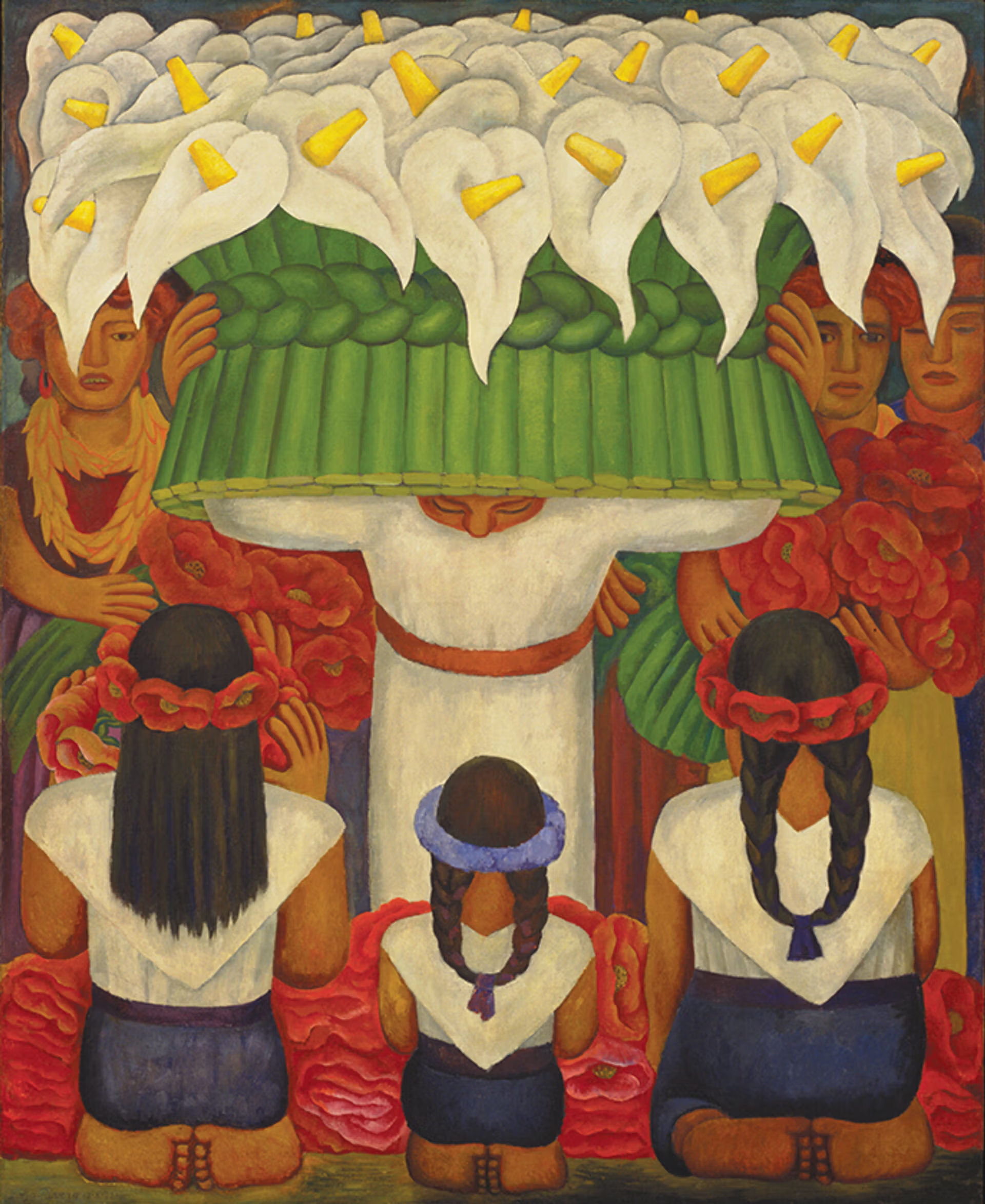
Diego Rivera’s Flower Festival: Feast of Santa Anita (1931) features in the MoMA show Photo: Erik Landsberg; © 2025 Banco de México Diego Rivera Frida Kahlo Museums Trust, Mexico, D.F./Artists Rights Society (ARS), New York.
Among the works chosen for the MoMA exhibition are Kahlo’s self-portraits, Rivera’s paintings of Mexican workers and traditions, and photographs of the two artists. Perhaps the most surprising pieces are watercolours of costumes and sets Rivera created for the 1932 ballet H.P. (Horsepower) by the Mexican composer Carlos Chávez. These include outfits that seem impossible to move in—dancers dressed as a giant bunch of bananas, a cigar or a gold bar.
“The ballet was a massive flop,” Bausor says, “but I hadn’t seen these works before or even heard of them. They are weirdly literal for Rivera, but I love them because they’re fun. It was a real discovery for me.” Bausor says he used the Rivera designs as inspiration for some of his own costumes for El Último Sueño.
Adams points to Rivera’s work in costume and set design—as unsuccessful as it may have been—as part of the history of collaborations between the visual and performing arts, popular during the Modernist era and continuing to this day. At both MoMA and the Met Opera, she notes that there are “works of art inside other works of art”, creating a completely new experience. “The public seems entranced by it all,” she says of the response to the MoMA show. “People are lingering, and they seem in awe. It’s a visual extravaganza.”
• El Último Sueño de Frida y Diego, Metropolitan Opera, New York, until 5 June
• Frida and Diego: The Last Dream, Museum of Modern Art, New York, until 12 September
