


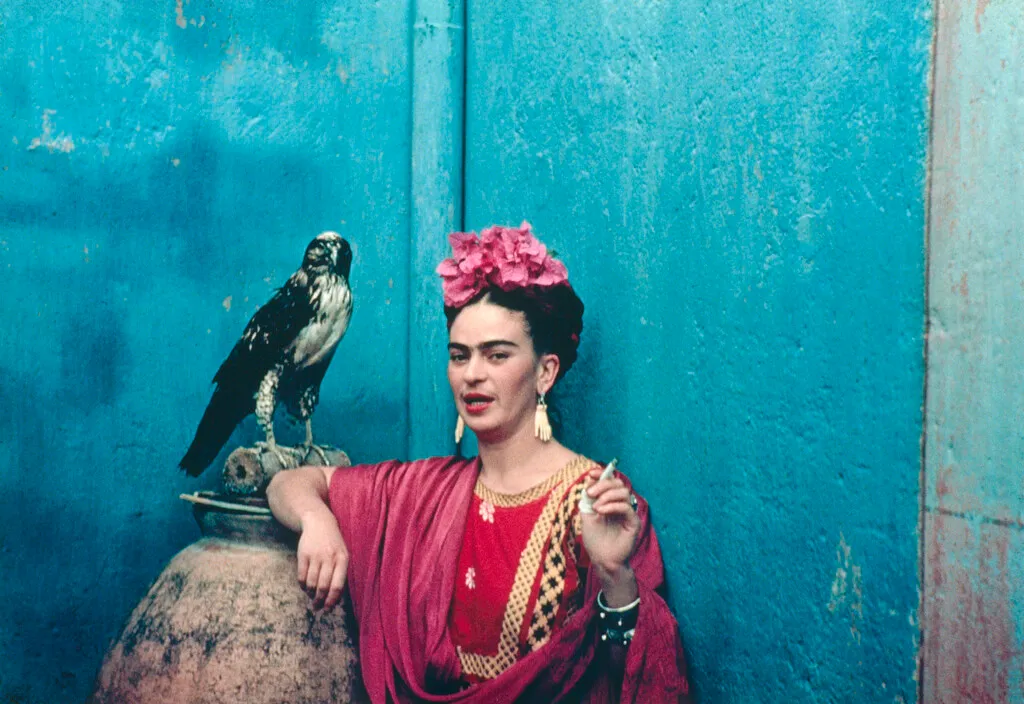
Frida Kahlo’s art is now firmly established in the art historical canon, hanging on the walls of some of the world’s most illustrious museums. But it’s also inspired a sundry of wares the world over—from notebooks and coffee mugs to earrings and dolls—that bear her image, both licensed and not, and this appears to have rankled some her descendants.
In an interview with the Times of London, published this week, Cristina Kahlo, another great-niece of the artist, said she has mixed feelings about just how exposed Kahlo has been in the past few decades, since the publication of Hayden Herrera’s 1983 biography on the artist.
“It’s been a double-edged sword,” Cristina Kahlo told the paper. “On the one hand, commercialisation means Frida Kahlo’s image is better known. But it’s better known in the wrong light sometimes because if you don’t know Frida Kahlo’s story then you are buying a figure you really don’t know anything about. It’s an image, nothing more. I think this in some way distorts what she really was: a great artist.”
Just last month, for example, the Frida Kahlo Corporation (FKC), founded in 2004 by Kahlo’s niece Isolda Pinedo Kahlo and great-niece María Cristina Romeo Pinedo, announced it had signed off on the licensing for the Frida Kahlo Wynwood Residences in Miami, a 14-story apartment building that carries a large-scale mural of her face on its side. The FKC’s website also includes a link to an Amazon store of Kahlo trinkets.
The FKC was founded in partnership with Venezuelan businessman Carlos Dorado, who owns 51 percent of the company, which has registered dozens of trademarks related to Kahlo.
Kahlo’s younger sister Cristina was the only one of the artist’s siblings to have children: Isolda, who founded the KFC, and Antonio, who is the younger Cristina’s father. According to the Times report, the two siblings had a falling out after the death of their mother, and the two sides of the family have no contact with each other.
The Times interview coincides with a major Kahlo exhibition and a period when her market is rising. Last November, Kahlo’s 1940 painting El sueño (La cama) sold for $54.7 million at Sotheby’s New York, setting a record for the artist. The painting also sent new benchmarks for a work by a Latin American artist and a work by a woman artist.
The Museum of Fine Arts, Houston, currently has on view “Frida: The Making of an Icon,” which will travel to London’s Tate Modern in June. The MFA Houston show features some 30 works by Kahlo alongside 120 more pieces by five generations of artists who have been influenced by her. The exhibition specifically looks at “the artist’s transformation from a relatively unknown local painter to a universal icon and global brand,” with a gallery dedicated to her status as a pop-culture figure, according to the an exhibition page.
The exhibition features the work of numerous Latinx and Chicanx artists, many of whom have also been instrumental in resurrecting Kahlo’s legacy. They include Carmen Lomas Garza, Rupert Garcia, Delilah Montoya, Yreina D. Cervantez, and Amalia Mesa-Bains.
“Frida: The Making of an Icon attempts to separate Frida Kahlo the artist from Frida Kahlo the phenomenon,” Mari Carmen Ramírez, the exhibition’s curator, said in a statement on the show. “[H]er image became subsumed within the desires, fears, and hopes of artists and activists who transformed it into innovative proposals that transcend their source of inspiration while commenting on pressing issues.”
The Museum of Modern Art in New York will also open a Kahlo-related exhibition, titled “Frida and Diego: The Last Dream,” next month. Curated by MoMA’s Beverly Adams, the exhibition will feature several works by both artists, including ones from the museum’s permanent collection, and the exhibition design will be done by Jon Bausor, the set designer for the Metropolitan Opera’s production, El Último Sueño de Frida y Diego, which opens in May.
Herrera, Kahlo’s biographer, told the Times, with a laugh, “It’s really madness. I’m still very astonished at her fame.”
