

Close Menu
  • News
  • Stocks
  • Bonds
  • Commodities
  • Collectables
    • Art
    • Classic Cars
    • Whiskey
    • Wine
  • Trading
  • Alternative Investment
  • Markets
  • More
    • Economy
    • Money
    • Business
    • Personal Finance
    • Investing
    • Financial Planning
    • ETFs
    • Equities
    • Funds

Subscribe to Updates

Get the latest markets and assets news and updates directly to your inbox.

Trending Now

Fashion Designer Stacey Bendet on Turning Her Manhattan Home into a Living Art Installation

July 12, 2026

Artists and Former Staffers Accuse Cape Town Gallery SMAC of Nonpayment and Withholding Artworks

July 11, 2026

ICOM Adopts New Museum Code of Ethics Taking Aim at AI, Colonialism, and Climate Change

July 11, 2026
Facebook X (Twitter) Instagram
The Asset ObserverThe Asset Observer
Newsletter
LIVE MARKET DATA
  • News
  • Stocks
  • Bonds
  • Commodities
  • Collectables
    • Art
    • Classic Cars
    • Whiskey
    • Wine
  • Trading
  • Alternative Investment
  • Markets
  • More
    • Economy
    • Money
    • Business
    • Personal Finance
    • Investing
    • Financial Planning
    • ETFs
    • Equities
    • Funds
The Asset ObserverThe Asset Observer
Home»Art Market
Art Market

Remains of 19th-century schooner resurface on New Jersey coast – The Art Newspaper

News RoomBy News RoomFebruary 20, 2026
Share
Facebook Twitter LinkedIn Pinterest Email

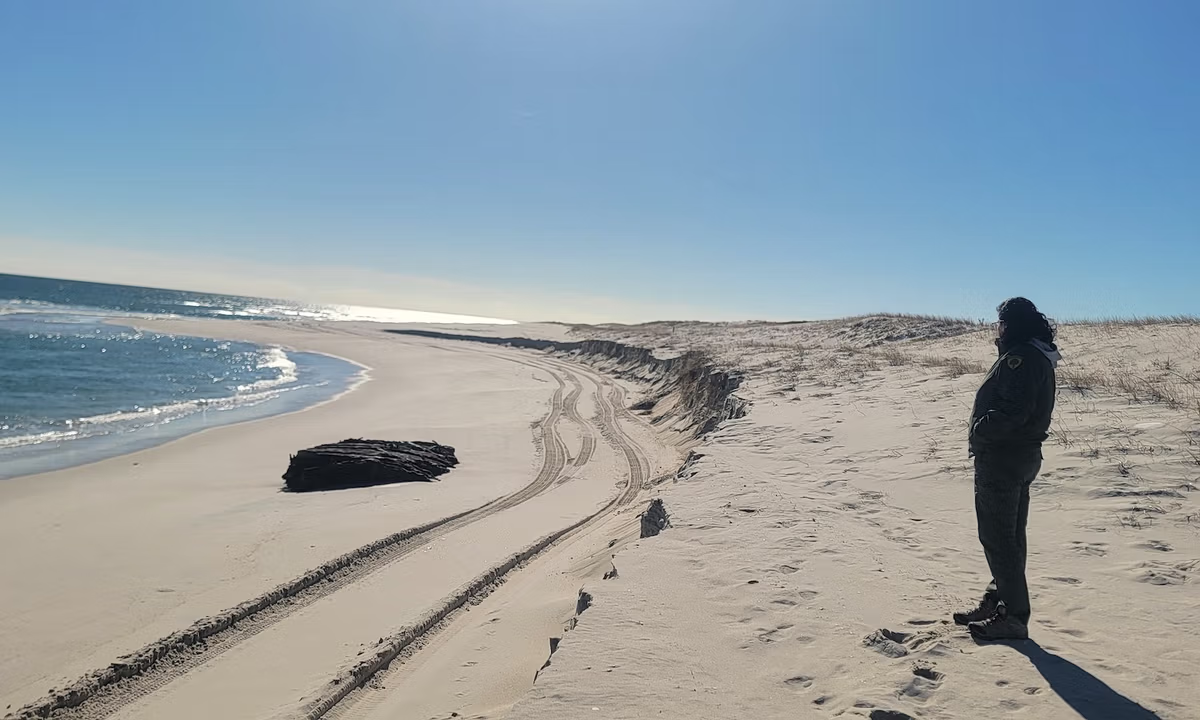
As unusual as it may sound, there are times when shipwrecks find their way back to land—a result of erosion and storm activity. This has recently been the case for remains of the 19th-century schooner Lawrence N. McKenzie, which were partially exposed last month on the shores of New Jersey’s Island Beach State Park. The 98ft ship, built in Massachusetts in 1883, had been en route from Puerto Rico to New York City when it sank on 21 March 1890. All eight of its crew members survived, but the vessel was destroyed along with its cargo of oranges.

The area where the McKenzie sank is known as New Jersey’s “graveyard of the Atlantic”, the result of unpredictable weather and its sandbars and shoals. As a result of the particularly treacherous landscape, the first US Life-Saving Service stations were established in the area in the late 1840s and early 1850s.

“It was each captain’s knowledge of the area that helped sail safely into harbour, but without weather reports, storms caught ships unaware,” Steve Nagiewicz, a local maritime archaeologist, tells The Art Newspaper. “Archaeologists estimate that there are 4 million shipwrecks worldwide, and at least 3,000 to 5,000 of those are off the Jersey shore.”

The McKenzie’s route reveals active trade between Puerto Rico, then under Spanish rule, and the US. A 2021 study revealed that, at the time, the US was Puerto Rico’s most important export market for goods like oranges, though commerce centred on sugar, tobacco and coffee.

Courtesy New Jersey Department of Environmental Protection

The schooner’s wooden and metal remains were identified with help from the New Jersey Maritime Museum’s Shipwreck Database, an important resource containing 4,800 records documenting vessels lost between 1701 and the present, most dating from the 19th century or earlier. Identification of the exact ship, however, is not always definitive. “Construction of ships like this was common,” Nagiewicz says of the recently discovered remains. “Sometimes we can identify the type of wood or there may be a unique element, but we mostly rely on historical records.”

Other wrecks have also emerged in the area, as Island Beach State Park is one of the state’s last significant remnants of a barrier-island ecosystem. “New Jersey’s coastline is ever-changing, shaped by wave action and storms that can uncover artefacts,” says a spokesperson for the New Jersey Department of Environmental Protection (NJDEP). “Several historic shipwrecks have been exposed at Island Beach Park over the years, and the McKenzie has surfaced before—but not in more than a decade.”

But after they are uncovered, a shipwreck’s remains decay rapidly. “When wooden timbers resurface, they soon deteriorate once exposed to wind and sand,” says Flor Trejo Rivera, a maritime historian at Mexico’s National Institute for Anthropology and History. And their presence is often ephemeral. “At times, they briefly reappear before another climatological event carries them back to the sea,” she adds.

For now, local authorities warn visitors against disturbing the McKenzie’s remains, which are protected by the New Jersey State Parks Code and an anti-looting law. (“People like to take souvenirs,” Nagiewicz says.) The NJDEP spokesperson notes that the department has “no intention of disturbing the remains” of the shipwreck, and Trejo agrees with that sentiment. “As this is a monitored area, this is a good decision,” she says, noting that maintaining an extensive register of what resurfaces is key.

Share. Facebook Twitter Pinterest LinkedIn Tumblr Email

Keep Reading

Fashion Designer Stacey Bendet on Turning Her Manhattan Home into a Living Art Installation

Artists and Former Staffers Accuse Cape Town Gallery SMAC of Nonpayment and Withholding Artworks

ICOM Adopts New Museum Code of Ethics Taking Aim at AI, Colonialism, and Climate Change

US Returns Two Looted Bronze Buddha Statues, Sold by Disgraced Antiquities Dealer Douglas Latchford, to Indonesia

Heritage Auctions’ Record $1.41 B. First Half Suggests Collecting Is Getting Broader

Exhibition in Bogotá shows off more than 1,000 repatriated pre-Columbian artefacts – The Art Newspaper

Chua Mia Tee, Leading Singaporean Social Realist Artist, Has Died at 94

British Archeologists Find 5,800-Year-Old Neolithic Monument in Suffolk

Could Mexico’s treasured Kahlos leave the country forever? – The Art Newspaper

Recent Posts
  • Fashion Designer Stacey Bendet on Turning Her Manhattan Home into a Living Art Installation
  • Artists and Former Staffers Accuse Cape Town Gallery SMAC of Nonpayment and Withholding Artworks
  • ICOM Adopts New Museum Code of Ethics Taking Aim at AI, Colonialism, and Climate Change
  • US Returns Two Looted Bronze Buddha Statues, Sold by Disgraced Antiquities Dealer Douglas Latchford, to Indonesia
  • Heritage Auctions’ Record $1.41 B. First Half Suggests Collecting Is Getting Broader

Subscribe to Newsletter

Get the latest markets and assets news and updates directly to your inbox.

Editors Picks

Artists and Former Staffers Accuse Cape Town Gallery SMAC of Nonpayment and Withholding Artworks

July 11, 2026

ICOM Adopts New Museum Code of Ethics Taking Aim at AI, Colonialism, and Climate Change

July 11, 2026

US Returns Two Looted Bronze Buddha Statues, Sold by Disgraced Antiquities Dealer Douglas Latchford, to Indonesia

July 11, 2026

Heritage Auctions’ Record $1.41 B. First Half Suggests Collecting Is Getting Broader

July 10, 2026

Exhibition in Bogotá shows off more than 1,000 repatriated pre-Columbian artefacts – The Art Newspaper

July 10, 2026
Facebook X (Twitter) Instagram
© 2026 The Asset Observer. All Rights Reserved.
  • Privacy Policy
  • Terms
  • Press Release
  • Advertise
  • Contact

Type above and press Enter to search. Press Esc to cancel.