


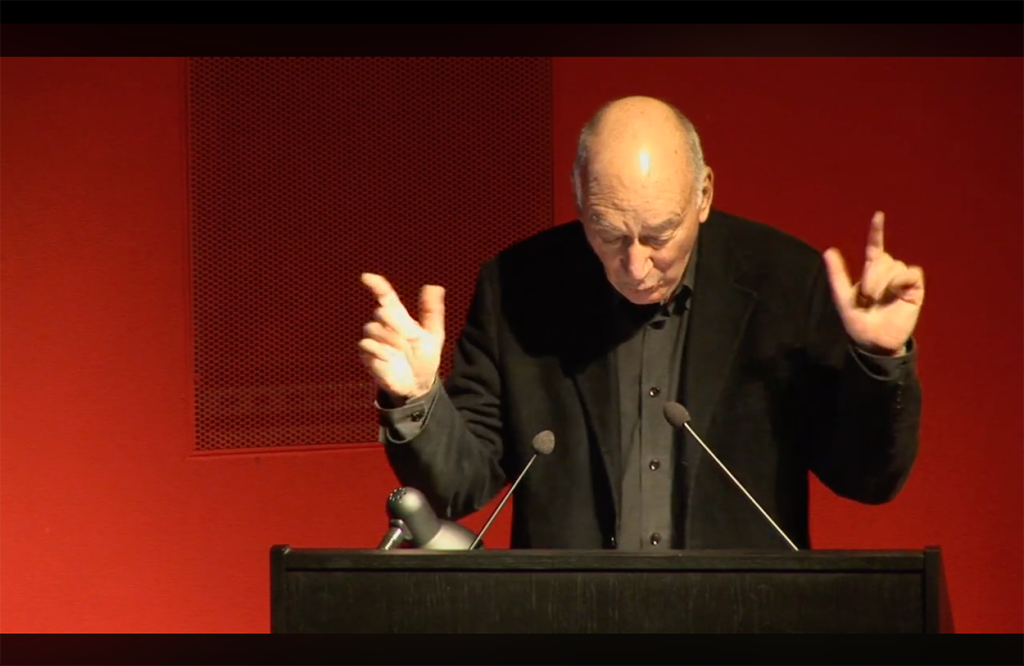
Finally! The real Michael Fried has stood up. A new collection of his life’s work reveals him to be a poet with a memory bestowed from the gods—one who weathered Peter Schjeldahl’s trumped-up charges of being a formalist, conservative fuddy-dud, one who emerges in our AI slop epoch as one of the great art seers who makes a frightening lot of sense, now more than ever. The critic who found a helpful narrative to understand the history, and future, of our images, without a drop of cynicism. This lefty aesthete salutes you!
The 87-year-old American critic is more than a mere Judd-Serra-Andre hater who wouldn’t be caught dead at Oh, Mary! on Broadway. The proof is Bloomsbury’s new box set of his collected writings—critical essays, yes, but especially his beautifully mundane, revelatory prose-poems, and a book-length interview with himself (a sort of intellectual autobiography). Collected Writings: Essays, Poems, Interviews (2026) is the big sum-up, a crown jewel of Fried’s life work, extending the rigor of his still-polemical “Art and Objecthood” (1967), the Artforum essay that confirmed his notoriety. That essay (deservedly) took the piss out of the then-nascent, post-Warhol scene of po-faced “Minimalists”; Fried chided the group for their literalness and theatricality.
Theater kids: don’t sharpen your Our Town pitchforks yet. Fried’s not knocking all theater. In truth, he’s more of a dirty old Brechtian with no use for art-as-mindless-entertainment. He’s against narcissistic theatricality concerned only with the “I,” with whether ironic gags and verbal aperçus will get an arch laugh. Fried has been falsely pegged as a Hilton Kramer lame-o defending some staid, starch-filled idea of art history: Manet good, Judd bad, old pretty art good, new weird art bad. No, goddamnit! Slow down, read closely. For Fried is, as his poems prove, a writer attuned to the shape of thought and the sound of a word. He is the last of a dying breed (but they’ll come back): the gentle critic with the chapeau—amiable, digressive, and slow in the wind-up, like Henry James in lit-crit mode. Fried is also for a lot of things. He is a stealth optimist.
What Fried really wants out of his attacks on theatricality, as becomes clear through a slow reading of both the Collected Writings, is for us to reject the kneejerk modern mandate to accept whatever we, the audience, are trained to want by markets, trends, and consumerist-bourgeois society. Turning to memories of Edward Said, Franz Kafka’s Diaries, and Shakespeare’s Coriolanus, he poetically expresses his moral outrage at the Israeli genocide of the Palestinians: “no thoughts of halcyon younger days can hold our long against present horrors.” And in a moving obituary to the late sculptor Anthony Caro, his lifelong friend, Fried speaks passionately: “I felt that fireworks should have been set off [for Caro’s Gagosian show in 2013], prisoners reprieved, travel made gratis, a bank holiday declared—something spectacularly out of the ordinary ought to have been arranged to mark so extraordinary an achievement.” Fried articulates a preference for artists who make absorbing works, works in conversation with good (i.e., mystery-stoking) art that came before it. Fried’s artists (Caro, as well as Kenneth Noland, Jeff Wall, Douglas Gordon, and Philippe Parreno) are hectic beavers, go-for-brokers who don’t care whether they will receive a positive review in the Times or make a big splashy wow at Whitney-Venice-MoMA. They are too concerned with their own intense endeavors to heed the latest vogue.
This is what I take Fried to mean when he says “absorption”: you, the audience, are drawn more deeply into beholding something that pulls you into its ornery, meditative orbit instead of meeting you where you already are. Art remains its own harmonizing, mystical thing, separate from you. Absorptive art beckons the viewer—who chases after that which ignores it, a tale as old as time—whereas the Minimalism Fried attacked was very big, very look-at-me, very exhibitionist. Its absorption was painfully literal: Step right up, folks, finish the artwork by moving through it yourself! Maybe finish art history while you’re at it! It all culminates in one person: YOU, the 2006 Time Person of the Year! Art doesn’t exist until YOU—the big American “I”—walk up and start making it exist.
Lies! Fried fights a good fight against such solipsistic falsities. He is like an activist who has, for sixty years now, chained himself to a tree, the mighty oak of Modernism, refusing to let Literalism’s bulldozers pass. The tree has been around since 1759. It is old, sure, but lovely, sturdy, centering; it still provides shade. And the Diderot-Baudelaire-Fried tree abides even as the forest burns mutely round it, match lit by Elon Musk and company. We need Fried as never before to deal with a world deluged by the hellish convenience of AI, whose so-called art takes even literalism too literally.
Édouard Manet, Olympia, 1863
Collection of the Musée d'Orsay, Paris.
Fried combs through the tangled past to critique the present with “conviction,” a pet word of his. A critic with conviction takes bets on what in her era will last, guided by Baudelaire’s evergreen missive, as Fried notes in an essay on the poet-critic, that criticism must be “partial, passionate, and political.” “Never before” is a phrase that recurs throughout his criticism. Never before Manet’s Olympia or Luncheon on the Grass (both 1863) had anyone so strikingly frozen the viewer with a confrontational “facingness”—the nude woman now stares back at you, the male patron, but you will never know what is in her gaze. Never before Anthony Caro (and, as we learn, never before Caro’s conversation with Fried specifically) had anyone rendered smallness as an abstract idea in itself; rather it was figured as a scaled-down bigness.
Fried is constantly surprised. This “never before”-ness has political implications: it suggests that art history is unfixed and malleable, and that it contains problems awaiting someone with Fried’s eagle eye to spot them, to survey the scene and intervene with conviction in the mess of histories. How anyone ever saw Fried as a holier-than-thou aristocratic formalist is beyond me. Maybe people didn’t read him closely. Or maybe he needed a social media manager.
The Buñuelian skeptic in me also shirks at Fried’s approving references to Diderot’s petite église invisible, the small hidden church whose members—painters, critics, curators, patrons—are the vision-gifted serious pursuers of art history. This still seems to presume one mega-history, one scripture. But Fried’s thought is far too varied and weird—closer to Manny Farber’s than Clement Greenberg’s—to permit dogmatic religiosity for long. (Fried read Greenberg closely, but he is hardly a worshipper of that self-appointed judge with his narrow docket of good and bad objects.) Just as Caro’s small table sculptures—which suggest the ground but never touch it, their sole sculptural curves dipping just below—retain their politically rebellious smallness, so, too, does Fried’s criticism suggest the bottom of religion without finding it.
Fried practices art history and criticism as a poetic, almost magical endeavor. “The medium of the prose poem is thought,” Fried writes in “The Prose Poem,” a veritable manifesto on his own process. The simple magic consists of following a thought meticulously through; finding, as its rope nears an end, another thread; and then following that thread ad infinitum, until one turns back to regard the cluster of rich, powerful, pristine ideas that have emerged. The idea is one of extension, of continuing the thread of modernity, of constantly making new again and again—maintaining continuity against so many distractions, ignoring the jewelry-rattlers who want to be entertained in the fancy theatah.
