


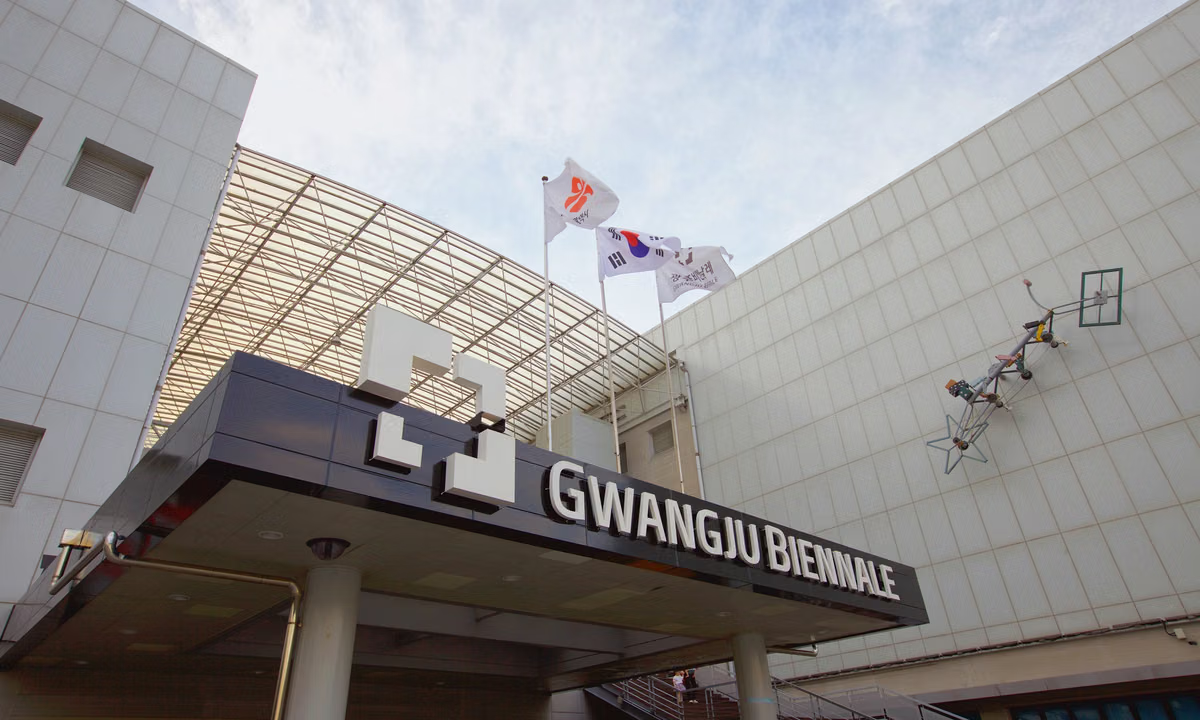
After ten days of conflicting narratives and accusations of censorship, the Gwangju Biennale Foundation (GBF) has agreed that a satellite exhibition launching at the upcoming 16th Gwangju Biennale (5 September-15 November) can exhibit as the Taiwan Pavilion rather than a previous designation that was based on name of the organiser, the National Taiwan Museum of Fine Arts (NTMoFA).
In a statement received by The Art Newspaper, the GBF says it reached an agreement with Taiwan’s ministry of culture yesterday “and officially approved the use of the name ‘Taiwan Pavilion.’”
Taiwan’s ministry of culture then sent an official letter to the National Taiwan Museum of Fine Arts (NTMoFA) confirming the pavilion’s official designation. The letter, issued at the request of the Gwangju Biennale Foundation, serves as official documentation confirming that NTMoFA is participating in the Gwangju Biennale Pavilion project as the institution representing Taiwan and authorising the use of the name Taiwan Pavilion. The foundation subsequently sent the official request to the pavilion’s host, Gwangju’s Asia Culture Center (ACC), authorising the presentation to go ahead.
Recent reports in Korean media had shown a cordon outside the pavilion’s venue at ACC, amid claims by Taiwan’s ministry of culture that the installation process had been paused due to the naming impasse.
A public dispute began in August, when the biennale released a poster listing its satellite pavilions, which named a NTMoFA Pavilion. On 15 August, the pavilion‘s curator and nine participating artists published an Instagram post in which they said that the “exhibition proposal submitted by the National Taiwan Museum of Fine Arts under the name Taiwan Pavilion, and accepted as such by the Gwangju Biennale Foundation, was unilaterally renamed ‘NTMoFA’, without the consent of the participating team, and brutally erased Taiwan from the poster.” The message continued: “This goes beyond the removal of a name. It is a threat to freedom of expression and to the global artistic community.”
The post went viral, garnering support from artists and art workers around the world, and from non-art supporters in both Taiwan and Korea, such as the Girls Bookshop in Gwangju. In a 19 August response, the Gwangju Biennale Foundation asserted that, as an institutional rather than a national pavilion, the exhibition was decided to be titled after the museum in a 12 January 2026 agreement.
Taiwan’s ministry of culture on 19 August issued a public statement asserting that “Taiwan will participate in the Gwangju Biennale as ‘Taiwan Pavilion’” and that the Gwangju Biennale’s “claim is an error…’Taiwan Pavilion’ was clearly labelled both in the proposal and in subsequent communications,” with an agreement signed 2 April. Images were posted on the ministry website of the proposal deck and of an email repeatedly calling the project the Taiwan Pavilion. Taiwan’s culture ministry claims in a timeline that it has been objecting behind the scenes since 10 June.
Taiwan, an autonomous island territorially claimed by mainland China, boasts a lively arts scene and its artists are actively involved in exhibitions around Asia and the world. However, given it is not legally recognised as a country by most of the international order, its formal governmental participation in overseas arts and other events is restrained. In sports, for example, due to mainland pressure it must join as “Chinese Taipei”, a sore spot for many Taiwanese.
The pavilion’s curator Chen Xiang-Wen has publicly alleged that there may have been behind-scenes pressure by larger forces, but no evidence has been presented that mainland China’s or Korean’s national governments have been involved in the matter. South Korea maintains diplomatic relations, albeit frequently frosty, with China, and does not recognise Taiwan. No claims were made that the content of the exhibition had been impacted.
“Gwangju Biennale has not intervened in, or censored, exhibition planning or content,” the Biennale Foundation’s 19 August statement said. “Gwangju Biennale categorises Pavilion participants as either national pavilions or institutional pavilions. Participants seeking to present as a national pavilion are required to submit an official letter of approval issued by the relevant embassy or ministry of culture.” Its updated release does not give a specific reason for its 25 August decision to approve the Taiwan Pavilion name. A spokesperson for the biennale adds that organisers are “currently discussing changing the pavilion’s designation on promotional materials”, but that they have not been provided with the updated design yet.
Mainland China has at the time of publication remained publicly quiet about the controversy.
