


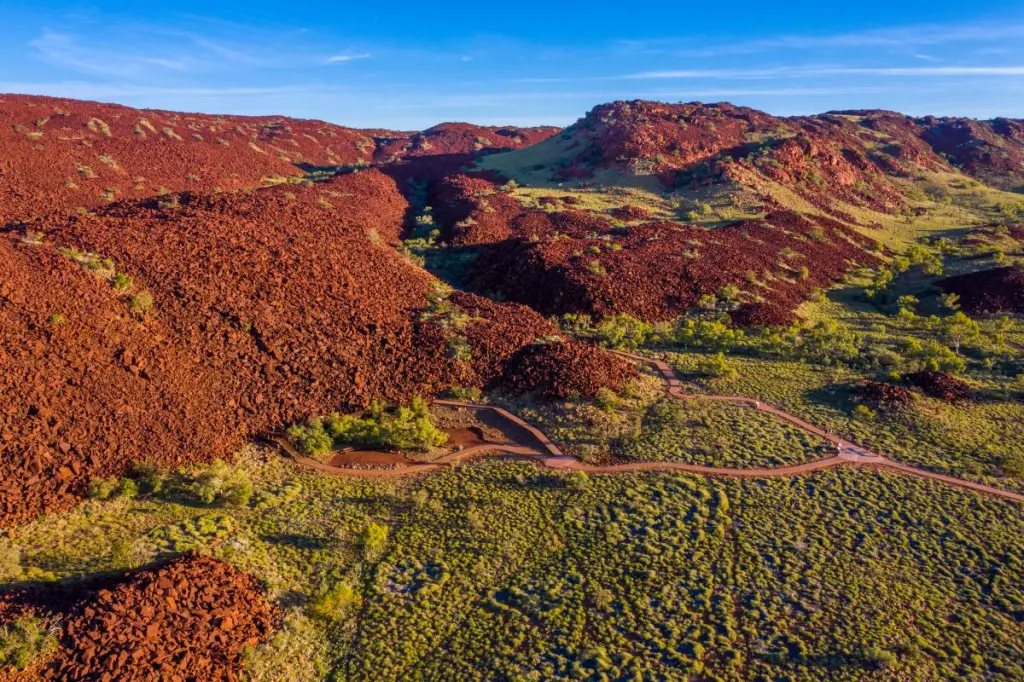
Ancient rock art at Murujuga, or the Burrup Peninsula, in Western Australia, has seen much larger damaged than previously anticipated due to industrial pollutants found in air emissions.
About 932 miles north of Perth, Murujuga contains one of the world’s most significant and dense collections of ancient petroglyphs, dating back about 50,000 years. These tens of thousands of petroglyphs depict animals, spiritual figures, and sacred stories.
Since the 1950s, however, Murujuga has also become one of Western Australia’s largest industrial areas, home to a major fertilizer plant and gas facilities, with the world’s largest urea plant expected to begin operations next year.
The Rock Art Monitoring Report, compiled over the last three years by members of the peninsula’s five Aboriginal language groups and a team of more than 50 Curtin University scientists, found that carvings closest to industrial projects degraded faster than normal, and current activity is not thought to be accelerating this deterioration.
The damage includes changes in the rocks’ porosity, or tiny hole structures on their surfaces, believed to result from historical emission levels. According to the report, sulfur dioxide emissions from burning fuel had the greatest effect on the petroglyphs.
“Transport fuels, shipping fuels industry all have some level of sulfur in their fuel,” lead scientist Ben Mullins told ABC News. “There’s a lot of evidence that that was a lot higher in the 70s and 80s, and even since 2010, shipping fuels have massively reduced sulfur levels and sulfur dioxide emissions.”
The report’s release coincides with a recent decision by federal Environment Minister Murray Watt to extend the North West Shelf gas project through 2070, and with Murujuga’s inclusion on UNESCO’s World Heritage List.
“This latest report provides further confidence that the monitoring program is building the evidence needed to support the long-term protection of our rock art and cultural landscape,” Murujuga Aboriginal Corporation (MAC) director and cultural adviser Belinda Churnside told National Indigenous Times. “World Heritage recognition brings new responsibilities for all of us. MAC will continue working with government, industry, scientists, and our Elders to ensure Murujuga’s outstanding cultural values are protected and cared for long into the future.”
A memorandum of understanding currently exists between the MAC and the state government to fund long-term monitoring of the area beyond 2026, but negotiations have not yet been finalized.
“As Traditional Owners and Custodians, we know that protecting Murujuga requires both cultural knowledge and robust science. These findings are an important step forward in helping us better understand the landscape and ensure it is protected for future generations,” Churnside added.
