


fields harrington was biking through the Williamsburg neighborhood of Brooklyn one day when a delivery worker sped past him, only to be clipped by a car. The worker’s groceries flew everywhere as he fell, and harrington, wanting to help, asked if they could call his boss. “That was a realization for me,” harrington told me. “There is no boss to call. You’re working for an algorithm.”
harrington, an artist and cyclist, had been on a somewhat more leisurely bike ride, headed to see friends. But in that moment, he came to see bike lanes as a kind of office for so many workers—many of them migrant, many of them precarious. Delivery workers are too often derided, blamed for the ways e-bikes are making city streets more chaotic and dangerous. In New York especially, they are framed as simultaneously a convenience and a threat.
Ever since the accident, harrington has made a point of staying alert to the changing cityscape from the workers’ perspective. Since 2024, he has been photographing delivery bikes across the city. Many have gloves affixed to the handlebars or are wrapped in customized reflective tape that, when hit by the flash of his 35mm camera, causes the backgrounds to disappear.
As he continued taking pictures, he began to notice a culture of customization, one not unlike motorcycle gangs with their sartorial style and bike decorations, nor unlike slab culture. “It’s a way of finding community,” he explained. “A lot of workers look for other people from their home,” and might display flags, stickers, or colors that reflect where they are from.
Work from fields harrington’s ongoing series of photographs documenting delivery workers’ bikes parked around New York City.
Seeing harrington’s pictures prompted me to pay more attention to the bikes I walk past every day—and they are everywhere. But I noticed, too, that to get harrington’s view, he has to crouch down: the customization is all too easy to miss while just walking by. Photography, according to Stephen Shore, is suited for exactly this: it’s a tool, Shore says, for heightening one’s attention to the world.
harrington’s pictures offer another rejoinder to art history. They’re riffs on Realist worker portraits, but they short-circuit the camera’s objectifying lens by photographing, well, objects instead of people.
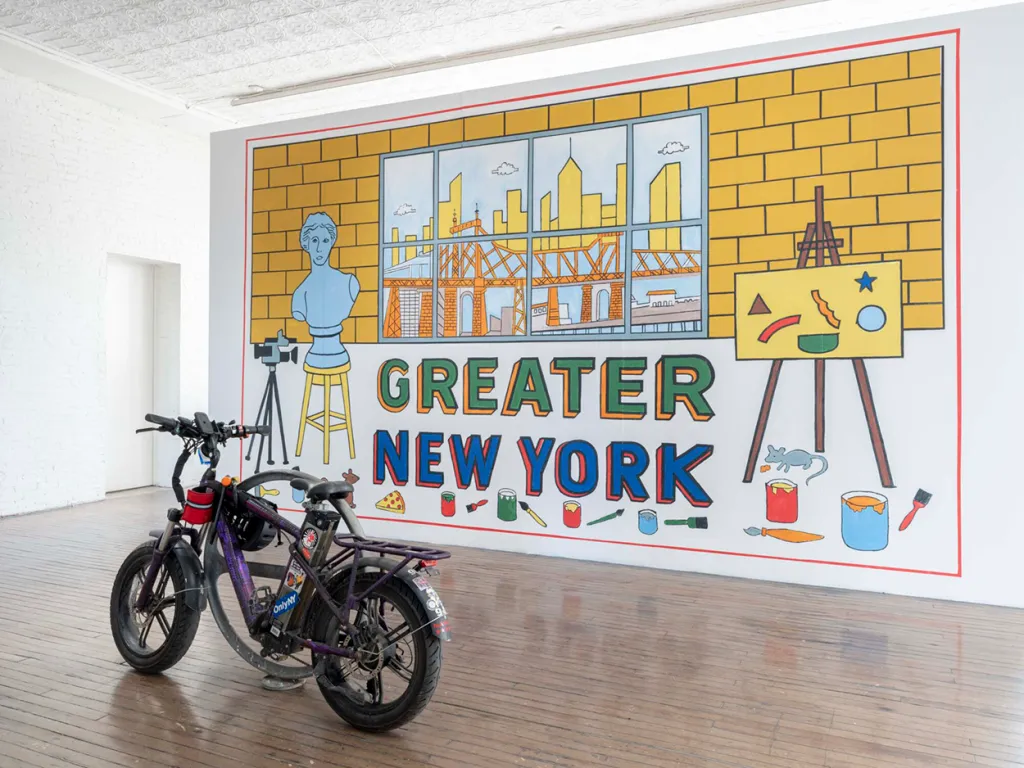
Still, as harrington prepared to show the series at MoMA PS1 for “Greater New York”—a recurring survey of New York artists on view through August 17—he found himself searching for a more reciprocal way to connect the worlds of art and labor. If a photograph is something one “takes,” what might art, in return, give?
“Rest,” harrington decided. He wrote a considered and captivating essay on e-bike batteries, homing in on ideas of extraction and exhaust—and how both apply to the workers’ lives as much as to the materials that power their batteries and bikes. His previous shows, like “indefatigueable” at Petrine Gallery in Paris and “non-exhaustive work” at KAJE in Brooklyn, have reframed rest as well.

Work from fields harrington’s ongoing series of photographs documenting delivery workers’ bikes parked around New York City.
But here, he also approached rest in a more literal sense, asking MoMA PS1 to rent a delivery worker’s bike and, for the hours the museum is open, pay its owner their usual wage: $21.44. Now, for one week of every month of the exhibition, a bike greets visitors to “Greater New York”; when it’s not there, you can assume its owner, Gustavo Ajche, is back out working. And bike or no bike, every 21 minutes and 44 seconds—the numbers reference the hourly wage Ajche and others have advocated and won—visitors hear a notification ding.
harrington met Ajche—co-founder of Los Deliveristas Unidos, and in many ways the face of the fight for these workers’ safety and fair pay—through the architect Elsa Ponce. Working with Los Deliveristas, Ponce designed hubs across the city where delivery workers can rest, escape extreme weather, use the bathroom, and recharge their phones and bikes. These are essential amenities that employers would typically provide, but here, the task (and cost) has fallen to the city.
The gig economy offers no paid time off—not sick time and certainly not vacation time. So harrington’s gesture makes a little space for that basic human need: rest. Ajche, of course, can do as he wishes while his bike is at the museum—including work, perhaps saving the wages for an emergency or rainy day.
I thought, seeing the bike in the museum, that as art, it drew attention to a labor issue that is unresolved, though largely uncontroversial among biennial-going types. Initially, I read the bikes not as advocating so much as reframing attention around an issue we too easily tune out. But bafflingly, the New York Times took umbrage, calling harrington “sympathetic to the plight of the worker, perhaps to a fault,” before lamenting that delivery workers are “imperiling pedestrians”—as if the workers themselves are not imperiled, and as if they have much of a choice.
Advocacy, I came to see, is still needed, apparently. After all, it was only months ago that I received that infamously Islamophobic flyer in my mailbox—the one that doctored and darkened Zohran Mamdani’s beard. It bore a revealing little logo at the bottom, thanking a sponsor: DoorDash.
