


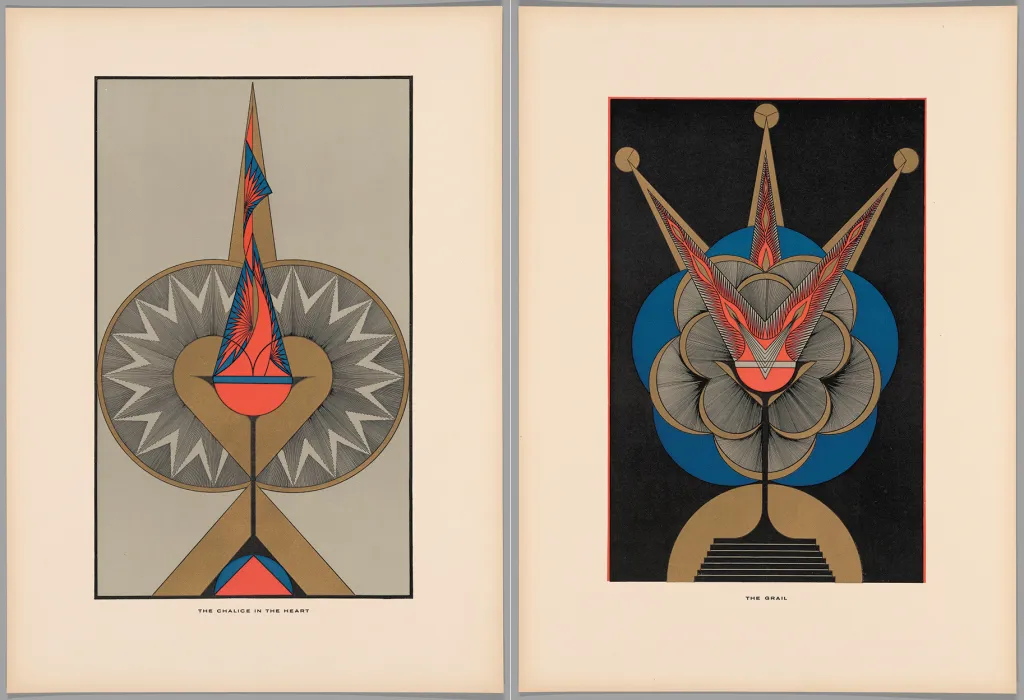
“The deepest things in human life … can only be expressed in images,” wrote Olga Fröbe-Kapteyn. And yet, though obsessed with images, she never called herself an “artist,” even as she painted and drew. Fundamentally, she was a collector: of people, of images, of ideas, always animated by her interest in symbols and archetypes. Carl Jung, her close friend and collaborator, fueled this long, epic inquiry. Still, she remains profoundly mysterious and contradictory, a person fiercely drawn to and driven by spirituality who left few windows into her own spirit.
Born in London to Dutch parents in 1881, Fröbe-Kapteyn was the highly educated daughter of highly educated parents. At once spiritual and analytical, she had no specific belief system. Like many Europeans who became interested in alternative or occult traditions in the early 20th century, she was drawn to and influenced by innumerable schools of spirituality, philosophy, and mythology. This paradox sits at the heart of Fröbe-Kapteyn’s philosophy: the importance, and challenge, of connecting the personal with the eternal. She was driven by the desire to connect all human experience with a set of universal truths and constants, a goal that could both equalize and erase.
After her family moved to Switzerland, Fröbe-Kapteyn learned tailoring, embroidery, and jewelry-making at Zurich’s School of Applied Arts, then went on to study art history at the University of Zurich. In 1909, she married a musician, Iwan Hermann Fröbe; they moved to Berlin, where she encountered a series of tragedies. In 1915, she gave birth to twin daughters, one of whom was severely disabled. Then just months later, Iwan died in a plane crash. The disabled child lived in an institution in Germany until she went missing after Hitler’s rise to power. Fröbe-Kapteyn never saw her again, nor knew what had happened to her, but it was understood that she had been taken and murdered as part of the Nazi project to “cleanse the race.”
There is no trace of Fröbe-Kapteyn ever mentioning this horrific event in her letters, nor anywhere else. “For her, being a mother is something different than taking care of your children,” Frederika Tevebring, a research fellow at King’s College London, told me. The idea of the “Great Mother” or the archetype of the prehistoric goddess figure fascinated Fröbe-Kapteyn. It was a major part of her collection of images of archetypes, which she sourced from libraries and archives around Europe and North America. But her own relationship with her children, alive or dead, was never a priority—to a degree that is difficult to imagine. Instead, she put her energy into art, both making it and collecting it.
“She suffered unspeakable traumas in her life and she never underwent analysis,” says Riccardo Bernardini, her biographer and the current scientific secretary of the Eranos Foundation, which was started by Fröbe-Kapteyn in 1933. “She was able to survive all of this thanks to her graphic practice,” he adds, comparing it to a form of art therapy. What survives of that practice today are series of screenprints she called “meditation drawings,” as well as dozens of sketches she described as “visions.” “My feeling is the technique and the time she dedicated to it were even more important than the symbols,” Bernardini told me. She drew under the guidance of her unconscious, striving to work free of intention.
Like many early abstract artists, such as the Swedish painter Hilma af Klint, Fröbe-Kapteyn did not consider her work “art,” but rather something touched by a higher power. Her works were made entirely in primary colors, plus black and gold. Their harsh geometric forms are sometimes punctuated by recognizable symbols like crosses and hearts, while others are made entirely of abstract twisting, circular, and diagonal forms. Her works were meant to be irrational—unlike the archetypes she collected, which had specific, if complex, meanings. The drawings and prints she made were not intended to be decoded. They existed outside language, in a world she thought of as her unconscious as she strove to work free of intention; other artists working in similar ways, like Klint, might call it the spirit world.
THOUGH HER PRINTS have recently come into view at auction and in museum collections—the Art Institute of Chicago and the Metropolitan Museum both recently acquired sets of screenprints of her meditation drawings—Fröbe-Kapteyn is best known as the founder of Eranos, the annual conference and research foundation. Based in her home, Casa Gabriella, in Ascona-Moscia, Switzerland, Eranos sought to be a “free space for the spirit,” where ideas from East and West could meet. Fröbe-Kapteyn’s vision was deeply of its time. Born of a desire for global connection and inner peace, it was as much a project of looking backward as forward. Although it claimed to have a global outlook, the perspectives it fostered on the “East” were very much situated in the “West.” Eranos has continued for nearly 100 years.
Jung attended the first Eranos conference and those that followed, building a wide network enabled by the leadership of Fröbe-Kapteyn. His concept of the collective unconscious, a universal element of the human mind connecting past and present, was fundamental to her understanding of images and the interconnected nature of ancient archetypes. The women who flocked to Jung are sometimes grouped together condescendingly as Jungfrauen (Jung women), and in some ways Fröbe-Kapteyn might fall into this category of groupies. But in other ways she is much more idiosyncratic. Her inexplicable refusal to ever participate in analysis despite her admiration of Jung sets her apart, as does her independent leadership of Eranos.
Fröbe-Kapteyn’s collecting project, though, began under Jung’s directive to accumulate an archive of images of archetypes that became the iconographic basis for his book Psychology and Alchemy,as well as the works of other scholars: Mircea Eliade’s The Forge and the Crucible,Erich Neumann’s The Great Mother: An Analysis of the Archetype. The collection eventually became Fröbe-Kapteyn’s own beast, however. Jung stopped financially supporting the project, and Fröbe-Kapteyn found her own backers in American financiers and art collectors Mary and Paul Mellon. She continued to amass her own extensive archive, which she donated to London’s Warburg Institute in 1946. As an institution concerned with creating its own idiosyncratic archive of images and knowledge, and one that shared Fröbe-Kapteyn’s German roots, the Warburg was a fitting home.
AFTER JUNG’S NEED for the project concluded, Fröbe-Kapteyn continuedit herself: By looking backward across human history, she hoped to find clues to aid her in looking forward. She also sought to create a tool with which individuals could decipher their dreams by finding and decoding the archetypes in them. Despite her background, her understanding of images was not really an art historical one, although psychoanalytical methodologies of studying the history of art were emerging. Instead, it is one that does not see images as “art” but as something more fundamental, a method of communication or thought that is too primal to be given that name.
This put Fröbe-Kapteyn in dialogue with a wider movement in early 20th-century Europe to turn back toward the prehistoric era, a time before written language—which was only just being recognized as an era when humans had complex societies and civilizations. The centrality of images to intuitive, subconscious methods of understanding came to be seen as particularly feminine. Images of ancient and prehistoric feminine figures, like those Fröbe-Kapteyn collected, were equally at home in ecofeminist movements as they were in the ethos of fascism. Both proffered a desire for a return to simpler times, to purity, to nature: These fantasies can all skew toward exclusionary extremism on the left and the right.
For Fröbe-Kapteyn, the fantasy led her to a fiercely complacent apoliticism in the face of the defining conflict of the postmodern era. This was, of course, still political. As with her adopted country of Switzerland, neutrality was not an escape from the implications of the war. In refusing to speak out against Hitler’s horrors, she acquiesced to them, as did Jung and many of his followers. Jung has been widely understood as representing the Aryanization of psychoanalysis, in contrast with its founder, Sigmund Freud, a Jew who was forced to flee his native Vienna for London after the Anschluss in 1938.
For most of her life, Fröbe-Kapteyn lived alone in her house on the shores of Lake Maggiore in Switzerland. Bernardini lives there today, and he wondered to me how she endured all those harsh, bleak winters by herself. “It is incredibly isolated,” he says. During the war, when she was consumed by her search for archetypal images, she found herself unable to sleep. She wrote to Jung asking for his guidance, and he advised that her reaction was quite normal for someone living in a home so filled with pictures that she nicknamed it the “House of Images.”
Yet Fröbe-Kapteyn’s belief in the immense potency of images is overwhelming and purposefully illogical—her goal was to find a “respite from logical thinking,” after all. She believed that she would find truth and solace by turning away from the present and toward the past. She articulated it as turning inward, but she wasn’t really: She was looking outward, just not at what was right in front of her. But in her desperation to better understand the world, she ended up overlooking it entirely.
Despite her solitary lifestyle, her life’s work was a practice of bringing people together at conferences; it’s just one of her many paradoxes. During the war, she wrote to Jung that Eranos was the only place intelligent Europeans could meet outside of “political misunderstandings and tensions”—a remarkably understated way of describing a century-defining war, as Tevebring has noted. Fröbe-Kapteyn’s apoliticism did enable her work to continue through a global conflict, but it collides disturbingly with Nazism’s consequences for her daughter—not to mention the consequences for millions of Jews and other targets of the Holocaust, including many members of Fröbe-Kapteyn’s prized “intelligentsia.”
Fröbe-Kapteyn’s friend, the philosopher Alfons Rosenberg, described her paintings as having a “frightening coldness.” Indeed, with their sharp-edged shapes, inscrutable forms, and unnatural colors, they do somehow inspire terror, or at least a feeling of instability, which also infuses her legacy. Her belief in a universal truth was not unique, but her pursuit of it was relentless and oddly self-erasing. In focusing on connection rather than difference, Fröbe-Kapteyn purposefully flattened her worldview: Cultures, belief systems, politics, historical periods all became manifestations of “primeval ideas.” Inside all those ideas, where is Fröbe-Kapteyn?
