


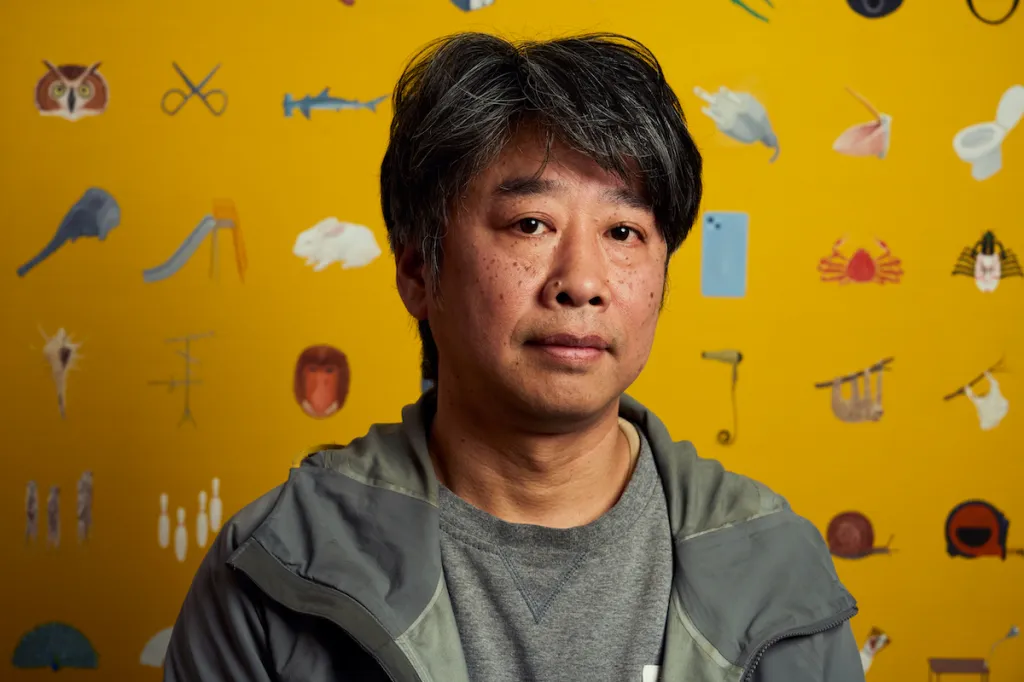
Akira Ikezoe has recently been thinking a lot about all that can be done with milk. It can be obtained from a cow, packaged, sold, and consumed, yes. But what if you could paint with it, or bathe in it, or even become resurrected by drinking it?
These are all scenarios that appear in a new painting by Ikezoe that features an array of naked figures (and some skeletons) who are roped into a dairy-centric system that happens to involve a pit of fire and a large mural. In typical Ikezoe fashion, everything is depicted with the sobriety of a diagram in an instruction manual. It’s funny, bizarre, and more than a little terrifying.
Standing before the painting in his New York studio, Ikezoe pointed to the top of the canvas, where faceless people pull at the udders of two cows. “They are taking milk out of the cow, and they start using the milk as paint,” Ikezoe said, narrating the scene. “But someone kicked the can of paint and stepped on it, leaving footprints. Then some people fall into holes and die. On the right side, there are four boxes, almost like seasonal change—spring, summer, etc. In winter, a skeleton comes out. Skeletons help them mix milk, and the milk goes into these shoestrings and comes down.”
Having articulated that whole narrative with a straight face, Ikezoe finally cracked a smile. “Yeah, I know it doesn’t make sense,” he said, letting out a big laugh.
His works’ refusal to adhere to rational ways of thinking is intentional. “I pick up many different things from the real world and create something new, re-establishing a world inside of myself,” he added. “I’m entertaining myself without meaning or purpose.”
Ikezoe standing beside one of his latest paintings. “Yeah, I know it doesn’t make sense,” he said.
Christopher Garcia Valle/ARTnews
Ikezoe’s attempts to remake the universe according to his own absurdist logic have earned him many admirers this spring, thanks to his simultaneous appearances in two prestigious New York shows: the Whitney Biennial and MoMA PS1’s Greater New York, a recurring survey for artists based in the city. He is one of just two artists in both of those exhibitions, the other being Taína H. Cruz.
Appearing in both shows would be a career-making moment for any artist, but it’s all the more notable in Ikezoe’s case because he was not so well-known in New York before, despite having steadily shown in the city since he moved from Tokyo in 2010. He doesn’t even have a New York gallery. Instead, he is represented by Proyectos Ultravioleta, a beloved commercial space in Guatemala City that is known for spinning artists with small but loyal followings into biennial-circuit superstars. Ikezoe seems poised for that exact trajectory, with his current showings after he was included in the 2025 Sharjah Biennial alongside artists such as Wael Shawky, Richard Bell, and Raven Chacon.

Ikezoe’s workstation. His painting process is inspired by his education in printmaking, he said.
Christopher Garcia Valle/ARTnews
Despite all the curators and critics who have come knocking at his small, orderly studio on the fifth floor of a Midtown tower over the past few months, Ikezoe maintains a quiet presence. Donning a slate-colored Outdoor Research jacket atop a grey shirt, he expressed a willingness to hear out others’ analyses of his paintings, even though he didn’t always agree with them. “Sometimes, people see the animals as symbols,” he told me. “They see frogs, and they automatically think about, like, bad politicians.” He thought for a second, then added, “Okay, yeah, but that’s not what I’m doing.”
Akira Ikezoe, Robot Stories Around Solar Panels, 2025.
Courtesy the artist and Proyectos Ultravioleta, Guatemala City, Guatemala
Compared to much of these other works in the Whitney Biennial, Ikezoe’s work does have a lighter touch. Robot Stories Around Solar Panels (2025), one of his paintings in that show, features machine people harvesting pearls from giant clamshells and posing as Botticelli’s Birth of Venus. This could all be read as a joke if not for the fact that other robot workers nearby are engaged in the process of building solar paneling—devices that could one day help solve an energy crisis.
“Putting animals in his work allows him to talk about serious issues without the doom and gloom of disaster aesthetics,” Marcela Guerrero, a curator of the Whitney Biennial, said. “The whimsy is a vehicle to enter these heavier topics.”
A sketch for one of Ikezoe’s paintings.
Christopher Garcia Valle/ARTnews
Ruba Katrib, a curator of Greater New York, said, “There are many, many reactions when looking at his work. It’s humorous, but then, when you figure out what’s going on, there’s definitely a feeling of sublime horror. There’s more going on in these paintings than meets the eye.”
Ikezoe’s own words seemed to prove Guerrero and Katrib right. During our studio visit, he spoke extensively about the destructive Fukushima nuclear disaster of 2011 and at one point showed me a manila folder filled with evacuation manuals pilfered from airplanes. “Every time I ride an airplane, I get one,” he said. The diagrams of passengers pulling out floatation devices and assuming crash position were presented with a crisp, legible aesthetic similar to the look of Ikezoe’s paintings. “These are really just illustrating a story and doing it visually,” he said.
Ikezoe showing off his personal collection of airplane instructional booklets.
Christopher Garcia Valle/ARTnews
He was born in a suburb of the Japanese city of Kochi in 1979 and moved to Tokyo when he was 18 to study in Tama Art University’s printmaking program. He’d begun making oil paintings as a high-school student and expressed a desire to continue that path while at the university. “I told my professor that I wanted to paint, but the professor said, ‘No, here, you have to learn printmaking.’ So I did for four years, and it was a little boring for me,” he said.
“But there was a good side,” Ikezoe added. Oil paint, he pointed out, dries very slowly, so he would obsessively return to the same work over and over, rarely knowing when to stop. “Printmaking is very different. You have to decide how to finish one image beforehand, and the rest is very automatic—just this color, this color, this color, and done. After graduating university, my oil paintings changed a bit: The color became thin, and I’d make one, two, maybe three layers. The printmaking process influenced me.” His earliest mature paintings, often filled with snarling creatures arranged in chaotic formations, started to include monochromatic backgrounds that became a staple in his art.
Feeling dissatisfied with Japan’s art scene, Ikezoe started turning his attention to New York, where he began exhibiting at a now defunct gallery called Esso. He moved to the city in 2010, two years after his first Esso show, because the city’s artists “had ideas we never thought of” in Japan. Did he ever have any desire to go back? “Zero,” he said. “I got married to a Guatemalan woman”—the artist Jessica Kairé—“and my son goes to school in New York. Our life is here.” (Guerrero, the Whitney Biennial curator, said Ikezoe was one of the few male artists she’d ever met who regularly brings up being a father.)
Akira Ikezoe, Chart of Darkness, 2025.
Courtesy the artist and Proyectos Ultravioleta, Guatemala City, Guatemala
When Ikezoe came to New York, he was able to read English, thanks in part to his mother, who taught the language to Japanese high schoolers. “Listening and speaking were totally different,” he said. While he tried to make sense of this new way of communicating, he began to paint grids of unlike objects grouped less by function than aesthetic. “Because I couldn’t speak English, I started collecting images by category,” he said. “I think I’m making up my own version of categorization. I’m still doing it.” A new painting from the series in the PS1 show, for example, features a bomb next to a bulging eyeball, an “O” with an umlaut next to a ball of yarn, and the creepy twins from The Shining next to a pair of dogs.
The year after Ikezoe moved to New York, an earthquake and tsunami in Japan caused an electrical grid failure, leading the nuclear power plant in Fukushima to release radioactive contaminants in the surrounding region. “I started really thinking about our relationship to nature, the way nature and culture are always invading each other, which is just what happened in Fukushima,” he said. His paintings became increasingly concerned with nonhumans, the transmission of energy, and faltering systems. He also produced an animation, Hole (2014), in which a nude version of himself traipses through a colorless world populated by hybrid beings, include a dog-headed fly that at one point transports Ikezoe’s dismembered head back to the rest of his body.
“He’s taking life at face value,” said Zeynep Öz, a curator of the 2025 Sharjah Biennial that included Ikezoe. “There’s so much despair about the things he’s going through, so much disillusionment, but it’s very light in the face of all that grave stuff.”
Akira Ikezoe, Clam and the Sun, 2025.
Courtesy the artist and Proyectos Ultravioleta, Guatemala City, Guatemala
Öz’s invitation to Ikezoe coincided with a change in his thinking. At the time, he was not in favor of nuclear power, but he started to wonder if it may still hold out possibilities for the future. “I’m still against nuclear power plants,” he said, “but I understand the need for them in this moment—there are so many wars. But I’m hopeful that technology will replace them. That was probably the beginning of me being interested in new technology.”
He said he was currently at work on a painting about aquaponics, wherein fish poop helps power a system that is less reliant on water and land than others like it. “I was watching this documentary about a Japanese scientist whose dream is to make [aquaponics] happen in outer space, to make food for astronauts,” he said. “But he was saying that right now, a person is still needed to feed the fish, so to fully close the circulation, humans actually have to be a part of it. I’m making my own version of this system with human participation.”
I told Ikezoe that it seemed as though he were effectively envisioning ways to use power more equitably and more sustainably. “It’s not going to happen in the real world, right?” he said. “I’m enjoying creating my own world.”
