

Close Menu
  • News
  • Stocks
  • Bonds
  • Commodities
  • Collectables
    • Art
    • Classic Cars
    • Whiskey
    • Wine
  • Trading
  • Alternative Investment
  • Markets
  • More
    • Economy
    • Money
    • Business
    • Personal Finance
    • Investing
    • Financial Planning
    • ETFs
    • Equities
    • Funds

Subscribe to Updates

Get the latest markets and assets news and updates directly to your inbox.

Trending Now

How to Buy Minimalist Art

May 5, 2026

Commemorating America’s 250th: Through the Eyes of Lafayette, The Original Transatlantic Ally

May 5, 2026

Nahmad Seeks to Reopen Modigliani Restitution Case With New Witnesses

May 5, 2026
Facebook X (Twitter) Instagram
The Asset ObserverThe Asset Observer
Newsletter
LIVE MARKET DATA
  • News
  • Stocks
  • Bonds
  • Commodities
  • Collectables
    • Art
    • Classic Cars
    • Whiskey
    • Wine
  • Trading
  • Alternative Investment
  • Markets
  • More
    • Economy
    • Money
    • Business
    • Personal Finance
    • Investing
    • Financial Planning
    • ETFs
    • Equities
    • Funds
The Asset ObserverThe Asset Observer
Home»Art Market
Art Market

How the adoption of canvas in Venice changed the way artists painted – The Art Newspaper

News RoomBy News RoomMay 5, 2026
Share
Facebook Twitter LinkedIn Pinterest Email

In 14th-century Siena and 15th-century Florence, paintings were largely on walls or panels. Then, over the course of the 16th century, the prestige of Venice’s painters brought with it the triumph of canvas, more suited to the damp Venetian climate than plaster, and cheaper and easier to transport than wood. But how did artists like Titian, Veronese and Tintoretto actually use this new material? The British art historian Cleo Nisse has provided a whole new way of looking at these innovations in Venetian Canvas and the Transformation of Painting. Here are four takeaways from the book.

Not all canvas is created equal

Canvas is a familiar enough word but Nisse reveals a vast, complicated and fascinating world of materials, twills and textures. At first, Venetian artists were drawn to a so-called “tabby weave”, whose smoother surface was closer to panel. Gradually they came to master rougher weaves, in particular a herringbone pattern that fostered gaps in the painting’s surface.

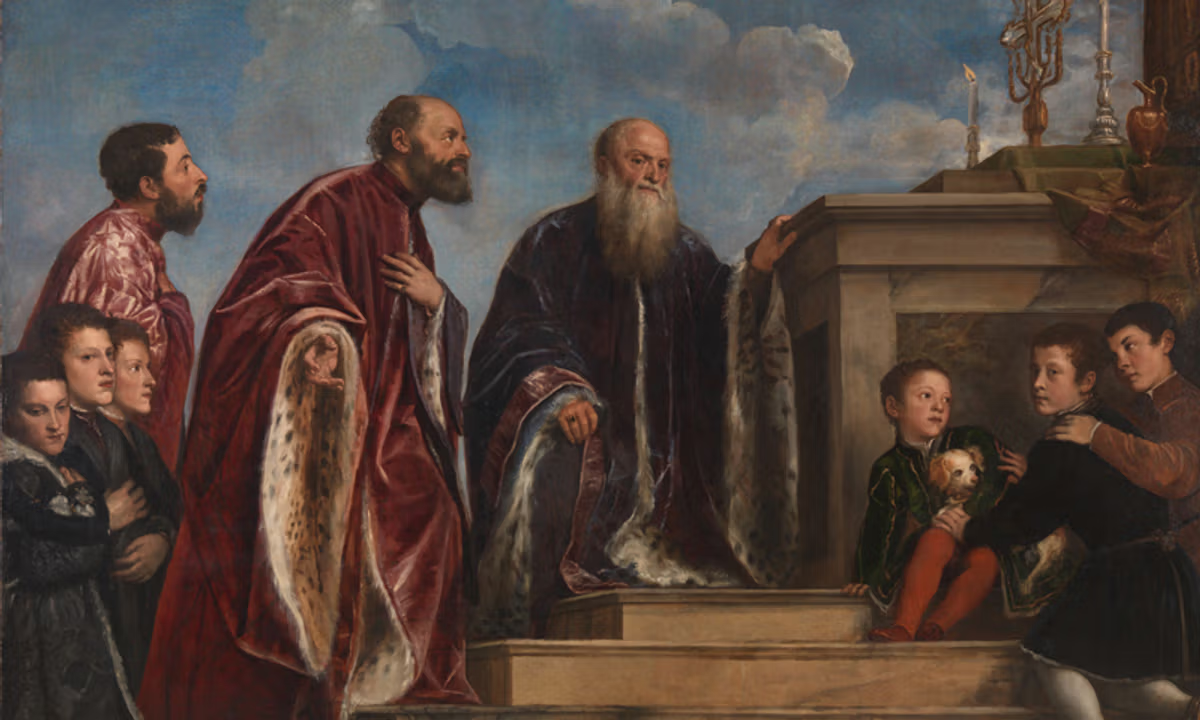
Many of these canvases, which could be made of either linen or hemp, might have had other purposes. For example, Tintoretto’s The Miracle of the Slave (1548) was painted on sail cloth. The complex weave pattern of Titian’s The Vendramin Family (around 1540-45) was fine enough for a tablecloth, and Nisse argues that the weave itself helped him create the “diffuse and soft” quality of light.

It pre-dates the Renaissance

Canvas, so strongly associated with the Venice Cinquecento, was actually a very familiar support in the late Middle Ages. Painting on canvas had served as an alternative to tapestry or embroidery, and what is regarded as a breakthrough canvas work, Gentile Bellini’s Il Beato Lorenzo Giustiniani (1465), may once have been a processional banner.

Vittore Carpaccio’s The Martyrdom of the Pilgrims and the Funeral of Saint Ursula (around 1490s)

The great innovator Carpaccio

As early as 1474, Bellini was replacing frescoes in the Great Council Hall of the Doge’s Palace with paintings on canvas—a stark case, Nisse argues, of “historical transition”. But it was Bellini’s pupil, Vittore Carpaccio, who first mastered canvas, in all its intricacies, in his series The Legend of St Ursula, in which he varied the type of canvas in successive paintings for differing effects. In The Martyrdom of the Pilgrims and the Funeral of Saint Ursula, Nisse says, he first used a rougher herringbone weave that was best suited to convey the dynamism of the massacre.

Titian’s Pietà was not only unfinished—but unfinishable

The book culminates with a striking, support-minded interpretation of Titian’s last work, Pietà, painted on a patchwork of ever-rougher canvas. The irregularity meant “it would have been very hard for Titian to ever have achieved a highly finished surface”, Nisse says, attributing the painting’s celebrated effects beyond its loose brushwork, or (as legend has it) the artist’s failing eyes, to its support.

• Cleo Nisse, Venetian Canvas and the Transformation of Painting, Princeton University Press, 288pp, $68/£58 (hb)

Share. Facebook Twitter Pinterest LinkedIn Tumblr Email

Keep Reading

How to Buy Minimalist Art

Commemorating America’s 250th: Through the Eyes of Lafayette, The Original Transatlantic Ally

Nahmad Seeks to Reopen Modigliani Restitution Case With New Witnesses

‘A remarkably tenacious motif’: the many faces of Marilyn Monroe revealed in new book and show – The Art Newspaper

Venice Biennale’s fierce pussy Group Says City Censored Posters About Queer and Trans People

‘She had a fresh, informed eye’: mural depicting late Venice Biennale curator Koyo Kouoh displayed in lagoon city – The Art Newspaper

Jon Batiste, Troye Sivan, and Amy Sherald lead a Met Gala rooted in art-historical homage.

Dozens of Venice Biennale Artists Stage ‘Drone’ Perfomance in Protest of Israel’s Participation

Remembering Pat Steir, one of the 20th century’s late-blooming great artists – The Art Newspaper

Recent Posts
  • How to Buy Minimalist Art
  • Commemorating America’s 250th: Through the Eyes of Lafayette, The Original Transatlantic Ally
  • Nahmad Seeks to Reopen Modigliani Restitution Case With New Witnesses
  • ‘A remarkably tenacious motif’: the many faces of Marilyn Monroe revealed in new book and show – The Art Newspaper
  • Venice Biennale’s fierce pussy Group Says City Censored Posters About Queer and Trans People

Subscribe to Newsletter

Get the latest markets and assets news and updates directly to your inbox.

Editors Picks

Commemorating America’s 250th: Through the Eyes of Lafayette, The Original Transatlantic Ally

May 5, 2026

Nahmad Seeks to Reopen Modigliani Restitution Case With New Witnesses

May 5, 2026

‘A remarkably tenacious motif’: the many faces of Marilyn Monroe revealed in new book and show – The Art Newspaper

May 5, 2026

Venice Biennale’s fierce pussy Group Says City Censored Posters About Queer and Trans People

May 5, 2026

‘She had a fresh, informed eye’: mural depicting late Venice Biennale curator Koyo Kouoh displayed in lagoon city – The Art Newspaper

May 5, 2026
Facebook X (Twitter) Instagram
© 2026 The Asset Observer. All Rights Reserved.
  • Privacy Policy
  • Terms
  • Press Release
  • Advertise
  • Contact

Type above and press Enter to search. Press Esc to cancel.