









Art is one of the most personal gifts a person can receive. Whether a painting, print, or a sculpture, art communicates mood, memory, and meaning in ways few other objects can. It has the potential to become part of someone’s daily life for many years, an object of reflection and beauty.
But taste in art is highly subjective, making gifting art, especially for the first time, a bit daunting. Don’t be put off. Advisors and dealers say people overestimate how complicated the process needs to be. “Chances are that if you are gifting art to someone, that person means a lot to you, and you likely possess an inherent sense of what they’ll enjoy,” said Maria Vogel, founder of the art advisory Rococo.
To help navigate the process of buying art as a gift, we’ve put together an expert-led guide to tackling the central questions, from sussing out taste to the logistics of framing and shipping.
How to tap into someone’s taste


Wrapped in a Bow, 2026
Vanessa Stockard
Birdcage Collective
Don’t ask what someone likes, the experts say. Instead, look at what they’ve already chosen for clues.
“Find out what kind of art they already have at home, especially what they chose for themselves,” said Weini Liao of Shanghai’s Matthew Liu Fine Arts. “That usually tells me so much about taste.” Jurgita Juospaitytė Bitinienė, director of the Rooster Gallery in Vilnius, Lithuania, agrees, adding that she also looks for “what connects those choices,” be it a medium, theme, or style. Liao also suggests thinking about where a work might hang—home, office, hallway, bedroom—since the space narrows down size and medium before browsing even starts.
Advisor and Artsy contributor Sadaf Padder, founder of Alpha Arts Alliance, searches for clues in conversation. Long before making a purchase, she suggests being aware of artists your giftee may already be interested in, or a gap in their collection you’ve noticed. Emily Sussman, an independent curator and advisor, encourages people to ask their giftees about the best gifts they’ve received. The answers can give you insights into what they value.
What to know when buying art for an occasion
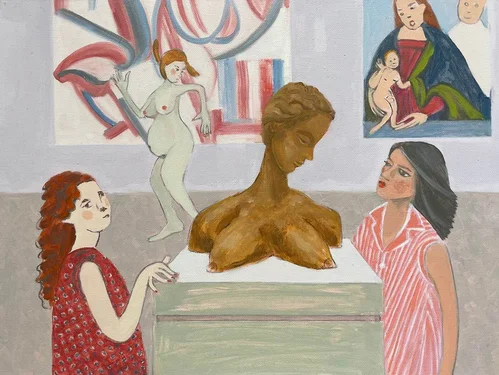

Untitled, 2025 Oil on canvas 9 x 12 in.
Elizabeth Tremante
Spinello Projects
When buying an artwork for a special occasion, be it a birthday, wedding, or anniversary, should the art reflect the moment?
On this question, dealers and advisors can see it both ways. Padder once placed a watercolor of Riverside Park, where a client had proposed to his wife, as a gift for their soon-to-arrive child. Vogel, meanwhile, advises taking a longer view. “Stay consistent and true to parameters around buying for someone rather than tying it to an occasion. That will better ensure the piece has timeless value to them,” she said.
Sussman encourages letting the occasion shape the mood. For a birthday, she said, “find a work that matches the sense of occasion in spirit…or a work that is personal to the recipient.” She advises skipping anything too literal, like a painting of a piece of cake, in favor of scenes that resonate personally.
Still, Liao noted, the occasion can give you some guideposts. A wedding gift, for instance, can encourage you to think about a work both partners can live with, or, for a retirement, something contemplative, or “a work that takes a little more time to appreciate.” Cultural context matters, too, Liao noted. A clock, for instance, is a fraught gift in Chinese culture, since the phrase sounds close to one associated with funerals.
Yes, you can buy art on a budget


Salão da Loucura, 2026
Marcela Cantuária
A Gentil Carioca
A meaningful gift of art is possible at a range of budgets, the experts agree.
Vogel pointed to works on paper, prints, photography, and works by emerging artists, including MFA students, as good starting points. Bitinienė noted that many of her gallery’s collectors are young, so budgets under $500 are common. At that price point, she turns their attention to smaller paintings, drawings, photography, and porcelain or sculptural objects. “Part of the pleasure of giving art is knowing that you have found something singular,” she said.
Artsy’s own price-based collections—Art under $1,000 and Art under $2,500—are built for exactly this kind of search.
Prints and editions, meanwhile, can offer access to established artists’ works at a fraction of the cost of a unique work. “Prints are so unsung,” Padder said, pointing to techniques like lithography and monoprinting that stretch back centuries. Liao stressed that a properly editioned photograph is an original work, not a reproduction, and noted that buyers should look for “the edition number, signature where applicable, certificate, and provenance.” The Artsy Edition Shop, with accessibly priced works by major names, is one place to start.
To frame or not to frame?


The Backdrop, 2012
Nandan Ghiya
10 Chancery Lane Gallery
When gifting an artwork, should the work be framed? It turns out there is no consensus, even among the pros.
“Giving someone an unframed work can sometimes mean giving them another task to deal with,” Liao said, though she suggests leaving canvases bare and keeping any frame “simple and neutral.” Vogel is a believer in framing gifts of art: “You wouldn’t gift a jewel without its setting, so don’t gift a work without its frame.”
Others take a looser approach. “For me, the artwork is the gift. The frame can be part of the life it begins afterward,” said Bitinienė.
Common mistakes—and how to avoid them


You're My Favourite Mistake (Blue), 2015
Rebecca Mason
Helm Gallery
The advisors and gallerists we spoke to warned against overcorrecting. “The most common mistake is probably trying too hard to choose something that is universally appealing,” said Mauro de Vanna, of Milan gallery Delvis (Un)limited.
Liao warned against being too literal, such as buying someone a seascape simply because they love the ocean. “It sounds logical, but sometimes it can be a little too literal,” Liao said. “A good art gift should be something the person genuinely wants to keep looking at and living with.”
Bitinienė, meanwhile, has noticed a related pattern. Buyers afraid of “getting it wrong” often retreat toward humor or provocation. “The quieter, less obvious choice can actually be much more personal,” she said. Padder points to another common conundrum—buying what you like rather than what the recipient would choose. She said this mistake is “especially easy” to make if “you live together and know you’ll be looking at the work, too.”
What to know about timing, shipping, and inquiring through Artsy


The Gift, 2026
Philippe Le Miere
Art & Collectors


Too excited to blow out the candles, even though they forgot to get more, 2025
Destiny Oyibode
Ogirikan Art Gallery
For anything bought against a deadline, gallerists and dealers encourage collectors to tell the seller up front. This goes for making an inquiry—a message sent asking about the price, availability, or details of a specific artwork—on Artsy for a listed artwork.
“I would always encourage a buyer to mention the occasion and the required delivery date when making an inquiry on Artsy,” de Vanna said. “This immediately gives the gallery the information it needs to advise them properly.”
Bitinienė’s gallery typically responds to Artsy inquiries within hours and can ship within a week, even internationally, though larger or fragile works need more room. Liao, working from Shanghai, replies within a business day and recommends three to four weeks for international shipping, once framing and customs are factored in.
When it comes to orchestrating delivery, several experts suggested presenting an image or a certificate of authenticity on the day of a special occasion, then arranging delivery once shipping and the giftee’s schedule allows.
And if you’re still not sure what to buy, Liao has a foolproof method. Shortlist two or three works and then let the recipient make the final call.
“The giver has still put real thought into the gift, while the recipient also has some freedom to choose.” As Bitinienė put it, “there is no single correct way to give art.”


