


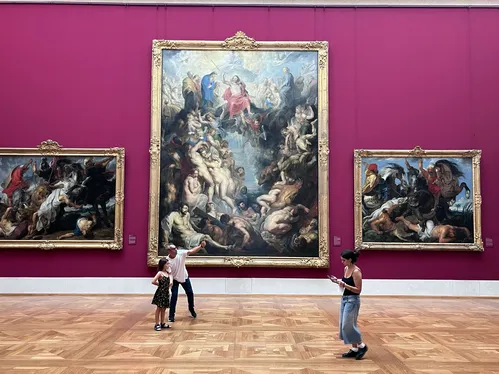
In our age of ubiquitous information, visiting a gallery almost inevitably involves taking a photograph. Visitors lean in with their phones, framing paintings, sculptures, and installations (and sometimes other photographs) before moving on.
These small acts of preservation happen for many reasons. A show is finite; an image can retain the experience for longer, trigger memories when you’ve forgotten an artist’s name, act as a kind of virtual postcard, or help explain to someone else how it felt to encounter a once-in-a-lifetime exhibition.
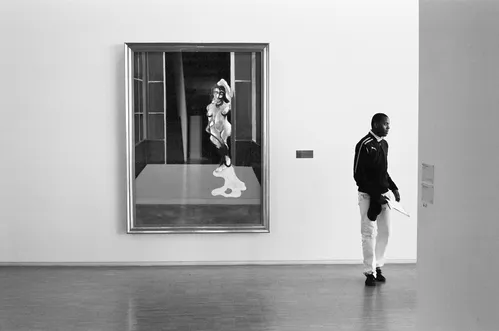
Regardless, when we look back through those images, they tend not to capture what it felt like to stand in front of the artwork itself—the inspiration, awe, delight, or pure horror of seeing another’s creation.
We asked five photographers how they approach photographing artworks, and what they attempt to capture when they do.
1. Look for interesting details
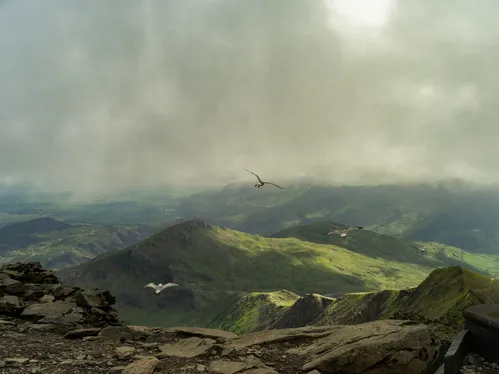
The best photographs of artworks often begin with a simple question: Why did this work stop you?
For photographer Mohamed Hassan, photographing art isn’t about neutral documentation but retaining the experience of the encounter. “I’m less interested in a neutral reproduction and more interested in holding onto why it stopped me,” he told Artsy. Often, that response is tied to scale and intimacy: “When the artwork is small, I often feel an even stronger desire to photograph it. Small works feel more precious and intimate, and almost fragile. They require you to move closer, to slow down, to adjust your breathing. That closeness creates a private moment between you and the object.”
Rather than photographing everything, start there. What drew you in? What felt easily missed but deserving of attention? Your photograph can be a way of preserving that specific experience.
2. Get in close
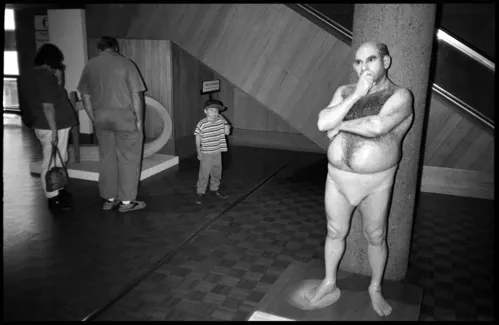
Photographs can be a way of studying the artwork you’re capturing. Artist Ed Templeton, who produces paintings, photography, and drawings, often uses his phone as a tool for understanding how paintings are made: “As a painter, I might be working on something and can use the images. I shoot to dissect how a certain painter achieved something, how they used their materials and brushwork, and how it might inform me if I’m doing something similar,” he said. That curiosity often means “getting as close as the museum guards will let me.”
In this sense, a photograph becomes less a souvenir and more a reference—a way of building a visual archive. Templeton describes his approach as “practical,” even if he acknowledges the other impulse at play, which he admits to occasionally falling for: people photographing art “almost like a trophy or a celebrity, to prove that they were in the presence of a famous work.”
Being clear about what you’re looking for—detail, technique, composition—can shift how you frame the image.
3. Use the whole space
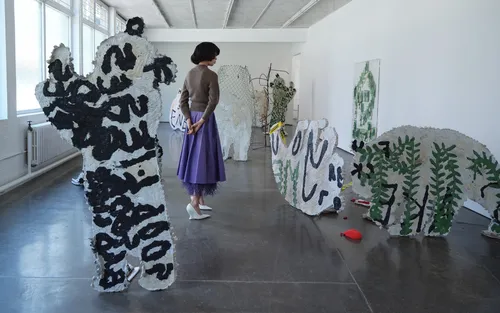
While some photos gain from capturing detail, other cropped images can flatten an artwork, stripping away what about the installation made the work impactful.
For Alexandra Gordienko, founder of MARFA Journal and a prolific photographer, context is crucial. She recalls Lisa Brice’s 2023 exhibition at Sadie Coles HQ in Bury Street, which featured just two paintings. “If you took a photograph and cropped it around the work, it would have looked like just another white space and the artwork,” she explained.
A wider shot, however, tells a different story—revealing “how sparsely the space was arranged, and how small the gallery was in relation to the artworks, how they sit in this historical building.” Sometimes the most meaningful photograph isn’t the closest one, but the one that captures how the work exists in space.
4. Notice (and accept) what you can’t photograph
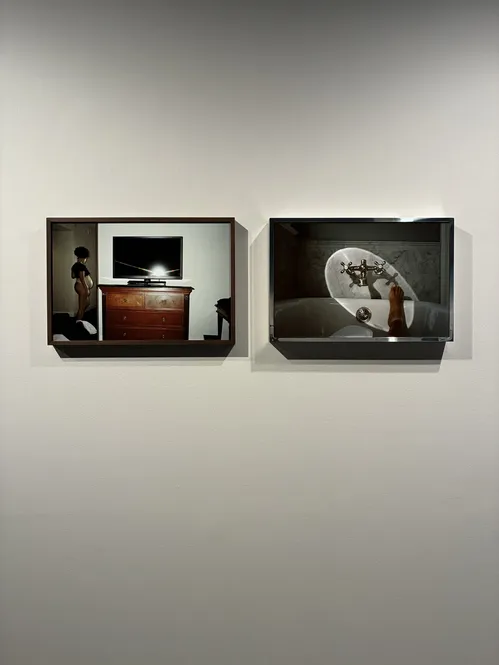
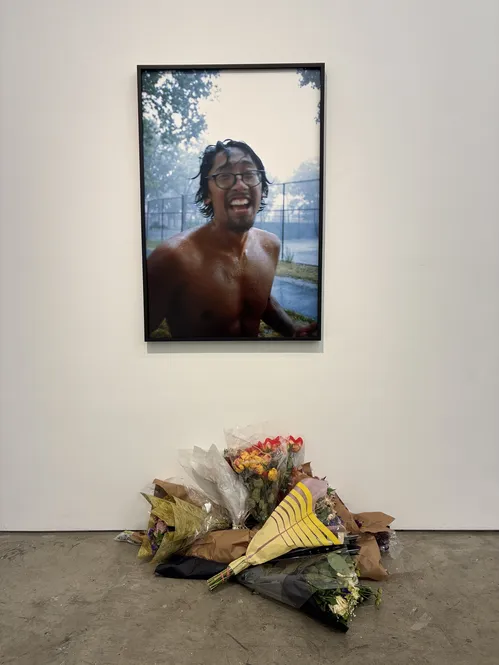
Even the most careful photograph can’t reproduce the physical experience of encountering art. “Texture is hard to translate, and scale is sometimes hard to understand,” Templeton noted. For him, seeing Otto Dix’s monumental triptych The War (1932) in person was unexpectedly demystifying. “In close detail, some of the brushwork and the way the paint sat on the canvas was surprisingly simple,” he said. “It was very eye-opening.”
Photographer Martha Naranjo Sandoval recalls a similar shift when viewing a physical print of Graciela Iturbide’s La niña del peine (1980). Despite having seen the image depicting a girl with a comb many times, Sandoval had never noticed what lay beyond the doorway she stands in front of.
“The first time that I could see that something was happening behind the girl was when someone showed me a print,” she said. “It’s something so delicate and subtle that, if I had tried to photograph it on my phone, it wouldn’t have shown.”
Rather than seeing this as a failure, it’s worth embracing the gap; a photograph can’t fully preserve an artwork—it points back to an experience you can’t fully replicate.
5. Share what you love
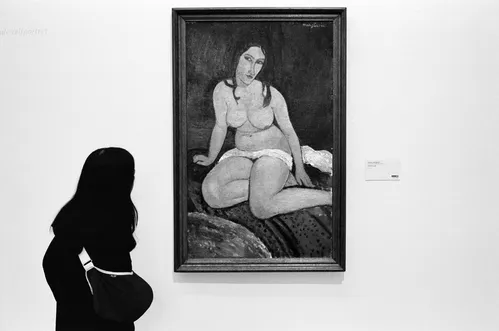
Finally, it’s worth turning the question back on yourself. Artist Zora Sicher describes her phone as a tool for thinking through what she sees. “All I’m doing is making connections between different influences for myself.” Photographing becomes a way of processing—“feeling something about someone else’s brain,” and holding onto “the little piece of it that makes sense to me.”
At its simplest, the impulse is human, and a core part of Sicher’s practice: to share something that excites her with the world.
Rather than aiming for a perfect reproduction, it can be useful to think of your photograph as a response to what moved you.
