








A Mixtec human skull adorned with turquoise, shell, jadeite and quartz, displayed for over six decades at the Wereldmuseum in Leiden, is now in the custody of Mexico’s National Institute of Anthropology and History (INAH). The remains, whose mosaic embellishment was likely assembled in modern times, were repatriated to Mexico in May 2025 following an initiative by the Nchivi Ñuu Savi collective and the Mexican artist Daniel Aguilar Ruvalcaba. The Yucu Saa Community Museum in Villa de Tututepec, Oaxaca, is the ancestor’s planned final destination.
The skull’s past is complex. In 1964, the Wereldmuseum’s then-director Pieter Hendrik Pott acquired it from the American dealer Robert Stolper. Although lacking provenance records, it was believed to date to the Late Postclassic Period (AD1300-AD1521) and was shown in the museum’s Central and South American gallery.
Concerns about its authenticity prompted analyses in 2011 and 2012, which were published in a 2013 paper by the archaeologist Martin Berger. The studies indicate that the skull belonged to a male who was between 35 and 49 years of age, from southern Mexico, supporting a Mixtec association. The mosaic materials are pre-Hispanic, though some shells were likely buried earlier and 99% of the adhesive is modern.
Pre-Hispanic human skull adorned with turquoise mosaic Photo: Gerardo Peña, INAH
“The skull as we see it today is clearly a modern combination of ancient elements,” Berger tells The Art Newspaper. “It was likely created in Puebla and Oaxaca’s border region, where turquoise has been found in dry caves along with burials.” In the press release announcing the remains’ returns, INAH says the skull may undergo further study, possibly including radiocarbon dating.
The skull is one of ten similar examples, most of which are modern combinations. By contrast, the only turquoise-mosaic skull found in an archaeological context is the one from Monte Albán’s Tomb Seven, discovered in the 1930s. But that skull differs in form and function from the other examples. For Berger, the present example illustrates how Indigenous ancestors were disrespected “in service of the international art market”, but also how they can be reappropriated into community histories.
In 2022, Aguilar learned of the skull during a residency at the Rijksakademie in Amsterdam. Aguilar’s project led to a restitution effort. He partnered with the Nchivi Ñuu Savi collective, founded in 2020 by Mixtec experts to promote the Ñuu Savi (people of the rain) language, culture and rights. The Yucu Saa community museum later joined the campaign, holding community workshops.
The group worked on a restitution petition. But in 2023, Mexican authorities made a separate request, which was approved by Dutch officials in December 2024. Aguilar says the Nchivi Ñuu Savi collective’s campaign was disregarded, prompting 1,020 Tututepec residents to petition the INAH to display the ancestor at their community’s museum. “There was a fair amount of institutional ghosting; authorities took over a year to respond,” Aguilar says.

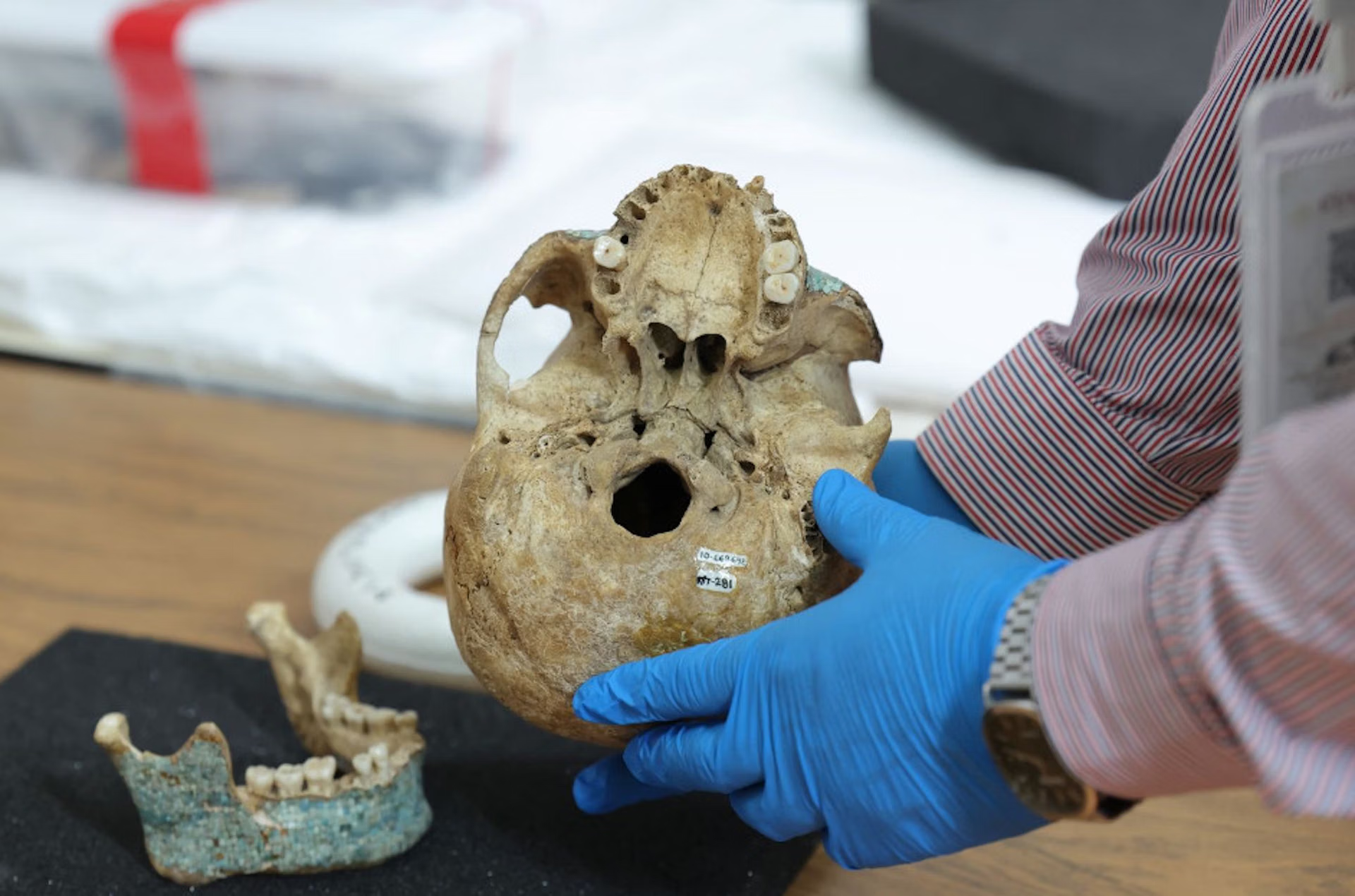
Pre-Hispanic human skull adorned with turquoise mosaic Photo: Gerardo Peña, INAH
Mexican authorities have since acknowledged the collective’s work. “We recognise the collective’s initiative, whose work contributed to the skull’s return and its reconnection with community memory,” culture minister Claudia Curiel says.
“Beyond archaeological debates on authenticity or its origin, looting impacts collective memory,” a representative of the Nchivi Ñuu Savi collective says, describing its return to the museum as an “act of historical justice and dignity”. The lack of provenance, the representative adds, is a consequence of violence. “This is also an act of recognition and respect for our ancestors, their memory and our bond with them.”
Raúl López Nicolás, the director of the Yucu Saa Museum, says representatives of the INAH visited his institution on 15 June and later informed them that the ancestor will first be exhibited at the Museo de las Culturas de Oaxaca. Its display in Villa de Tututepec is planned for April 2027, once conditions are in place. “We are currently working to improve security and exhibition conditions,” López says.
To those who advocated for the ancestor’s return to the Mixtec community, this case could set a meaningful precedent for future restitution efforts in Mexico. “We want to prove that well-organised communities can safeguard our heritage under the highest standards,” López says. “This debunks the centralist notion that these pieces can only be exhibited at the big national museums.”


