


I meet Diego Marcon at a Milanese café on an autumnal afternoon and remark that his work is blowing up in the US. Recently, he had his first American solo show at the Renaissance Society in Chicago and soon, he’ll have another at the New Museum in New York.
He tells me he hasn’t spent much time in the US and that it has been interesting to learn about how his work was being received across the pond. In his first video TINPO (2006), a child wields a gun, light-heartedly terrorizing his family before holding it up to his own hed. Marcon thought was obviously fantastical, just a toy, since in Italy, where he lives, guns are really rare. Stateside not so much: Americans found it dark and serious.
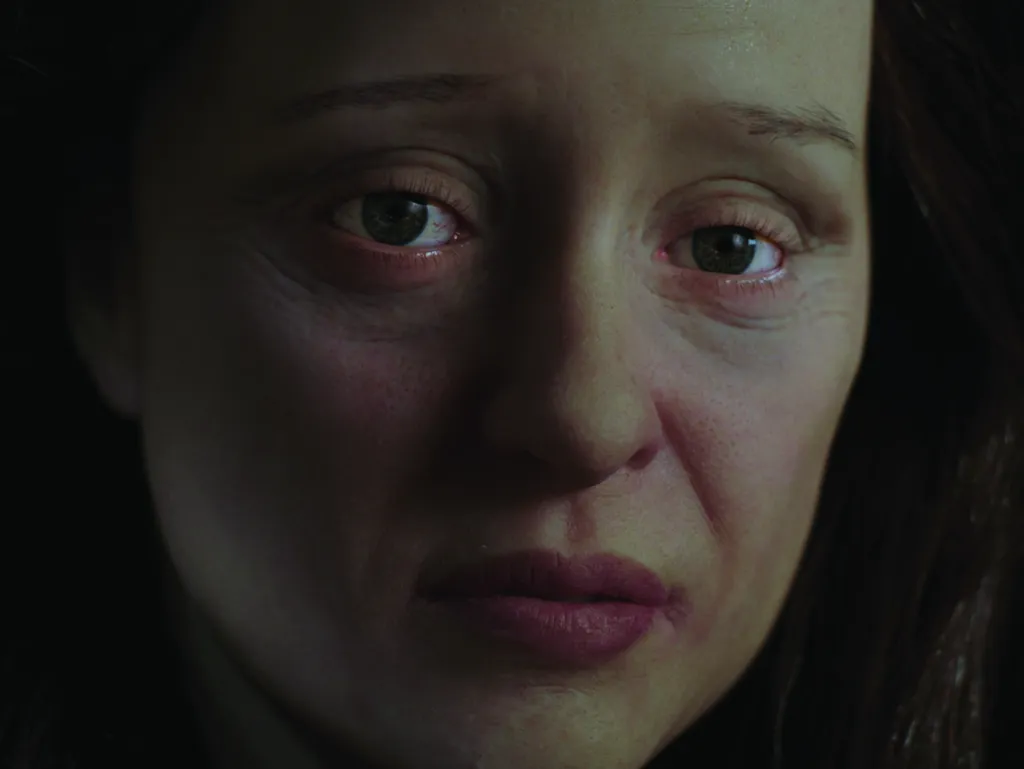
Marcon is the mayor of that sweet spot known as the uncanny valley—where the fantastical collides with ordinary, the real with the fake. The uncanny gun was unintentional, but other disorienting double takes are meticulously concocted. In La Gola (2024), commissioned for a solo show that traveled around Europe, you strain to see whether the people in it are people at all.
View of Diego Marcon’s 2024 exhibition ‟La Gola” at the Kunstverein Hamburg.
©Diego Marcon. Courtesy the Artist; Sadie Coles HQ, London; Galerie Buchholz, Berlin/Cologne/New York; Kunstverein Hamburg; Kunsthalle Wien; and Centre d’Art Contemporain Genève for BIM ’24
That video features two characters—a man and a woman—who stay incredibly still save for their wandering, expressive eyes. As the camera cuts back and forth between them and we follow their epistolary exchange, we might see them in new positions or new settings, but we never see them actually moving—which is creepy. And the focus makes no sense: in one shot, a person’s nose is crisp but his cheeks are blurry, which should mean that basically everything else is beyond the depth of field too. But no: the eyes are in focus, sharp and wet, hauntingly so.
I simply had to ask Marcon how he did it, what I was looking at. He told me that the characters are inanimate busts; he filmed them in different settings, then animated only their eyes using digital effects. These bodiless creatures speak with unusual candidness about the most bodily things: caring for a sick parent with diarrhea, the way “good food eases the burden of dutiful social participation.” The whole time you’re wondering: But do these characters even have a body!?
Marcon’s films often have a narrative, but at the same time, they are very concerned with the materiality of film. These unlikely bedfellows—Hollywood movies meets Structrualist film—turn out to form a happy union, breathing new life into video art. The medium has struggled to standout in recent years, owing largely to the videoification of everything that makes the medium feel invisible. Plus, Skibidi Toilet is a tough act to follow.
For Marcon, structure and language come first, and storytelling emerges later. His films are never narrative in an exposition-conflict-resolution way, but they draw on family dynamics familiar enough that you can easily fill in the gaps (or at least project your own feelings onto his art). In this way, his films are like dreams: it’s hard to say what happened exactly, but the general gist haunts you to the core.

Still from Diego Marcon’s The Parents’ Room, 2021.
©Diego Marcon. Courtesy the Artist and Fondazione Donnaregina per le arti contemporanee, Naples.
Marcon’s marriage of narrative and material has proven popular. He is that now-rare phenom popping up in all the biennials and museums and supported by great galleries, too; in our post-monoculture times, museums have less and less in common with the market, and with each other. In addition to his two US solos, Marcon also featured recently in the 2022 Venice Biennale and the 2025 SITE Santa Fe International, both curated by Cecilia Alemani. His success is proof that while video art can be the hardest sell for viewers, given all the time and weirdness it demands, it is high risk, high reward; so many of the most beloved pieces of this century are made of moving images.
Formally and materially, Marcon sets up new parameters for each piece, always leaving you on your toes as to what is and isn’t real. Take the The Parents’ Room (2021), Marcon’s breakout work at the Venice Biennale, which is what caught the attention of his dealer, Sadie Coles; he also shows with Galerie Buchholz. Initially, I thought for certain that the work was CGI, but was thrown off by dusty bits that screamed celluloid, that were evidence of material film with all its vulnerabilities to the elements. Again, I asked the artist, and learned that this time, unmoving actors were wearing rather realistic-looking silicone masks, doing all their acting with their eyes. It’s an inversion, in a sense, of the way La Gola was made. Together, they show just how much communicating eyes can do.
View of Diego Marcon’s 2025 exhibition ‟Krapfen” at the Renaissance Society, Chicago.
©Diego Marcon. Courtesy the artist; Sadie Coles HQ, London; and Galerie Buchholz, Berlin/Cologne/New York. Commissioned by Fondazione Sandretto Re Rebaudengo, Lafayette Anticipations, the New Museum, the Renaissance Society, and the Vega Foundation. Photo by Bob, ©The Renaissance Society at the University of Chicago.
Marcon’s plots are always dark; their eerie stillness makes me think of Michael Haneke. In The Parents’ Room, a child is executed by his father, who then commits suicide, but neither death is graphic, and all the horror is narrated in this singsongy way. In Krapfen (2025), a traumatized child no longer wants to eat his favorite jelly donut. And in Frtiz (2024), a CGI child dangles from a noose. Yet there is more than just shock value going on; emotionally speaking, these videos contain multitudes. It’s the kind of work that makes you wonder: What happened to this artist? But of course, I didn’t ask him that, and anyway, felt reassured by his smiley sweetness.
Where Marcon makes it hard to tell what’s animate and inanimate, this tension proves titillating rather than simply withholding. That what-is-real, what-is-human sleuthing feels like a heightened version of trying to consume anything in the age of AI. If Marcon’s work is about the materiality of film and of bodies, it is equally about immateriality; in his world, we watch the virtual and visceral collide.
