


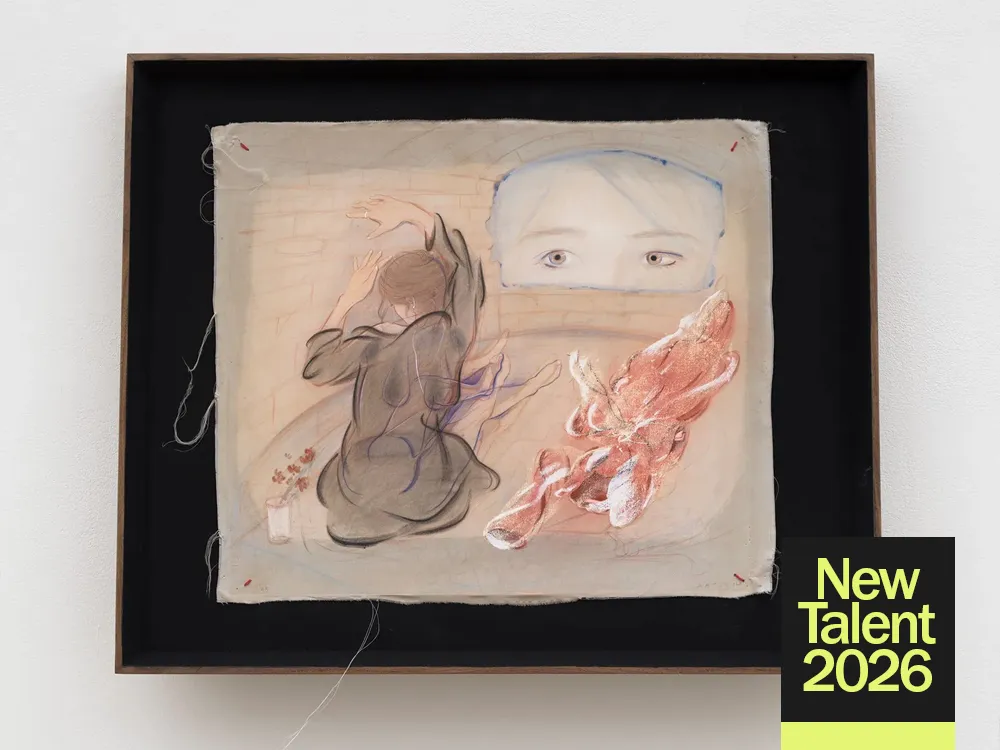
In Joeun Kim Aatchim’s paintings—but she calls them drawings—everything is so vivid, yet so elusive. Her line feels definitive, yet the images they convey seem to fade away into sheer luminosity.
Her works are typically painted using mineral pigment in shellac—sometimes with watercolor, pastel, or other materials—on layers of silk that, stretched across frames, show through to the wall behind. They’re all about one image being seen through another—not different things, in the manner of Francis Picabia’s transparencies, but different versions of the same thing; different attempts, a little like the way Henri Matisse would partially overpaint his works to show multiple thoughts about how to depict one thing, or how to position it within the composition.
Aatchim speaks about her method as being a layering of first drafts. “Rather than working on a piece over and over to make it perfect,” she told me, “I can keep my first thought” even as the piece develops. The result is a bouquet of essays, finding resolution in the tentative. She calls what she does “drawing” because she considers it “a thought in progress,” and because her materials never completely cover the surface she’s working on. “It doesn’t matter if it’s pencil or chalk or paint. If it doesn’t cover the surface, I consider that a drawing, whether it’s on the floor, on the street, or on the wall, or an object.”
The Korean-born artist has been exhibiting widely since earning her MFA at Columbia University in 2017, where she’d gone at the suggestion of Kiki Smith, to whom she’d been an assistant. Since then, she’s had solo shows at galleries in New York, Los Angeles, Guadalajara, Seoul, and Madrid. Coming later this year is her first exhibition in São Paulo, at Almeida & Dale. I caught up with Aatchim not in her Brooklyn studio but in Seoul, by Zoom, while she was visiting her parents. Was she working there? “I tried to rest, but I don’t know how to rest, and I don’t have any hobbies,” she said. “I started thinking, maybe I’m nobody if I’m not making art. So I started making work in the dining room.” In any case, she added, the materials she likes to use are more readily available in Korea than in New York.
But maybe, her real material is mnemonic. She considers her vivid sense of recall to be both a blessing and a curse. She explains that “memories I haven’t drawn yet keep lingering in my head, and have to be stored somewhere. You know, because I stored this somewhere safe, I can now get new memories.” That probably explains why her simple yet multilayered portraits of friends and observations of her everyday world can be at once so clear and distinct yet so intangible. After all, memories can’t be fixed. They’re always thoughts in progress.
