


Every time a tech company promotes an emerging technology like AI or the metaverse, the pitch sounds the same: a promise to “unleash” the imagination, or a new “immersive world.”
When Facebook rebranded as Meta in 2021, its ad showed four people looking at Henri Rousseau’s Fight Between a Tiger and a Buffalo, as it sprung to life and a portal opened before them. Four years later, when Meta debuted its Ray–Ban Meta smartglasses, the company touted its in-lens display and voice activation with an ad featuring Chris Hemsworth and Chris Pratt looking at Maurizio Cattelan’s Comedian, i.e. the banana, which Hemsworth promptly ate. What does it say about our collective consciousness that the direction of tech innovation seems to always lead to that scene in Mary Poppins, when the nanny and her wards jump onto a chalk drawing and end up in an animated world? That question lay at the center of several works performed at Giorno Poetry Systems (GPS) earlier this month.
Located in what was once William S. Burroughs’s loft on the Bowery, GPS hosted a three-day program in early May, “Exert: The Physics of Metaphysics,” that was meant, in the words of artist and curator Mark Leckey, to “give the internet a body.” In the exhibition program, Leckey wrote that he sees the only distinction between machine and human intelligence as “our corporeal self, not in the sense that consciousness can only be embodied—maybe—but that our bodies carry a different kind of knowledge, call it gnosis, that must be heeded. It’s the body that tells you when you are in the right place, time, and company.”
As I stepped onto the line for the event, watching couples pass under the wrought-iron gate that leads to GPS, I certainly felt I was in the right place. Inside, the crowd settled under the loft’s low roof, shuffling over patterned carpets to find a seat, buy a can of beer, or use the single bathroom. There was a golden shrine pushed to the corner of the room to make way for a projector and a comically large sound system. It was day two of the event, and the programming featured a reading by novelist Hari Kunzru, and a performance lecture by critic Gideon Jacobs, a drumming performance by Jay the Bucket Drummer, a Deli Girls concert, and the screening of some of Leckey’s short films. Across the works by Kunzru and Jacobs, both of them still “in process,” the artists seemed to ask the same question: What is reality for in the age of constant simulation?
Kunzru took to the podium and read excerpts from a novel he is developing. In it, a young man is navigating a world in which simulation seems to be encroaching from every corner. He’s paid to show up to a tech party and has to suffer through the founder’s speech about the virtual reality technology he is releasing, or else, when he is with his friends, he notices that the physics of the world around him don’t seem to be operating normally. His friend tries to comfort him when he expresses distress at the breakdown of his reality.
“When you believe something is fake, you feel bad?”
“Well yeah,” he replies.
“You know you can unlearn that, right?”
Feelings or truth, belief or fact: along which axis should we prioritize experience when reality seems so mutable? Is it better to put VR glasses on cows so they’re happier as they produce milk, or let them experience the often horrid conditions of factory farming because it is real? If we make things better by providing a simulation, will the root conditions ever change? There is a sense that simulation, whether it is through VR, AR, or AI technology, is perverse precisely because it is so mollifying. Are images all we really need to be content?
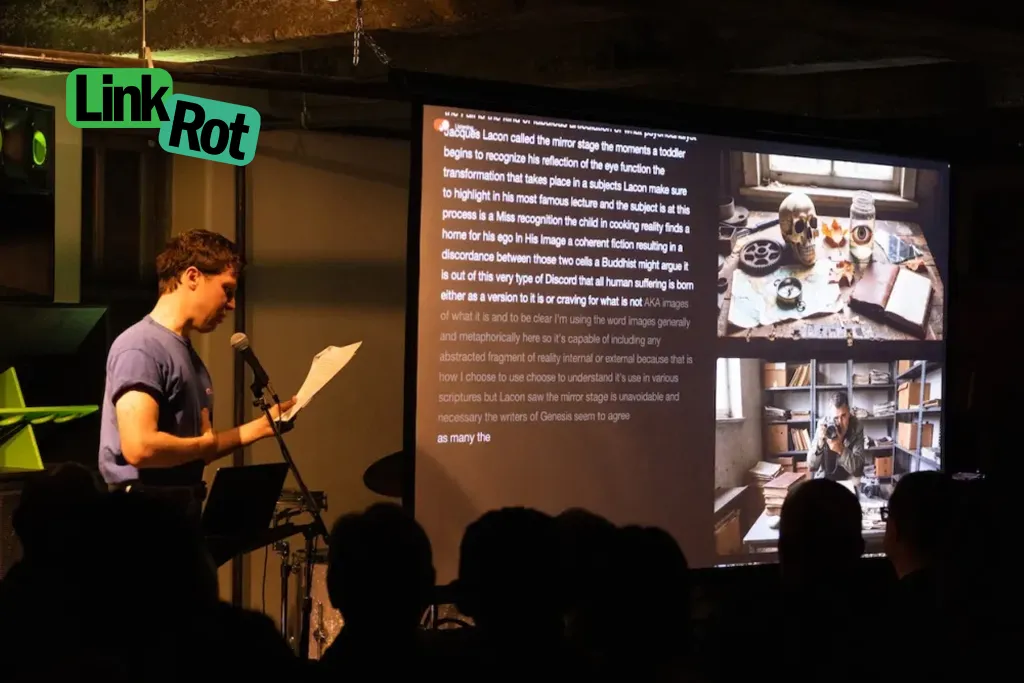
Jacobs addresses this question in his performance lecture “All Images Are Quite Useless,” which blends various genres of creative production. There is a monologue from his play, Images: A Show, an excerpt from his Spike essay “What Are Images Now?,” a guided meditation featuring an AI video work made by Cassandra Jenkins, and a website he made with his brother. The website, which the audience watched from the projector, auto-transcribed as Jacobs read from his essay, and then turned sections of the transcriptions into prompts, which were then turned into images. It was a bizarre experience that scrambled my brain. He would talk, but there was a part of me that couldn’t listen; the constant generation of images seemed to pull my thinking mind out from under me. As Jacobs described Lacan’s theory that babies initially form a cohesive I upon seeing their reflection, images of babies looking into cracked mirrors appeared on the screen. Often lacking such a clear subject, the generator resorted to producing images of a person talking surrounded by people listening, or a (white, male) professor at his desk or drawing calculations on chalkboards. The setting for these images had a post-apocalyptic bent to them in a Young Adult–novel way. Abandoned buildings with peeling paint, cobblestone alleyways wet from rain, scorched paper, and yellowing desktop computers made frequent appearances. If Jacobs mentioned a word connected to spirituality or religion, it would inevitably produce scenes from a desert landscape, featuring robed men.
Sometimes, however, the generator would land on a truly poetic interpretation. As Jacobs described the difference between photographs created with light and images created in data-center darkness, the generator flashed an image of the interior of a barn. The barn had an open wall, so its interior was in shade, but one could see a bright field outside. In the foreground, a thick rope was being split in half by an invisible force, and where it was being torn the residue from a popped bubble scattered a glitchy iridescence in the air. Inspired.
I was struck by the difference in ‘immersion’ across these different genres. As Kunzru read, I “saw” so vividly the world he was describing, whereas confronted with Jacobs’s Rorschach test of responsively-generated images, I felt like there were flies blocking my vision. That Jacobs’ work was not ‘immersive’—while still being an incredible work—has little to do with AI and everything to do with the coordination of images, text, and sound. It was fragmentary and too responsive, leaving no space for my personal semiotic process to produce its own images in response to what I was hearing, nor did it produce the kind of harmony that would allow me to simply fall into the flow of narrative. This is where the promise of simulation technology so often fails: more images does not necessarily mean more immersiveness.
While the ability to create the images mechanically has certainly reached hyperdrive since the invention of the camera, we have always been an image-making species. While I wouldn’t dare presume what happens in the mind of an animal, the semiotic process—the generation of meaningful signs—is taken to be a particularly human activity. In philosopher Charles Sanders Peirce’s seminal essay “Logic as Semiotic: The Theory of Signs,” he described the process by which human beings generate signs by presenting us with a quintessential scene of imagining: A man begins to wish for something, and he follows that wish with a question: Can I have it? In order to answer this question, he begins to “search his heart,” that is, to imagine the steps he would have to take to have what he wants. The practical nature of the imagination could be seen as the origin of the other side of the imagination: our ability to imagine the impossible, and by imagining the impossible, we have brought a lot of life and death into the world. Often with the image of heaven in mind.
What “immersiveness” means in tech ad-copy parlance is not immersion in our world but in another one. A fantastical, other world where one is chosen for limitless love, a never-ending life, a cosmic quest, and incredible pleasures. In the politics of images, maybe the question is not so much about the difference between reality and simulation, but where our desires lie. Maybe the political image is made in a wish, not for heaven, or fanfiction, but to reside in this world, flawed and ephemeral as it is.
