


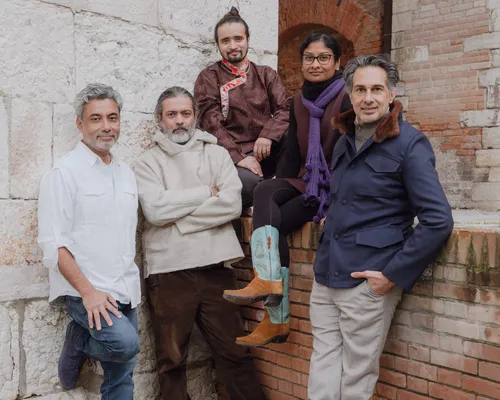
The national pavilion of India will make a return to the Venice Biennale 2026 for the first time since 2019. The group exhibition, curated by Dr. Amin Jaffer, is entitled “Geographies of Distance: remembering home.” The five artists selected to represent the country are Alwar Balasubramaniam, Sumakshi Singh, Ranjani Shettar, Asim Waqif, and Skarma Sonam Tashi, who all make work using organic materials and techniques traditional to India.
The group exhibition will be presented by India’s Ministry of Culture in partnership with the Nita Mukesh Ambani Cultural Centre and Serendipity Arts Foundation. The show will explore the changing notions of home, at a time when India’s cultural identity and landscapes are evolving at a rapid pace. “The India Pavilion brings together artists whose practices reflect the evolving realities of contemporary India. Working across regions and material traditions, these artists articulate India’s global voice through deeply personal and innovative forms of expression,” said Vivek Aggarwal, secretary, Ministry of Culture, in a statement. “Their work demonstrates how India’s creative talent continues to engage meaningfully with questions of memory, place and transformation in a changing world.”
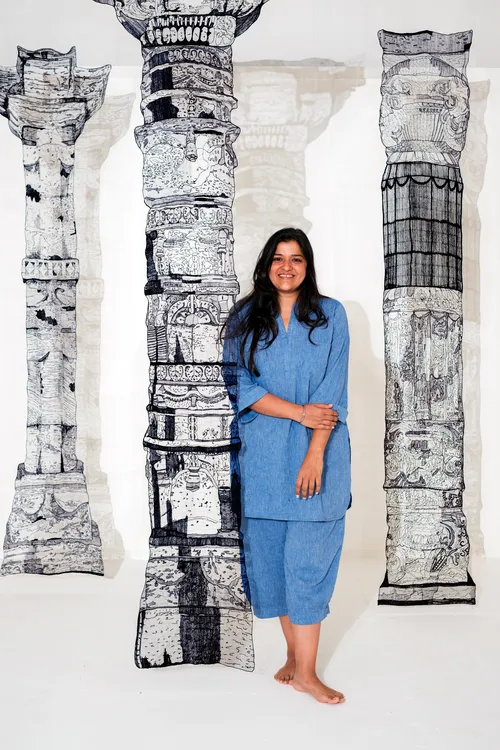
The five participating artists hail from a range of geographical backgrounds across India and work in equally diverse practices. Painter, printmaker, and sculptor Alwar Balasubramaniam, who also goes by Bala, makes work from his studio in rural Tamil Nadu. He uses nearby soil and clay to investigate the relationship between the body and its surroundings. New Delhi–based artist Sumakshi Singh transforms delicate embroidery thread into architectural installations that are imbued with memory and storytelling. Meanwhile, sculptor Ranjani Shettar is known for her large-scale poetic constellations made from beeswax, wood, vegetable pastes, lacquer, steel, and cloth that represent threatened environments in rural India. Asim Waqif, who trained as an architect, uses organic materials including bamboo, cane, and reed weaving alongside other found objects like cloth, rope, and sound elements for his environmental installations that spark conversation about over-consumption and sustainability. And Skarma Sonam Tashi’s practice is heavily informed by the mountainscapes and ancient building techniques of his native Ladakh, which he represents in his tableaux using transformed materials like papier mache, glue, and natural pigment.
Gajendra Singh Shekhawat, the union minister of culture and tourism of India, added:“India’s return to La Biennale di Venezia is a proud moment of reflection and a statement of cultural confidence. Our national pavilion will showcase a contemporary India that is deeply rooted in its civilisational memory while fully engaged with the world today. Through this pavilion, India affirms the strength of our cultural diversity, the vitality of our creative communities, and the role of art and culture in contributing to how our nation is seen and understood on the global stage.”
