


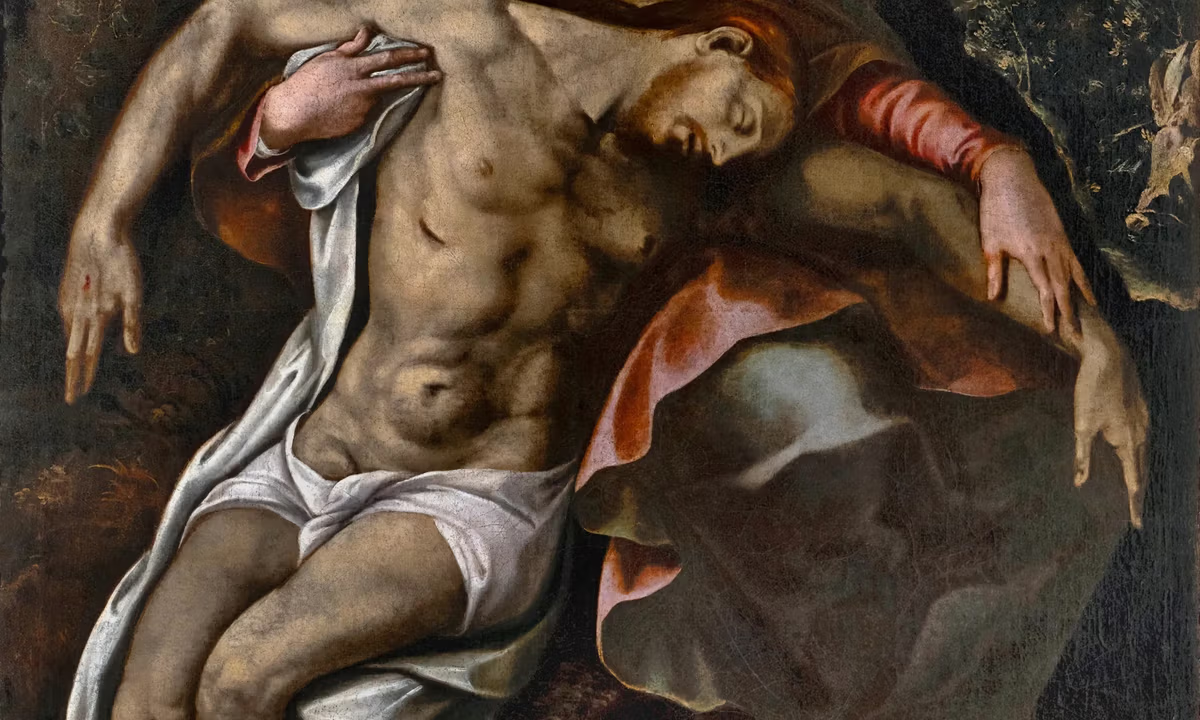
Earlier this month, the Belgian art historian Michel Draguet published to much fanfare a 600-page report on what he contends is a newly discovered painting by Michelangelo. Draguet has entitled the controversial work the Spirituali Pietà and dated it from the 1540s.
This announcement was met with swift scepticism, with a series of unnamed experts reportedly expressing doubt. The art historian David Ekserdjian, an emeritus professor at the University of Leicester, UK—and a leading authority on the Italian Renaissance with particular focus on Correggio, Parmigianino and Michelangelo—tells The Art Newspaper: “This painting, in terms of artistic style, has nothing to do with Michelangelo.”
The painting was bought in 2024, from the Wannenes auction house in Genoa, Italy, which had listed it in its Old Master and 19th-century paintings catalogue (25 June 2020) as an anonymous work from the 16th-17th centuries.
The buyers, two Belgian collectors, have not revealed their identities. Draguet says they are not currently seeking to sell the painting, but to place it on loan with a museum, in order to further art historical study and discussion. “As long-term philanthropists, they are convinced this is a Michelangelo and should therefore be in a public collection.”
Draguet had previously worked with the collectors, borrowing works from them, in his capacity as the director general of the Royal Museums of Fine Arts of Belgium for 18 years, until stepping down in 2023.
When they found the two monograms that looked like Michelangelo signatures on the painting, they excitedly asked if he would take on the task of determining their validity. “I got into this as a bit of a challenge,” he says.
Technical analysis by the Royal Institute for Cultural Heritage of Belgium confirms the palette and linen of the painting date back to the 16th century. It shows the monograms were painted before craquelure (dense cracking) formed on the painted surface and also confirms the presence of what looks like the numbers 1-5-4 beside one of the monograms, which could be be an incomplete date.
Draguet, whose further credentials include membership of the Royal Academy of Sciences, Letters and Fine Arts of Belgium and a professorship at the Université Libre de Bruxelles, has based his proposed attribution primarily on those monograms being made at the time the painting was created. They align with monogram signatures attributed to the artist in reference books including Emmanuel Bénézit’s Dictionnaire critique et documentaire des peintres , sculpteurs, dessinateurs & graveurs (1924).
He also cites reddish highlights around the shapes of the composition and the multidirectional brushstrokes rendering both flesh and fabric, as proof of the master’s hand. Mostly, and in a notably circular form of logic, he points to the sculptural pose of Christ supported by the Virgin Mary with his arms outstretched as a much-copied Cinquecento (16th-century) compositional invention which can now be attributed to Michelangelo.
But Ekserdjian highlights fundamental flaws, not within the granular detail of the analysis, but its premise and main focus. Michelangelo was, as he puts it, “incredibly famous for not liking to paint”.
“There are early paintings,” says Ekserdjian, “and obviously there’s the Sistine Chapel ceiling, and there are two frescoes in the Cappella Paolina [in the Vatican Palace]. But that’s your lot.” The other glaring question, to his mind, is, if this were a Michelangelo, and such an influential composition which would go on to be so copiously copied, why would nobody have known by now that he had painted it.
What’s more, Ekserdjian says, Michelangelo was “not a signer… he was legendary for not signing in a monogram”. Famously, the only work, he says, that Michelangelo actually signed is the sculpted Pietà in Saint Peter’s Basilica, in the Vatican. In his Lives of the Artists, Vasari recounts how the artist etched ‘Michelangelo Buonarroti, Florentine, made this‘ on the Virgin’s sash, after overhearing visitors mistakenly attributing the work to ‘il Gobbo’ (the Hunchback), also known as Cristoforo Solari.
Ekserdjian also points to how thoroughly recorded Michelengelo’s output is. “Michelangelo, among 16th-century artists, is incomparably, the most documented in terms of artistic biography, because you have Vasari in 1550, [Ascanio] Condivi, who writes a completely separate biography of Michelangelo [in 1553]; then Vasari is expanded and emended in 1568,” he says.
“These guys might, if he’d painted a picture of this sort, have had something to say about it. It’s true that you should normally be jolly careful about arguing from silence. In other words, saying nobody ever knew that such a thing existed… sometimes things do come out of the blue and surprise people. But Michelangelo is epically and fully documented.”
Draguet says he is open to being disproven nonetheless. Citing Leonardo da Vinci’s Salvator Mundi and the Caravaggios that have emerged in recent years from Spain, he says he wants transparency, “a real public debate, which such works, alas, elicit too rarely.”
Claims relating to a Michelangelo attribution are not uncommon. Last week, for example, an independent researcher in Italy claimed she had found documents linking the artist to a bust depicting Christ the Saviour.
Ekserdjian says he fields three to four requests a week from private collectors who think they have found something major. Very, very occasionally they have. But this, he argues, is “a non-event.”
