


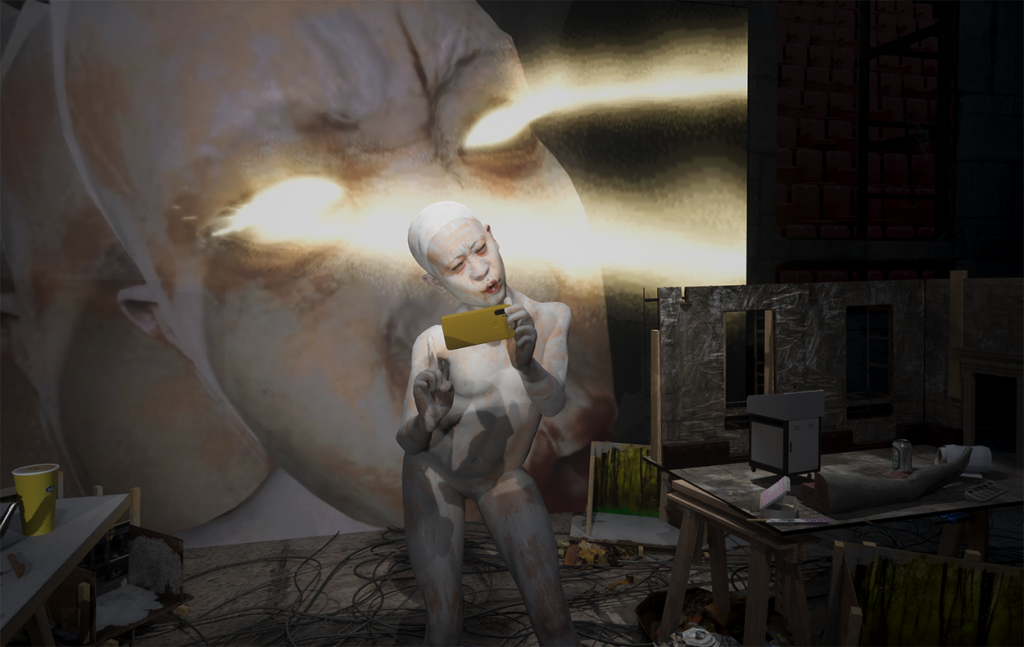
“How do you say ‘bad luck’ professionally in English?” a naked CGI human with a Barbie crotch asks ChatGPT, speaking into their phone. Their body is covered in a messy layer of white paint, and their pupils have been erased, leaving them looking like a demented marble statue. “Inauspicious,” the phone replies, as our protagonist charmingly stumbles through pronouncing it. They’re asking because they want to deliver the bad news gently: “It is inauspicious to be born after 1989.”
What I want to know—and what ChatGPT cannot tell me—is: what is the English word for the emotion Li Yi-Fan elicited in me with this animated video? Screen Melancholy (2026), on view at the offsite Taiwan Pavilion in Venice, is chaotic and absurdist, uncanny and unhinged, creepy and hilarious. But the feeling it produces is more than the sum of its parts—a totally fresh sensation. Beleaguered after three full days of Biennale-ing, it gave me new energy, a second wind.
Screen Melancholy has something of the uncanniness of an Ed Atkins video, the absurdism of skibidi toilet, and the “stuplimity” of a Ryan Trecartin work, to borrow Sianne Ngai’s neologism for that sensorial state where shock and boredom fold into one another as overwhelming becomes the baseline. But Screen Melancholy is also wholly its own thing. ArtReview dubbed Li the “poet of enshittification.”
As the character morphs into an eye, then a prostate, then a heart, then an appendix, they ask us questions: “How’s your relationship with all the images you’ve ever seen?”—while offering something that feels truly unlike any of them. “Do you know about animation?” they ask. “I can teach you, but I have to charge,” delivered in an unforgettable voice. In one scene, the background switches to a desktop cluttered with dozens of saved pasta pictures
“Free charging in the Taiwan Pavilion!!!” the painted figure announces while dancing. It’s a small act of resistance: Technically, since China pressured the Biennale Foundation in 2003, the site is billed not as an official pavilion but as a collateral event organized by the Taipei Fine Arts Museum. Visitors lounge on benches shaped like arms and feet, with working phone chargers sticking out and here and there. Plug in—but prepare for a silly scolding from the painted figure: “Why are you charging your phone in public space? It’s gross!”
I can’t remember the last time I laughed so hard in an exhibition. I admit I was sometimes—but not always—the only person laughing in the packed pavilion. It’s “a real test for who finds it funny or just creepy,” James McAnally of CounterPublic told me reassuringly.
For a chance to see the work in the US, you can meet it in St. Louis: curator Raphael Fonseca is bringing Li to CounterPublic this September. The artist is also in the current the Carnegie International in Pittsburgh. I really can’t recommend it enough.
View of work by Janis Rafa in “Canicula,” a 2026 exhibition at Fondazione Between Art and Film, Venice.
Photo Emily Watlington
As it happens, two of my other favorite offsite works were fleshy films, even vegetarian videos. Thanks in no small part to LED screens, video art is so back. The medium has struggled in recent years to distinguish itself from the endless short-form content flooding our phones, but giant LED screens have a way of merging with their surroundings, turning images into environments. Plus, they look incredible in a palazzo.
Fondazione In Between Art Film, at the Complesso dell’Ospedaletto, features the best installation of video art I’ve seen in years. I was mesmerized by Janis Rafa’s Baby I’m Yours, Forever (2026). Scenes from an industrial meat refrigeration plant are rendered as haunting and surreal as they ought to be, though not through shock tactics or overt gore. In one sequence, a dangling skinned carcass cuts to a human figure contorted beyond anatomical recognition on a stripper pole: I think I saw a nipple on a shoulder blade, though I can’t be sure. Elsewhere, milk pours down a staircase like a waterfall.

View of Lu Yang’s exhibition “DOKU The Illusion,” 2026.
Photo Ludovica Arcero. Espace Louis Vuitton Venezia.
The whole thing is mesmerizing and disgusting at once—daring you to look away while luring you in closer—like Chaïm Soutine’s horrified-yet-fascinated slaughterhouse carcasses, painted by a man who kept kosher. Rafa, a Greek artist whose practice often centers animal life, understands disgust without turning it into moralism. I find meat disgusting both morally and materially, but her work doesn’t preach, even if it hardly makes meat seem appetizing either.
Lu Yang, at Espace Louis Vuitton, offers a rejoinder to Li Yi-Fan’s maximalism. Maybe in an era when we’re all numbed by images, more is more. The Louis Vuitton store is no palazzo, but Lu Yang transforms it into a reflective chapel—something like the inside of a lunchbox. A mirrored ceiling reflects the main event—a video—turning it into a kind of futuristic fresco.
Still from Lu Yang’s film DOKU The Illusion, 2026.
Courtesy Espace Louis Vuitton Venezia
Buddhist meditations on attachment and desire overlay visuals that morph between anime, anatomy lesson, and music video, complete with an interior tour of the protagonist’s torso before he breaks into dance wearing stunning red eyeshadow. Thoughts on karma punctuate a dancey sequence staged in the meat aisle of a grocery store, where some of the cutlets are labeled “human.”
Iván Tovar: El Fuete Melancolico (The Melancholic Whip), 1969.
Photo Courtesy Fundación Iván Tovar.
All three exhibitions traffic in the surreal, but the final unmissable offsite show belongs to a capital-S Surrealist: Dominican painter Iván Tovar. His knockout paintings were a genuine revelation; I even prefer them to Wifredo Lam’s. A century ago, as fascism rose and reality itself seemed to lose coherence, the Surrealists became the great painters of human-animal-object hybrids. It’s easy to see why that sensibility has returned with such force today.
