






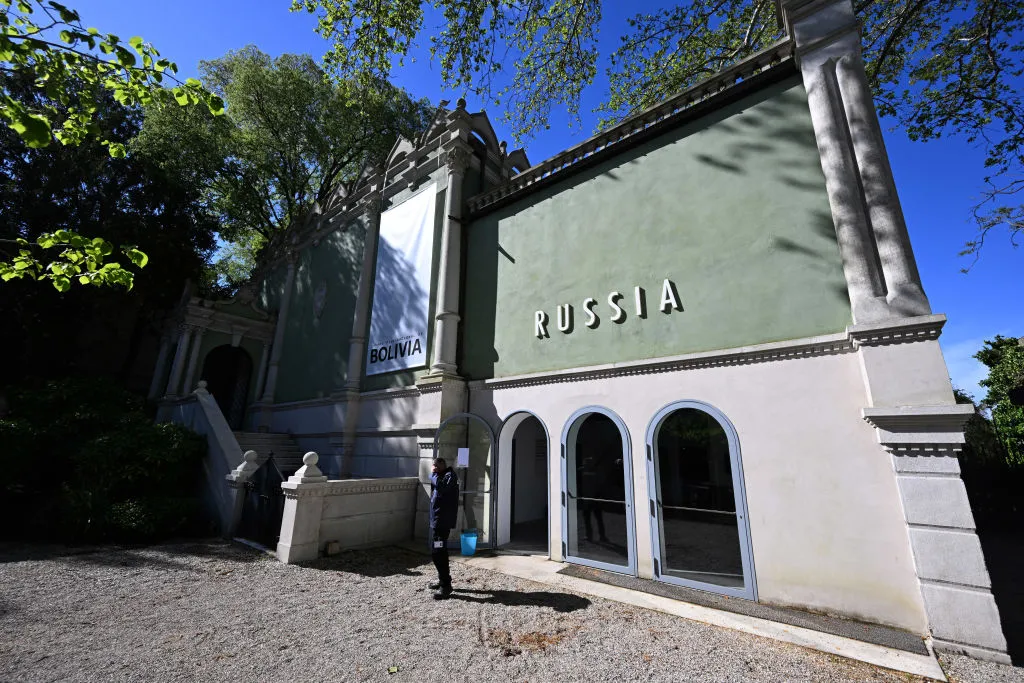
Only days before the opening of the 61st Venice Biennale, Italian culture minister Alessandro Giuli has launched his long-teased investigation into the Russian Pavilion. Italian media reported today that an inspector sent by the minister to Venice has set up an office in Ca’ Giustinian, a palazzo on the Grand Canal in San Marco, and has demanded full access to all records related to Moscow’s presence at the exhibition.
According to La Stampa, the investigation is focused on any “irregularities” in documentation significant enough to prevent the pavilion from opening to the public on May 9, including issues related to entry visas obtained for the Russian artists and their delegation. In response, a source reportedly close to Venice Biennale president Pietrangelo Buttafuoco expressed confidence that no regulations were violated in relation to the Russian Pavilion, and that the parties involved in its planning had cooperated with full transparency with the Italian Culture Ministry.
Among the reported justifications for the inspection is the decision by the Biennale’s international jury to exclude Russia and Israel from any awards on the grounds that their leaders are “accused of crimes against humanity.” The inspection also raises the possibility of further escalation on the ministry’s part, as the next potential step would be to place the institution under special administration—a move that would significantly expand the inspector’s access to documentation pertaining not only to Russia, but also to Israel.
The Russian Pavilion has become a lightning rod for political controversy in the weeks leading up to the opening of the Biennale, with voices across Europe’s arts and culture sectors urging its exclusion as the country’s war against Ukraine continues. Earlier this week, reports emerged that the pavilion will be accessible to the public only during the Biennale’s pre-opening vernissage (May 5–8), seemingly in compliance with international sanctions against Moscow. A performance tied to the pavilion’s exhibition, The Tree Is Rooted in the Sky, will be staged for preview attendees, after which the building will close for the remainder of the Biennale, with digital documentation of the performances presented on screens installed in the building’s windows.
The plans were first reported by Italian news outlets, which cited email correspondence reviewed by their reporters between Biennale president Buttafuoco, Biennale general director Andrea Del Mercato, and Russian Pavilion commissioner Anastasia Karneeva. According to the reports, the framework for Russia’s participation began to take shape in June 2025, while an excerpt from a November 2025 email exchange between Karneeva and Del Mercato shows the latter’s efforts to help secure a travel visa for pavilion curator Petr Musoev, citing his correspondence with an official tied to Italy’s diplomatic mission in Russia.
The Biennale Foundation responded to the published correspondence, saying in a statement to Il Giornale on April 27 that planning for Russia’s participation had been carried out with “absolute respect for the rules,” adding that it had acted “in strict compliance with applicable national and international laws and within the limits of its powers and responsibilities.”
Giuli, however, has maintained steadfast opposition to the Russian Pavilion, announcing earlier this week that he will neither travel to Venice for the preview of the exhibition nor attend its opening ceremony on May 9. He previously called on the culture ministry’s representative on the Biennale’s board of directors, Tamara Gregoretti, to resign; she resolutely declined.
Earlier this month, the European Union cut its annual funding to the Venice Biennale—reportedly $2.3 million—citing the roughly 15,000 Ukrainian civilians who have died as a result of Russia’s invasion since 2022.


