


This month, on 11 June, marks the 250th anniversary of John Constable’s birth. Two books about his art were published in 2025, comparing and contrasting it with that of his great contemporary in landscape painting, J.M.W. Turner, and designed to appear in the latter’s own 250th anniversary year (Nicola Moorby, Turner & Constable: Art, Life, Landscape, Yale University Press, reviewed in The Art Newspaper June 2025;and Amy Concannon (ed.), Turner & Constable: Rivals and Originals, Tate Publishing). Meanwhile, a book by Tim Barringer focusing on Constable’s work in the collections at the Yale Center for British Art in Connecticut (Constable, YCBA) appeared late last year, in anticipation of the 2026 anniversary.
Constable’s rural upbringing was unusual for artists in this period
Unlike those publications that appeared last year, which essentially take an art historical approach, Constable’s Year blends art history with biography and, above all, with nature writing in a delightfully seamless way. The author brilliantly succeeds in demonstrating how Constable’s art and life were shaped by the yearly cycles of weather and, especially in his early career, by the changing agricultural seasons in his native English county of Suffolk. This is a highly original and imaginative approach, and one the author has undertaken by visiting many of the Suffolk sites Constable depicted in his art in the very seasons he painted (or experienced) them. Owens even committed herself to writing the four chapters of her book—which opens with spring and ends with winter, thus covering the trajectory of Constable’s life (1776-1837) from youthful promise to the struggles of old age—during the actual seasons they chart.
Given her subject, one might at first assume the source material to be at its richest for those chapters covering spring or summer. For they were Constable’s preferred seasons, and indeed most of his paintings destined for exhibition at the Royal Academy of Arts (in the second half of his career mainly produced in the studio) are scenes set in high summer and, more often than not, at “noon”. Equally, the summer months—as for most landscape artists in this period—were Constable’s favoured season for making plein-air sketches. Yet Owens manages to give equal weight in her book to autumn and winter too. She achieves this not only by assessing the works themselves, and their known (or likely) dating, but by mining the extensive Constable correspondence published by the Suffolk Records Society between 1962 and 1975.
If we were unable to deduce Constable’s intense love of nature simply from looking at his paintings or drawings, we would need only turn to his letters for evidence. The letter he wrote to his great friend Archdeacon John Fisher in 1821, about his love for “the sound of water escaping from Mill dams,…Willows, Old rotten Banks, slimy posts, & brickwork” is well known. However, the correspondence contains many more utterances like these, often made by Constable at the turn of a new season, registering, for example, his joy at hearing skylarks in spring, noticing buttercups flowering in the Suffolk meadows, or observing the intensity of the season’s blossom. Owens cites many of these passages, as well as emphasising the artist’s love for the Georgian nature poets James Thomson (especially his celebrated series of poems The Seasons, published in 1730), William Cowper and Suffolk poet Robert Bloomfield. Moreover, throughout the book, the author reminds us that Constable’s rural upbringing—he was the son of a farmer and corn merchant—was unusual for artists in this period, and helped shape his profound understanding of the agricultural calendar.
London’s hold
Owens points out that Constable could rarely leave London (where he had lived since 1799) for Suffolk during the early spring, because he was usually busy finishing the paintings he intended to submit to the Royal Academy exhibition, which opened on the first Monday in May. Meanwhile, if summer was the most productive time of year for him to gather new material in the field, in practice the summer months tended to run well into autumn if the weather remained fine, whether he was painting in Suffolk or elsewhere. Thus Constable might continue to paint as late as October, even early November.
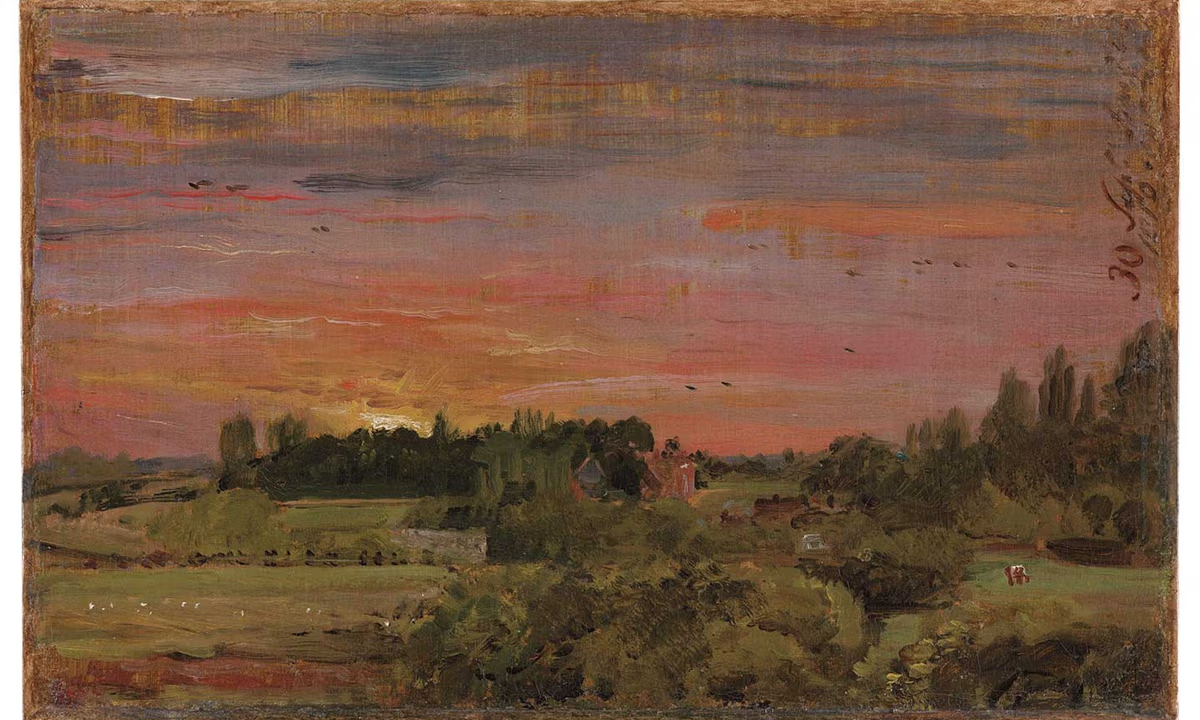
Constable’s Hampstead Heath, Looking Towards Harrow, at Sunset, 12 September 1821. Though summer was the favoured season for plein-air art at the time, Constable painted landscapes through most of the year Private collection
Examples of his early autumn paintings or plein-air sketches include: Stour Valley and Dedham Church (around 1815, Museum of Fine Art Boston), in which labourers are seen busy digging manure from a dung heap for seasonal spreading on the nearby fields; views of Weymouth Bay or Osmington village made during his autumn honeymoon of 1816; and many of the sky studies he made in oils in Hampstead, London, in the early 1820s, annotated by him as having been painted in September or October. Although Constable himself claimed to dislike “the autumnal tints in nature”—he knew only too well that autumn was traditionally regarded as the classic “painter’s season”—the fact remains that his response to autumn often depended on his mood or the weather.
Just as Owens has emphasised, despite his protestations to the
contrary, that autumn was of great importance in Constable’s art, so too has she weighed the significance of the more easily overlooked season of winter. For winter was the time when, as for most artists, Constable switched to painting in the studio. His famous six-foot works were all painted over the winter months. Owens takes the example of The Hay Wain (1821, National Gallery, London) to demonstrate the effort—and skill—on Constable’s part in successfully conjuring up the feeling of a Suffolk summer noon during lamp-lit winter days in London.
These, she writes, were demanding months for him both physically and mentally. It was in the winter that the collaboration between Constable and the engraver David Lucas over the late print series English Landscape tended to be at its most fraught, especially if Constable was suffering from illness, including attacks of rheumatic fever. The prints made for the series reveal the “chiaroscuro” of nature as seen at different times of the day and through the changing seasons. Although winter is the only season in the series not to be so named in one of the print’s titles, some of the engravings, especially those with blustery skies—and Owens here singles out Hadleigh Castle (1829)—have a distinctly wintry feel.
This is one of many insights Owens’s unusual approach yields in this rewarding and beautiful book. Constable’s Year should be perused and revisited whatever the season.
- Susan Owens, Constable’s Year: An Artist in Changing Seasons, Thames and Hudson, 224pp, 61 colour Illustrations, £25 (hb), published 29 January
- Anne Lyles is an expert, curator and writer on Constable and 19th-century British landscape art
