


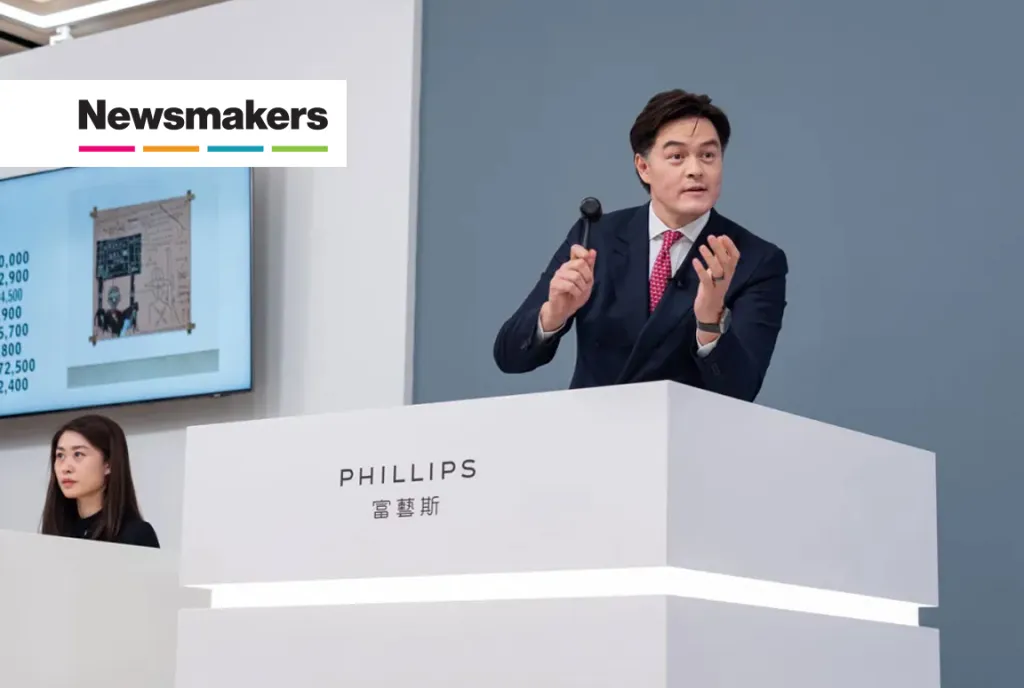
The auction house Phillips is currently going through a major executive shake-up as several high-profile senior leaders have exited the company this summer, as ARTnews reported last week. Among them is Jonathan Crockett, Phillips’ outgoing Asia chairman who will step down on September 2 after leading the firm’s regional expansion for over a decade.
An accomplished athlete of English, Irish, and Chinese heritage, Crockett previously worked at Sotheby’s in both London and Hong Kong and ran his own art advisory firm before helping launch Phillips’ regional headquarters in Hong Kong in 2016. Under his leadership, Phillips expanded its presence into eight major Asian cities, including Tokyo, Taipei, and Jakarta.
He also drove surging Asian client participation in Phillips’ global salerooms, including helping orchestrate the 2022 sale of Jean-Michel Basquiat’s Untitled, from the collection of Yusaku Maezawa, for $85 million to an Asian buyer, marking the most valuable lot ever sold by Phillips. This past March, the house’s Hong Kong sales achieved over $76 million, a 50 percent year-on-year increase from the $51.6 million worth of art sold in 2025, with collectors from Japan having an increase buying activity of 95 percent by value year-on-year.
Ahead of his departure next week, ARTnews spoke to Crockett on August 25 about his move back to London, his next steps, and the state of the art market in Asia and globally.
This conversation has been edited and condensed for concision and clarity.
ARTnews: After leading Phillips in Asia for over a decade, why did you choose to step down and return to the UK?
Jonathan Crockett: I’ve spent most of my professional life away from home, and I’ve already lived in Hong Kong for almost 20 years. The primary reasons for returning home now are family: my father passed away a couple of years ago, my mother now lives alone, and I want my children to go to school in the UK. But personally, I’m someone who likes challenges. The challenges I had set for myself were conquering new markets and building our mainland China presence. I’m not the type to settle, so when we reached the point where we’d ticked all those boxes and things started to feel routine, my engagement and intellectual curiosity naturally wanes, making the 10-year mark a good and natural point to step away from Phillips—it’s at a level where it can sustain itself.
What are your next steps?
For the time being, I’m going to focus on my family. But having spent more than 20 years in this business, with a particular focus on Asia, I’ll remain connected to it and to the clients with whom I’ve built trusted relationships over the years. I expect to continue working with them in a personal capacity, perhaps advising on their collections or helping them buy and sell.
How do you think the Hong Kong and broader Asia markets have evolved since you started?
Since 2009, the market in Asia has never settled—it’s been in constant transformation. It’s seen multiple shifts in how it operates, how collectors prioritize different categories, and how demand reflects changing tastes. The market has included longstanding collectors, but also new emerging collectors and investor-speculative types, people who aren’t typical collectors but buy art and luxury as an asset class. All of these different players have moved in and out of the market over the last 17 years.
In Hong Kong, it feels as though things change more than once a year, because the city has undergone so much economic, social, and political change [in the past two decades], it almost has its own unique microclimate that affects not just the art market, but others, too. When there were far more Western and expatriate collectors in Hong Kong, they had a particular taste that differed from what local Hong Kong or collectors from China were buying.
During the pandemic, with people stuck at home, buying shifted online and by phone, and sales did tremendously well across all categories. Almost like retail therapy, it also triggered a boom in speculative, ultra-contemporary art. Post-pandemic, that trend has cooled significantly. Market taste has matured and pivoted back toward mid-career and established artists, with buyers prioritizing stability over hype.
What do you make of the recent auctions in Hong Kong across the auction houses?
Hong Kong has bounced back. Certain categories have done extremely well: luxury watches in particular, as well as traditional Chinese art, whether ceramics or paintings. We have a presence in watches, so we’ve benefited from that interest, while other houses with fully-fledged Chinese art departments have benefited from the recent resurgence of interest there.
At Art Basel Hong Kong this year, some galleries were selling works for many millions of US dollars, and we continue to see works at that price point sold at auction, so the demand is still there. But it’s definitely lower than before, and the market has responded differently. Instead of fewer high-value lots, we’re seeing record numbers of lots offered, albeit at a much lower price point.
Chinese collectors have been a key driver in this region, but Beijing has recently rolled out new offshore tax and monetary rules, making it even harder to move money out of Mainland China, and markets in London and New York remain so strong. Looking ahead, how challenging do you think it will be to convince collectors to give top-tier consignments to the Hong Kong market?
It’s hugely challenging to secure top-tier consignments for Hong Kong, particularly for Phillips. That’s always been the case over the last 10 years, because we were always the underdog. But we’ve managed to find a way to surmount that challenge. In the past year or two, it’s been particularly difficult, partly because taste has changed and partly because the local economy hasn’t been performing especially well. That said, I don’t think these recent policy changes in China will have much of a knock-on effect on the Hong Kong market.
Phillips Asia headquarters in Hong Kong’s West Kowloon Cultural District.
Courtesy Phillips
Phillips was the first house to have a permanent space in Hong Kong for year-round exhibitions, even before Christie’s and Sotheby’s. Then in 2023, you spearheaded the move of Phillips’ headquarters to the West Kowloon Cultural District, while others chose to stay in the Central district. In hindsight, was that the right move, given that many collectors don’t want to cross the harbor for previews?
Hong Kong is very fortunate to have the West Kowloon Cultural District, I don’t think the city realizes how fortunate it is. Unfortunately, prioritizing public spending is difficult, and the place is still a building site, so I can’t really comment on that. But personally, I think it’s a shame that West Kowloon hasn’t been a top priority for the Hong Kong government. It has every possibility of becoming a global destination for tourism and business—something like the British Museum or the Sydney Opera House, a place people travel specifically to visit—and unfortunately, it’s not there yet. As for our galleries, they are without question the best in Hong Kong in terms of ceiling height, natural light, and space. But in hindsight, had I known it would take this long, I might not have pushed so hard to be at West Kowloon.
We’ve seen many top dealmakers leave Phillips over the past few years, do you think there’s an internal shake-up?
I was hired by [former chief executive] Ed Dolman, whom I really admired, respected, and learned a lot from. I thrived in the culture he built at the company. Since his departure, we’ve had three changes in leadership in three years. Because we’re a smaller company, when someone leaves it feels like a bigger deal than it might at a larger company, where it gets drowned out among all the other employees. But I think what we’re seeing is natural attrition: Yes, people are leaving, but they’re also hiring great people, and the team that remains is still very strong.
What’s the main challenge for your successor?
Running this business has been one challenge after the next, so whoever takes on the role needs to be very adaptable. But the initial challenge, I think, will be sourcing consignments and persuading people that Phillips is the right place to sell their property, as well as finding replacements for the people who’ve left to take on the client-and-collector relationships we’ve built over the last 11 years. But as I say, we’ve got a great team at Phillips, and I think they have every potential to keep the business succeeding.
