


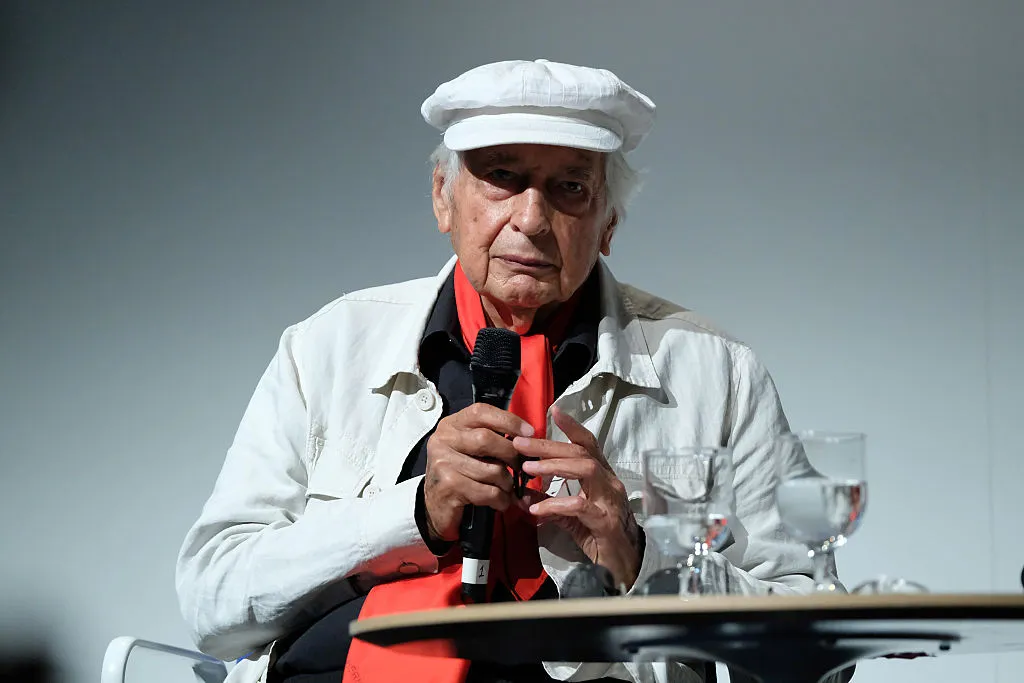
Julio Le Parc, the Argentine-born artist whose shimmering mobiles, vibrating light installations, and participatory environments helped redefine the relationship between art and its audience, died on May 30 in Paris. He was 97.
His son, Yamil Le Parc, confirmed the death to the Argentine newspaper La Nación. The artist had been hospitalized in recent days after a decline in health and died at the American Hospital in Paris. According to his son, Le Parc remained deeply engaged with his work until the end and had been eagerly anticipating a major retrospective scheduled to open at Tate Modern in London on June 11. He had hoped to attend the exhibition, which surveys nearly seven decades of his career.
For more than six decades, he pursued a simple but radical idea: art should not be something that happens to viewers. It should happen with them.
Working with mirrors, light, movement, color, and optical effects, Le Parc became one of the leading figures of kinetic art. His installations often transformed museumgoers from passive observers into active participants, asking them to wander through mirrored chambers, trigger mechanical devices, or lose themselves in fields of shifting light. Long before museums embraced immersive experiences, Le Parc was creating environments that depended on the viewer’s presence to come fully alive.
Born on September 23, 1928, in Palmyra, Mendoza, Le Parc grew up in modest circumstances. His father worked for the railroad and his mother was a seamstress. As a young man, he moved to Buenos Aires to study art, though his path was far from straightforward. Frustrated by the rigidity of academic training, he dropped out for a time before eventually returning to complete his studies.
Before becoming one of the world’s most celebrated experimental artists, Le Parc worked as a doorman at Buenos Aires’s famed Teatro Colón while attending art school at night. He later recalled those years as formative, not only because of the art he encountered but because they reinforced his instinctive skepticism toward hierarchy and established authority.
In 1958, Le Parc moved to Paris on a French government scholarship. The decision would shape the rest of his life. Drawn to a city that seemed alive with artistic experimentation, he quickly immersed himself in a generation of artists searching for alternatives to traditional painting and the cult of individual genius.
Two years later, he became a founding member of the Groupe de Recherche d’Art Visuel, or GRAV, alongside artists including François Morellet, Francisco Sobrino, Horacio García Rossi, Hugo Demarco, and Joël Stein. The collective rejected the idea of the solitary artistic master and instead pursued collaborative experiments centered on movement, perception, and public participation.
Le Parc’s fascination with light soon became his signature. Works such as Mobile Transparent (1960), a suspended cascade of Plexiglas elements, and Light in Movement (1962), an immersive environment built from mirrors and projected light, demonstrated his ability to create visual experiences that seemed to shift and pulse before viewers’ eyes. Rather than presenting finished objects for contemplation, he created situations that encouraged exploration and discovery.
His international breakthrough came in 1966 when he won the Grand Prize for Painting at the Venice Biennale. The award carried a certain irony. Many of the works that earned him the honor barely resembled paintings at all, relying instead on reflected light, movement, and optical instability. The prize nevertheless established him as one of the most important experimental artists of his generation.
Politics shaped his work as much as formal experimentation. Having come of age in Argentina during the Perón era, Le Parc remained deeply suspicious of authority, whether political or cultural. He rejected the notion that critics, curators, collectors, or museums should determine how art was understood. Instead, he believed viewers should arrive at their own conclusions through direct experience. That conviction informed both his artistic practice and his political commitments.
In 1968, after participating in the protest movement that swept through France, Le Parc was briefly expelled from the country. The episode only strengthened his reputation as an artist who viewed experimentation in art and challenges to authority as closely connected pursuits.
Although he became synonymous with the kinetic art movement of the 1960s, Le Parc never stopped reinventing himself. Over the decades he developed major series including Modulation and Alchemy, using subtle shifts in color and geometry to create illusions of movement on flat surfaces. He often worked on multiple projects simultaneously and continued producing new work well into his nineties. As he once remarked, even during a short interview he could find himself imagining a new artwork.
Interest in his work surged again in the 2010s. Major retrospectives were mounted at institutions including the Palais de Tokyo in Paris, the Pérez Art Museum Miami, and the Met Breuer in New York. In Argentina, where he remained a beloved cultural figure despite spending most of his life abroad, celebrations of his 90th birthday in 2019 included museum exhibitions, public installations, and a large-scale light projection on Buenos Aires’s Obelisk.
Even as age limited his ability to travel, Le Parc continued working. In 2024, Argentina’s National Arts Fund awarded him its Grand Prize for Lifetime Achievement. That same year, a monumental golden sphere titled Sol was installed in the departure hall of Buenos Aires’s Ezeiza International Airport. Measuring roughly 10 meters in diameter, it was among the largest mobiles he ever created.
In recent years, he embraced new technologies with the same curiosity that had fueled his earliest experiments. Working alongside his sons Juan, Gabriel, and Yamil, he explored virtual reality projects and launched a virtual museum, extending his lifelong interest in participation and perception into digital space.
Le Parc’s wife, the artist Martha Le Parc, died in March 2025. Together they had three sons, all of whom became involved in preserving and expanding their father’s artistic legacy.
News of Le Parc’s death came less than two weeks before the opening of “Julio Le Parc: Light. Colour. Action.” at Tate Modern, a major retrospective spanning works from the late 1950s to the present. The exhibition traces the arc of a career that stretched across nearly seven decades and helped make participation, movement, and perception central concerns of contemporary art.
Le Parc spent much of his career arguing that the public deserved a larger role in the experience of art. For him, the viewer was just as important as the artist, the critic, the collector, or the museum director. It was a belief that animated his work from the beginning and remained intact until the end.
The Tate retrospective will now open without him. Yet for an artist who spent a lifetime insisting that viewers become active participants rather than passive spectators, the exhibition arrives not simply as a memorial, but as a reminder of how much Le Parc influenced contemporary art.
