






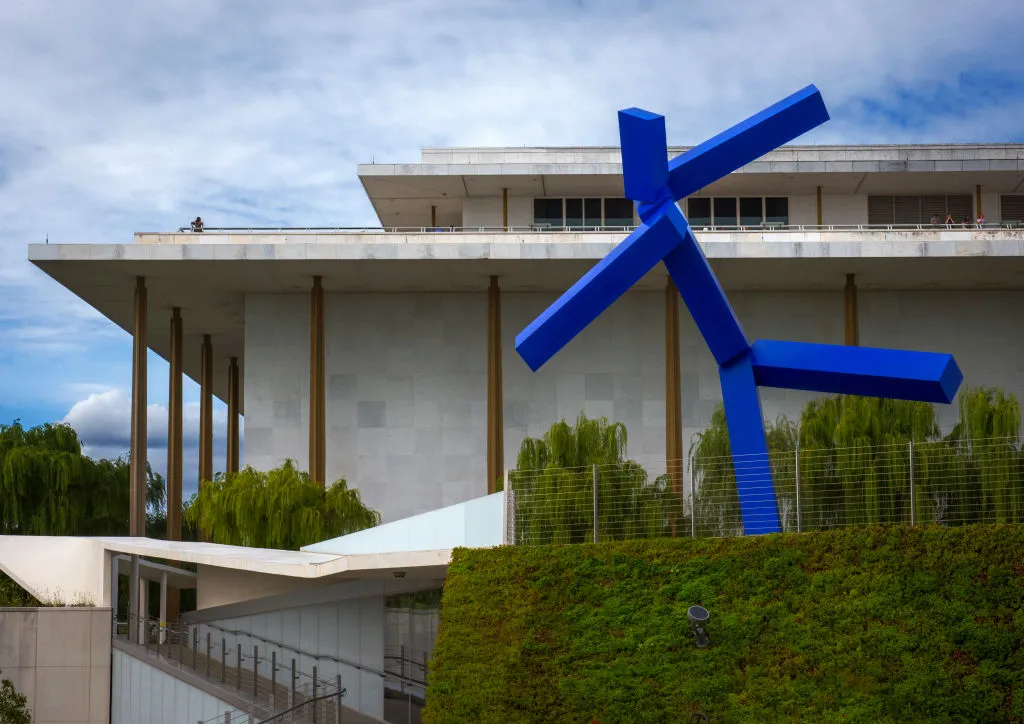
The removal of a monumental Joel Shapiro sculpture at the John F. Kennedy Center for the Performing Arts in Washington, D.C. has generated concern among artists who have shown there.
Workers began to disassemble the Shapiro work, titled Blue, on Tuesday; the Kennedy Center has not stated a rationale for why the 24-foot-tall sculpture of a stick-figure-like person was taken away. But the New York Times reported that internal documents suggested that the work, which Shapiro gave to the Kennedy Center as a gift in 2019, was “targeted for elimination after President Trump’s takeover of the center.” (A Kennedy Center spokesperson did not respond to request for comment for this article.)
In that Times report, Ivy Shapiro, the artist’s daughter, said that her father would’ve been “alarmed” by the deinstallation of Blue. One other artist with work at the Kennedy Center reacted similarly.
“I’m crushed,” said sculptor Deborah Butterfield, speaking to ARTnews by phone on Wednesday, the day after Blue’s disassembly began. The Shapiro sculpture was formerly on view in the REACH, an addition to the Kennedy Center that was opened in 2019. A sculpture of a horse by Butterfield, titled Milk River, is currently on view there, too.
Butterfield described Milk River as being “almost a Buddha.” “It’s a reverential, reflective piece, and I don’t think they’re threatened by it,” she said, so she does not expect it to be targeted for removal. But she worried about what the Shapiro sculpture’s removal could be mean for art in D.C. and the country more broadly.
“It’s the insidious malevolence behind this decision,” she said. “To control our thoughts and what we see, it’s really frightening to me.”
She referred to efforts by the late Pat Williams, a Democrat and a Montana Congressman, to defend the National Endowment of the Arts during the 1980s and ’90s, when that government-run organization was under threat amid a culture war. Once again, the NEA’s grant-making abilities have been severely curtailed. “They’re firing professors, cutting grants, they’re they’re trying to shut people up, you know, taking over networks, trying to control what we hear, what we read, what we look at,” said Butterfield, who served on a panel that reviewed NEA grant applications in 1983. “It’s very scary.”
Others seemed to agree. “The removal of Blue is simply the latest example of Trump’s authoritarian tendencies,” wrote Hands Off the Arts, a group focused on the Kennedy Center, on Instagram this week. “Not content to only deface a memorial, Trump is continuing to censor art and use taxpayer dollars to suit his own taste. As John F. Kennedy said, ‘art is not a form of propaganda; it is a form of truth.’”
The group has said it is planning a protest at the Kennedy Center for September 18.
For the artist Mokha Laget, who spent part of her career in Washington, D.C. and is now based in New Mexico, the Shapiro removal is part of a larger shift in the Kennedy Center’s mission under the second Trump administration. Many artists “had a lot of affection for” the Kennedy Center, she said, but never considered it a politicized institution, adding, “It’s extremely unsettling, to say the least, to see such a dramatic change in its very character.”
In 2023, at the Kennedy Center, Laget exhibited Watershed III, a 35-foot-long abstract painting that responded to a drape painting formerly on view there by Sam Gilliam, a legend of the D.C. scene who died the year before. The painting was exhibited by Laget as a loan under the Biden administration, which had plans to renew the agreement to exhibit the work, she said. But under the second Trump administration, her communication with the Kennedy Center dissolved. “What was previously a well-oiled machine was 1788539355 a ghost,” she said.
Finally, Laget said, she succeeded in reaching someone who helped her get the work back in the second half of last year, during a period when Trump was increasing his efforts to control the Kennedy Center and its programming. The piece is now back with Laget, though the Kennedy Center’s website has not been updated to reflect this.
Though Laget declined to guess why the Shapiro sculpture was removed, she said the event highlighted what she called the “fragile” nature of institutions like the Kennedy Center.
“There’s a kind of social contract between artists and cultural institutions, and that goes with a trust that the institution will care for the work and provide a stable context for it,” she said. “And so, when that contract is broken, for whatever reason, in whatever way, it’s very hard to piece it back together.”


