


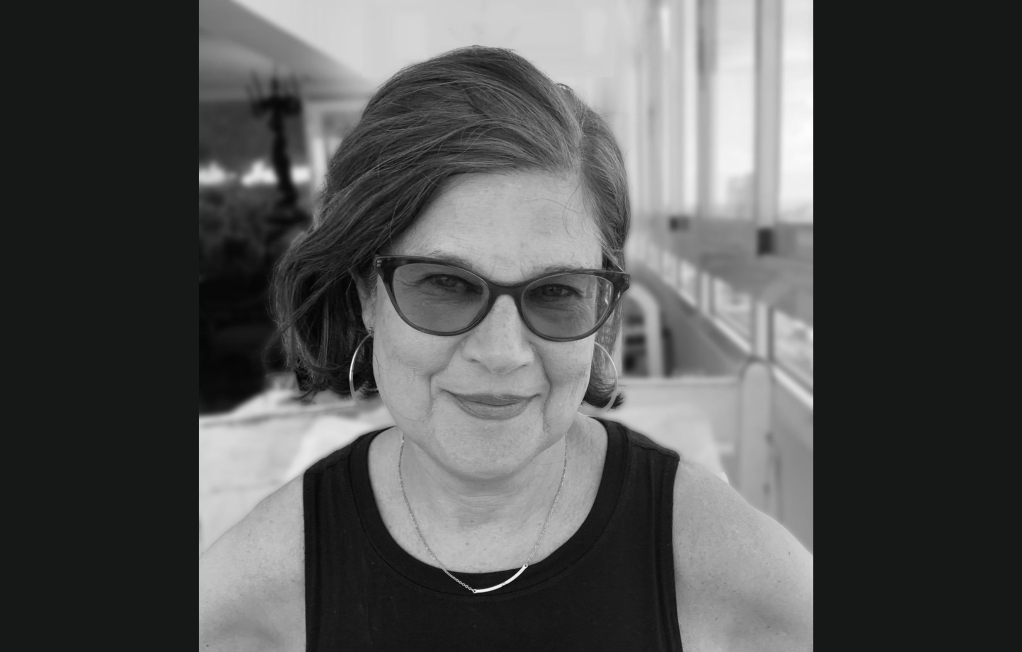
Kit Fitzgerald, a visionary video artist with a sense for the music and motion of painting, died on August 3 at 73. The news was announced by her husband and longtime creative partner, Peter Gordon, on Instagram. He wrote that she “fought a rare and aggressive cancer, but always maintained a sense of beauty and wonderment.”
A trained painter, Fitzgerald imbued electronic art with the unruly touch of brush and canvas—vivid color, dynamic light, stuttered gesture—resulting in what she termed “technology with a humanness.” Her paintings were populated by people and places reduced to wild lines and strange confines; interposed with sound, they provided spectral stages for the preeminent composers, poets, and choreographers of the last three decades. Beginning in 1984, she and Gordon brought their production design to Tokyo, where they performed with Ryuichi Sakamoto; to the Sydney Festival, for an Arthur Russell tribute directed by Gordon; and to La Mama in New York City, for a landmark live show with Max Roach.
“She was one of ten kids in a family that enjoyed each other’s company,” Gordon told ARTnews of her childhood in Springfield, Massachusetts. “She was never one to sit alone; I think that’s why she liked collaboration and performance—it involved working with people.”
In 2020, Fitzgerald created projections for The Mother of Us All, a collaboration between the Juilliard School, the New York Philharmonic, and MetLiveArts: “video quilts that played joyfully with the Engelhard Court architecture at the Met,” as the show’s director, Louisa Proske, shared online.
Kit Fitzgerald, Bleu Fleurs (2014).
Fitzgerald was at the vanguard of American artists critically engaging with television as a medium; she and John Sanborn were among the first artists to receive commissions from PBS and the BBC. Their celebrated collaboration, Interpolation (1979), spliced everyday sounds and images into cacophonous clips, as if broadcast from network news in another dimension—”exaggerated and intensified with unsettling skill,” according to the Metropolitan Museum of Art, which acquired the one-channel video in 2023.
Her body of video work resisted easy explanation. “What is it about? There’s no puzzle, there’s no trick, it’s about itself,” she told MTV in 1982, ultimately describing the experience as an abstract symphony. As the New Yorker once wrote, “Her images are avant-garde painting of a high order.”
Twenty years into the video movement, institutions had begun to take notice. “Video Art: A History” opened at the Museum of Modern Art in 1983, curated by Barbara London and featuring more than 250 artists, among them Fitzgerald. MoMA followed the seminal survey with “The Arts for Television” in 1989, the first of its kind to examine television as a site of creative deconstruction. Sixty-seven artists presented videotapes—encompassing literature, dance, music, theater, and more—as alternative programming; Fitzgerald contributed To Sorrow (1984) to the music section, alongside Laurie Anderson, Robert Longo, and Julie Hayward.
Inspired by the writing of Thomas Hardy, with a score by Gordon, To Sorrow was a meditation on humanity’s self-isolation from nature. Its clips of the lush but lonely Irish pastoral landscape were sourced from another video performance, The Return of the Native, and conveyed some of her cinematic signature: a tracking shot or slow focus from an unexpected vantage point, like a car window; a meticulous pan of shifting light at the far horizon. At one point in To Sorrow, horses amble towards the camera in a slow-motion sign of life.
“Kit was a wonderful artist and a joyous person,” Barbara London wrote online, sharing her condolences.

A still from To Sorrow (1984).
Her work, Gordon reflected, “doesn’t superimpose artifact on top of the real thing. It’s like having a conversation and you listen to what they have to say—some people just talk over the conversation. Kit would listen.”
Fitzgerald’s work was exhibited at the Whitney Museum of American Art, including twice in its biennial, and broadcast at institutions far beyond, including Moderna Museet, Stockholm; Gallery Watari, Tokyo; the Institute of Contemporary Art, Boston; and the Stedelijk Museum, Amsterdam. A Smith College graduate, she taught at Concordia College, where she created and led the New Media Communications and Digital Production undergraduate and graduate programs. Her work was distributed by New York’s Electronic Arts Intermix.
She is survived by her husband and their son, Max.
