


A show of works by the South Korean artist Lee Ufan opening at the San Marco Art Centre is one of 31 official collateral Venice Biennale events announced today to coincide with the world’s most prestigious art exhibition (9 May-22 November).
Curator Jessica Morgan, the director of the Dia Art Foundation, a New York-based arts non-profit, will show works in Venice spanning Lee’s seven-decade career, reflecting his achievements as a leading proponent of the Japanese Mono-ha movement. “I felt that what has been missing is a story of the trajectory of his work. He’s an artist philosopher, a thinker, and I would say his movement through the different series of painterly works has been very clearly conceptualised. It felt appropriate to take [visitors] through his painterly journey, so to speak, from the late 1960s through to the present day,” she says.
“[It is] an overview of these different movements and painting, which actually are quite literally movements, from the expressive series From Line to the works [1973-84] to where movement comes in with the Wind series [1982-91].” Paintings from the Correspondance series dating from the late 1980s and early 1990s will also feature. “It ends with these new paintings—large-scale strokes using incredible colour which also have a dimensionality that has not been part of his practice previously, where the brush strokes almost act like building blocks, creating a sense of depth on a canvas.
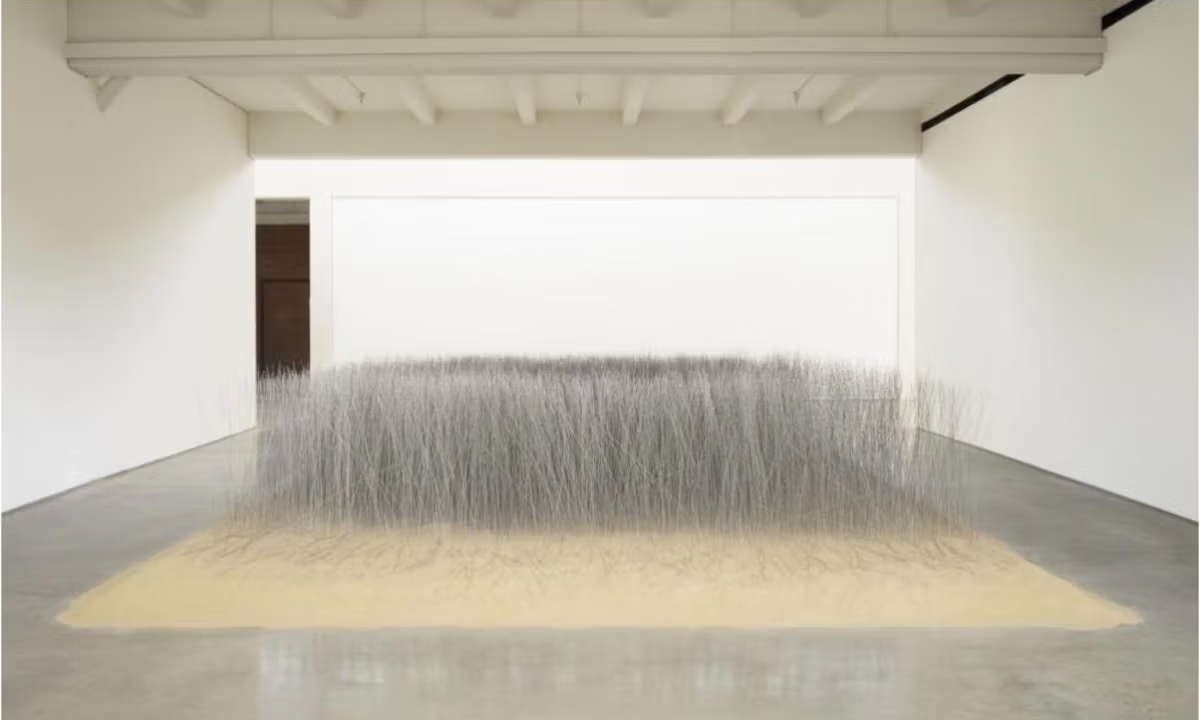
The show, which marks the artist’s 90th birthday, will also include major sculptural works, including Relatum (formerly Iron Field) (1969/2019) drawn from the Dia collection. “It is a bed of sand with hundreds and hundreds of iron rods handplaced [on the work], creating this incredible impression of a natural landscape almost but clearly with an industrial form,” Morgan adds. Visitors can walk across a piece called Mirror Road comprised of polished steel plates, giving the impression of walking on water.
At the same time, a display of Lee’s paintings and sculptures, with eight paintings donated last year by the artist to Dia Art Foundation at its heart, will launch at Dia Beacon in upstate New York in May. “The paintings [donated] will be in dialogue with the sculpture. It’s about celebrating an absolutely incredible gift. The paintings really reflect his work from the late 1960s and early 1970s through to the 1980s, with these two absolutely spectacular paintings from the Wind series, which I think will surprise everyone—really big gestural works. I think [it’s] not what everybody expects to see with Lee, but it is a very important part of his practice,” Morgan says.
Lee’s impact as an artist cannot be overstated, Morgan argues. “It is fascinating that he’s moved with such confidence between painting, sculpture and installation. There aren’t that many artists who are as successful as him across [various] media, where there’s a consistency of experimentation but also a consistency of a through line in his work [with] subtle and actually quite profound variations and innovations over the decades.”
Collateral events
Other significant collateral events in Venice include presentations from Scotland and Wales.
The Glasgow based artist duo Davide Bugarin and Angel Cohn Castle, known as Bugarin + Castle, will represent Scotland while the artist Manon Awst and critic Dylan Huw will collaborate on the Wales presentation.
A large-scale open-air installation entitled Nabatele by the Ukrainian artist Anna Kamyshan promises to be a talking point. The work, a floating shtetl synagogue on a massive rock floating, above the Venetian Lagoon is supported by the Ukrainian-born businessman Leonard Blavatnik. Meanwhile the Kyiv-based Victor Pinchuk Foundation is again launching a platform at the Biennale, presenting the exhibition Still Joy-from Ukraine into the World at the Palazzo Contarini-Polignac.
An exhibition focused on Gaza launches at the Palazzo Mora organised by the Connecticut-based Palestine Museum US (Gaza, No Words, See the Exhibit). Parasol Unit, a non-profit foundation which closed its London gallery in 2020, will relaunch in Venice with a group exhibition of works by 11 women artists from Central Asia and wider Eastern regions including Huma Bhabha of Pakistan and the late Iranian artist Farideh Lashai (Turandot: To the Daughters of the East, ACP–Palazzo Franchetti, 9 May-31 October).
If All Time Is Eternally Present, a series of video projections screened on the Palazzo Nervi Scattolin, includes 2 Lizards (2020), an eight-part animated video series by the New York-based artist Meriem Bennani and the film director Orian Barki. The video project, organised by the Pier Luigi Nervi Foundation, also includes works by London-based Tai Shani and Kandis Williams.
