


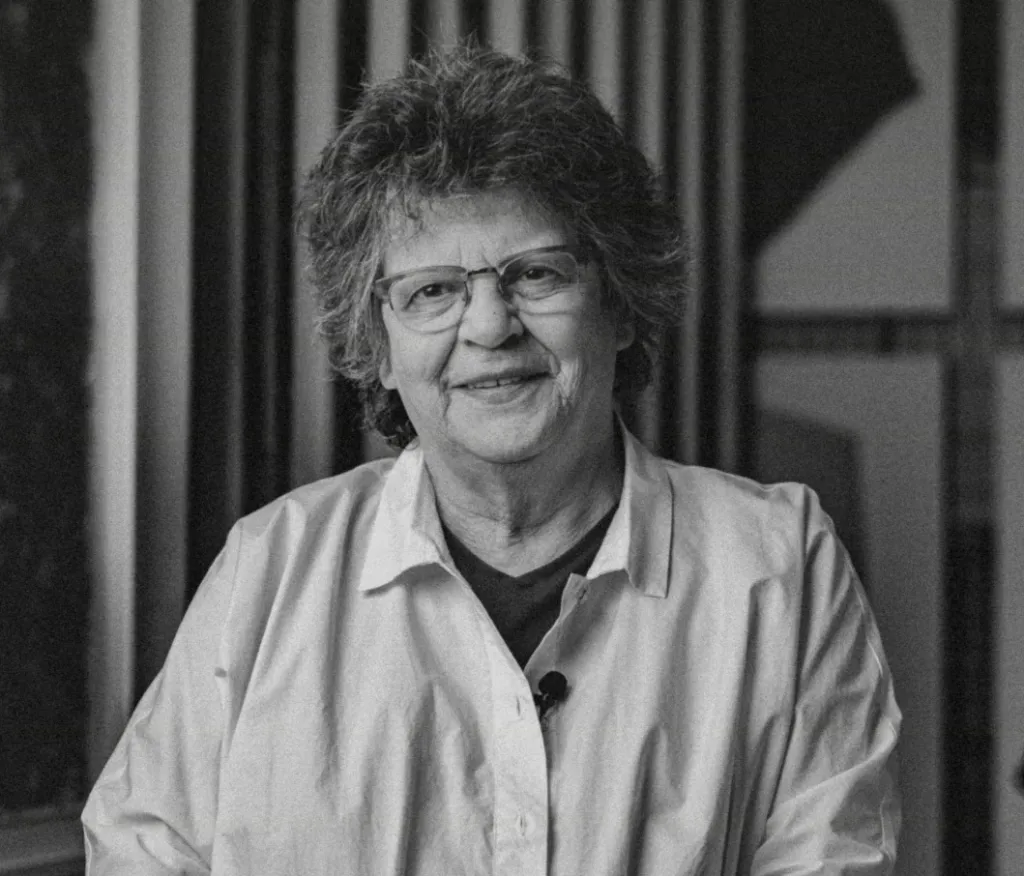
Luísa Cunha, the Portuguese conceptual artist whose whispering sound installations and language-based works made her one of her country’s most influential contemporary artists, died on Monday of cancer at Lisbon’s Hospital de São José. She was 77.
Over a career that began in the early 1990s, Cunha built a body of work that quietly transformed ordinary words into immersive works of art. Using whispered recordings, brief commands and fragments of conversation, she invited viewers to reconsider how language shapes space, memory and human relationships.
Though she worked across photography, drawing, video, objects and performance, Cunha became best known for her “sound sculptures,” minimalist installations in which recorded voices filled galleries with intimate phrases that shifted in meaning through repetition. Rather than relying on spectacle, her works rewarded careful attention, using language itself as both material and subject.
Born in Lisbon in 1949, Cunha earned a degree in Germanic Philology from the University of Lisbon before turning to visual art later in life. She completed the Advanced Sculpture Course at AR.CO – Centro de Arte e Comunicação Visual in 1994 and went on to teach sculpture there until 1997. Although she entered the art world relatively late, she had been exhibiting regularly since 1993.
The EDP Foundation, which awarded Cunha its prestigious Art Grand Prize in 2021, praised the “originality, experimental boldness, multidisciplinary and pioneering nature” of her work, highlighting the way she used verbal language, space and sound in a “permanent game of constructing and deconstructing meanings.” The jury also noted her lasting influence on younger generations of artists.
Language sat at the center of nearly everything Cunha produced. According to the Calouste Gulbenkian Foundation, she drew on the philosophy of language and the mechanics of perception, creating texts and sound sculptures that blurred the boundaries between public and private life. Her whispered voices, murmurs and repeated phrases encouraged viewers to construct their own meanings rather than receive fixed interpretations.
Among her best-known works was Do What You Have to Do (1994), in which two suspended speakers repeat subtle variations of the same sentence. Reviewing the installation for Artforum in 2013, critic Miguel Amado wrote that the work transformed a simple command into both an expression of authority and an act of resistance, describing Cunha as “one of the best investigators of the intersection between personal narratives and collective consciousness in the Portuguese art scene.”
Her work was exhibited widely in Portugal and internationally, including at the 14th Sydney Biennale, the Calouste Gulbenkian Foundation, the Serralves Foundation, Culturgest and the EDP Foundation. In 2021, she was selected as the featured Portuguese artist for the “Studio Visits” program connected to the 34th São Paulo Biennial, an initiative supported by Portugal’s Directorate-General for the Arts and the Calouste Gulbenkian Foundation.
Recognition accelerated during the final years of her career. In addition to the EDP Foundation Art Grand Prize, she received the AICA Portugal Visual Arts Prize in 2022 for her exhibition Partitura #4 at Galeria Miguel Nabinho and her installation Não at MAAT. The following year, MAAT presented Hello! Are You There?, the first retrospective of her work, surveying three decades of production across sound, photography, drawing, video and sculpture.
Cunha often described her artistic practice as one of observation rather than invention. The EDP Foundation said her work grew from a lifelong habit of looking without preconceived goals—”first finding things, and then searching for them.”
In an interview published by her gallery, Cunha reflected on the unlikely path that led her into art: “No, I don’t even know what that ambition is, to be an artist. I was thrown into this. When my speech changed I realized there was one thing I needed to do: allow the present to flow.”
