


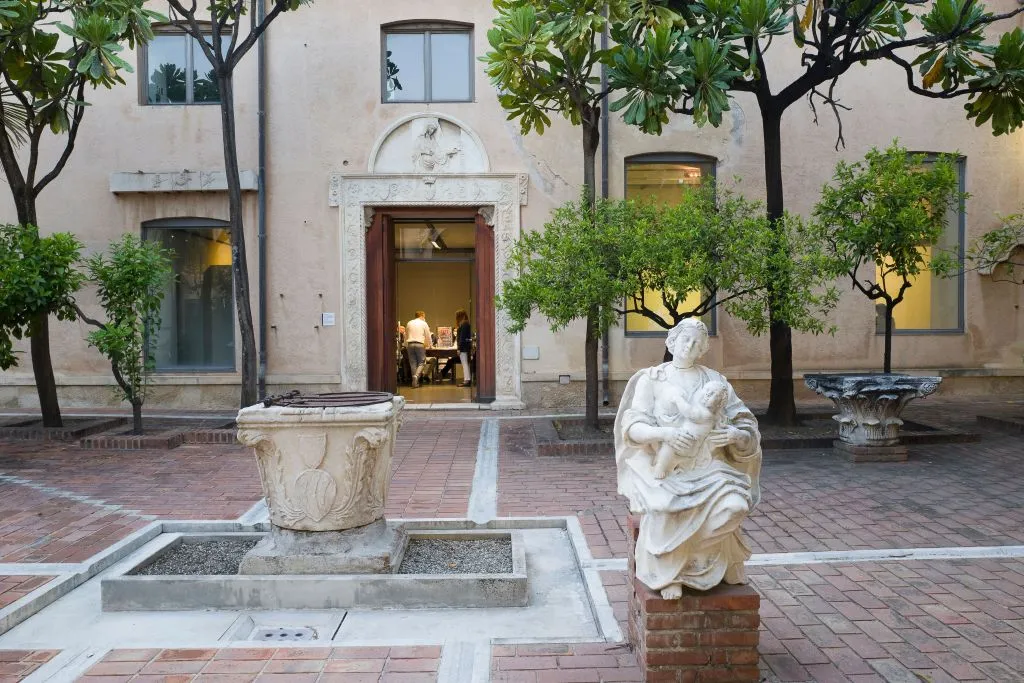
The theft of four paintings by Renaissance master Antonello da Messina from a Sicilian museum has prompted suspicions of mafia involvement, given the startling speed and ease of the high-stakes crime, Italian authorities said on Monday.
“It’s a very, very strange affair,” Messina’s top culture official, Enzo Caruso, told Reuters, detailing the troubling circumstances: The thieves broke into the Regional Museum of Messina on the night of August 15, bypassed the museum’s alarm system, broke into security display boxes, and fled the scene with the three of five surviving panels that composed the altarpiece Polittico di San Gregorio, and a fourth, smaller painting, within a matter of minutes. It’s difficult to conceive how this is possible, he said, without intimate knowledge of the museum’s layout.
Renato Schifani, the president of Sicily, has since confirmed that the museum’s video surveillance system and alarm were functioning properly, and guards were on site. An internal investigation is underway to determine whether any museum staff had been accomplices.
Caruso noted that selling any work by an artist of such exceptional stature as Antonello on the black market would be virtually impossible. A more likely scenario, he said, would be for the paintings to be used as currency or collateral in criminal dealings—or simply ransomed.
“The Mafia? It’s possible they might try to blackmail the state itself in order to return them. These are the kinds of dynamics that ordinary people never get to see,” he said.
The burglary took place as Messina celebrated the Ferragosto national holiday, when attention was diverted from the paintings, the only works by Antonello remaining in his hometown. Their disappearance was discovered only two hours later, when tourists stumbled upon two Antonello paintings, apparently abandoned by the assailants, leaning against the museum fence.
“Perhaps they did not anticipate how heavy they would be,” Caruso added. “These are wooden panels … stealing them is not as easy as stealing a canvas that can be cut from its frame.” Furthermore, the paintings were found without protective covering; a professional art thief would presumably take greater care with 15th-century paintings worth tens of millions of dollars, he said.
Their disappearance has become something of a local sensation: La Repubblica reports that more than 100 visitors came to the museum within a day of the news breaking, many milling into the gallery to see the black cloth now shrouding the pedestals for Polittico di San Gregorio. Originally composed of six panels, Antonello created the altarpiece for the Monastero di San Gregorio, which was destroyed in the 1908 Messina earthquake. The fourth stolen work, a double-sided devotional depicting the Virgin and Child on one side, was sold by Christie’s to the Sicilian regional government in 2003.
The stolen works have been valued between €70 million and €80 million ($81 million–$92 million), the Associated Press reports.
“It is an extremely serious and significant loss,” Marisa Mercurio, the director of the museum, told the Guardian. “They have stolen works of enormous cultural, artistic and symbolic importance, not only for Messina but for Sicily as a whole. All we can do now is hope they are recovered as soon as possible.”
International interest in Antonello has only surged, as scholarship increasingly positions him as a pivotal link between the northern and southern Renaissance traditions. He made waves in the art market earlier this year, too, when Italy’s Culture Ministry acquired his painting Ecce Homo for $14.9 million through Sotheby’s in New York.
Italy’s art crime squad, meanwhile, is making headlines of its own. Just days before the Antonello theft, police in the northern Italian city of Parma announced that they had recovered three stolen paintings by Renoir, Cézanne, and Matisse, valued at around €10 million ($11.5 million), and detained five suspects in connection with the March 22–23 theft.
The Rome-based art theft investigators are reportedly hunting for the Antonello trove, whose whereabouts have become a source of national anxiety.
“I have the feeling the thieves may be keeping the [Antonellos] hidden while things calm down,” Caruso said. “Or perhaps they immediately took the sea route,” he continued, noting that the museum sits along the Strait of Messina.
