


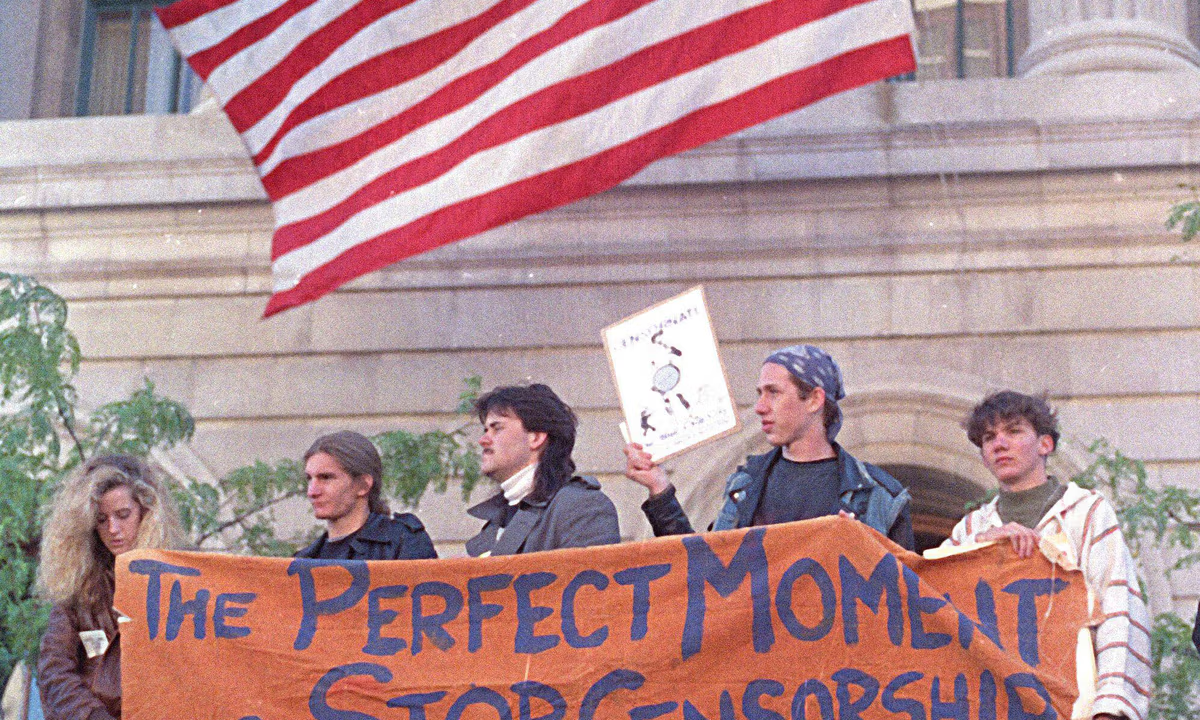
In the summer of 1989, The Perfect Moment, a retrospective of the recently deceased photographer Robert Mapplethorpe, was touring the US. It had shown in cities like Philadelphia and Chicago without incident, but as it prepared to open at the Corcoran Gallery in Washington, DC, conservative politicians discovered that the National Endowment for the Arts (NEA) had supported it with a $30,000 grant. This sparked national controversy, due to the perception that the federal government was endorsing Mapplethorpe’s explicit photography. The Corcoran bowed under public pressure and cancelled the show, whereupon the Washington Project for the Arts (WPA) picked it up and exhibited it to great acclaim. But the broader conflict over government arts funding was only beginning.
Growing up in DC, the author Isaac Butler witnessed many episodes of the American culture wars of the 1980s and 1990s firsthand—his mother was on the board of the WPA, and her first meeting there featured their vote on whether to take on The Perfect Moment. During this time, conservative figures like Jesse Helms used controversial art that directly or indirectly received money from the government as a wedge issue to scaremonger about declining public morals and to defund such programmes.
Butler chronicles the period in The Perfect Moment: God, Sex, Art, and the Birth of America’s Culture Wars. The furore over the Mapplethorpe retrospective is covered, as are similar social and legal battles over Andres Serrano’s photograph of a small crucifix submerged in urine, Immersion (Piss Christ) (1987); warning labels on music CDs; the work of David Wojnarowicz and more. Butler says it is his most personal book—not just because of his ties to DC, but also his “sentimental attachment to the NEA”. He calls the agency “one of the great things to come out of post-war America”.
Isaac Butler, author of The Perfect Moment Photo: Heather Weston for Bloomsbury Publishing
The impetus for The Perfect Moment was not a conservative attempt at censorship, but a liberal act of self-censorship: the widely condemned decision to delay a travelling Philip Guston retrospective in 2020 because of worries about the interpretation of his Ku Klux Klan paintings. “It was about the sensitivity of theoretical viewers who might be traumatised by seeing images of the Ku Klux Klan,” Butler says. “Guston was a radical anti-racist, and the images of the Klan are part of that project. All you need is a little wall card that explains this.”
The episode got Butler “really interested in reclaiming free expression as a leftist value” and set him off researching the so-called “NEA Four”. In 1990, the performance artists Karen Finley, Tim Miller, John Fleck and Holly Hughes had their NEA grant applications rejected because of risqué subject matter. The artists took the matter all the way to the US Supreme Court, which affirmed the NEA’s decision-making process. The agency’s way of avoiding similar controversies going forward was to simply stop funding individual artists.
As Butler conducted preliminary research in 2022, the HB 1557 act, commonly known as the “Don’t Say Gay” statute, was passed in Florida. This “only caused [him] to be more passionate about free expression and academic freedom”, and the project expanded beyond the NEA Four. “I wanted to start earlier and tell the full arc of the culture wars.” Donald Trump’s re-election as president in 2024 made the process of researching and writing even more fraught. “I’d wake up and read the news and be like, ‘Oh, there’s today’s version of it. Well, I’m going to leave that aside and do my work with—ah shit, my work is about yesterday’s version of it’,” he says. Despite this, Butler emphasises the book is primarily a work of history. “I think history is about illuminating the past. Resonances and rhymes are in there, but I wanted it to have its own value for understanding this period, which I have a feeling will speak to us even after Trump is gone.”
A helpful structuring approach was to take the “wars” part of the “culture wars” moniker literally; Butler cites James McPherson’s 1988 American Civil War book Battle Cry of Freedom as an influence. “I started thinking about it as a non-violent military history,” he says. “We’re going from battle to battle. We introduce the people who matter, then get into a conflict, then its aftermath, and how it sets up the next battle. Now we’re in Culture War II, and my book is about Culture War I.”
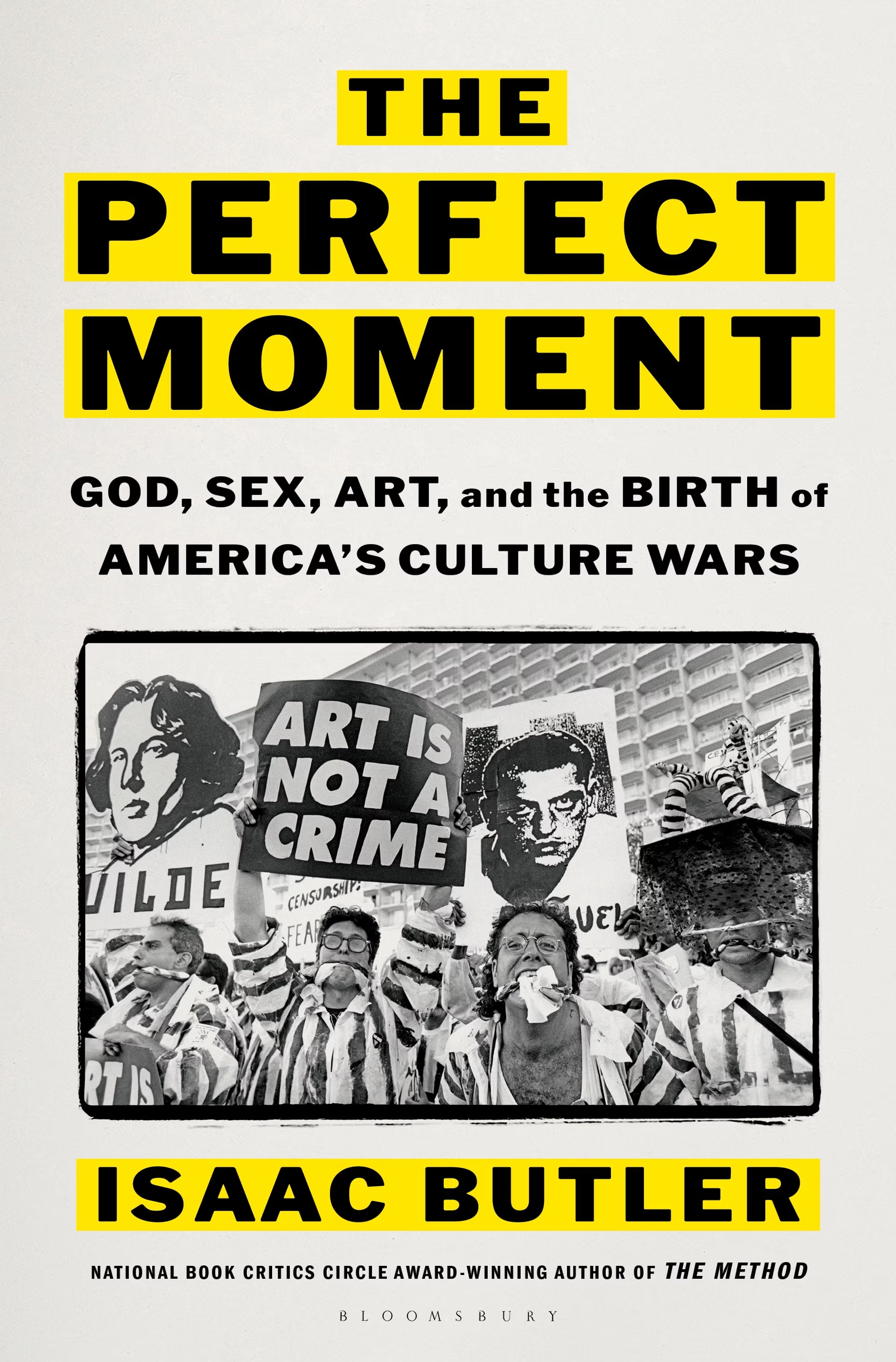
The cove of The Perfect Moment: God, Sex, Art, and the Birth of America’s Culture Wars by Isaac Butler
While the NEA persists despite attempts to defund or abolish it, it has changed a great deal since the culture wars of the 1980s and 90s. As Butler reflects, smaller non-profits like the WPA “have become much harder to maintain”. “Many of the artist-run spaces that came out of the 1970s have died because there’s less money,” he says. “Because work in those spaces was more likely to cause a scandal, they tended not to get funding. So they were more dependent on the government than larger institutions, because they didn’t have stuff like endowments.”
Some things have not changed, though. “We still have centrists saying, ‘If we could just talk to each other in good faith, I’m sure we could reach an agreement.’ That was already over in this moment 40 years ago,” Butler says. A major recurring thread in the book is arts organisations pre-emptively surrendering: “The government exerts pressure on an institution, which then tries to cave a bit or find some wiggle room. And of course, it’s just a disaster.”
One counter example is the Contemporary Arts Center in Cincinnati, which fought off obscenity charges in court for exhibiting The Perfect Moment in 1990. “You hope for more cases like this, where the institution says, ‘Actually, go fuck yourself,’ and they fight it out and win,” Butler says. “The examples of the Corcoran and the Mapplethorpe show, or the lawsuits against Ivy League schools today, all show that once you give a little ground, they’re going to see you as vulnerable and keep taking more. It’s like a bully with your lunch money.”
• Isaac Butler, The Perfect Moment: God, Sex, Art, and the Birth of America’s Culture Wars, Bloomsbury Publishing, 384pp, $32 (hb)
