


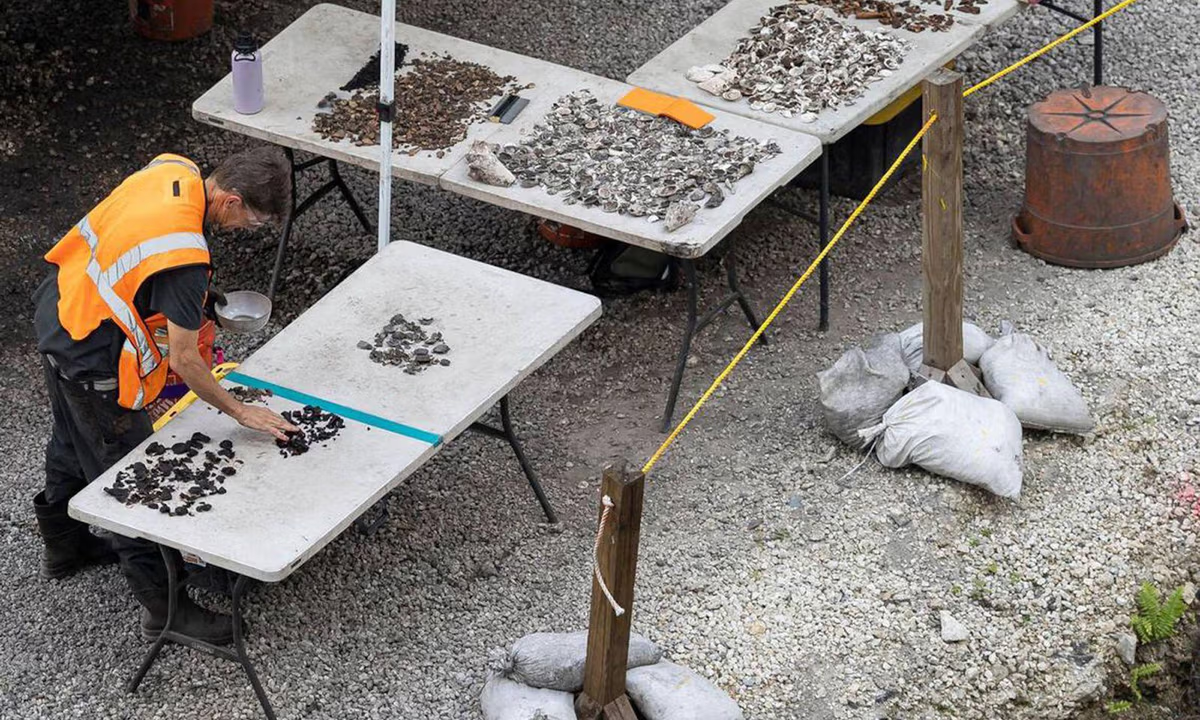
An ancient archaeological site and burial settlement dating back 3,500 years to the Archaic period has been found during construction of a luxury apartment building in Miami’s central Brickell neighbourhood. The site at 1809 Brickell Avenue is part of a larger Native American settlement belonging to the Tequesta civilisation, Miami’s first people.
The development company that bought the land, Related, was founded by Jorge M. Pérez, the billionaire art collector and philanthropist after whom the city’s Pérez Art Museum Miami is named. The company already faced public outcry in 2023 after another part of this long-buried Indigenous village was discovered during construction of a luxury hotel and residential project one mile away at 444 Brickell Avenue.
The Miami Herald first reported on the discovery at 1809 Brickell Avenue last summer, and the city has released a preliminary report on the archaeological findings. The site is eligible for listing in the National Register of Historic Places because it can provide important information on Tequesta material culture, architecture and subsistence. Despite its eligibility and significance, Miami’s office of planning confirmed to The Art Newspaper that “currently the city does not plan on designating the site”.
Prehistoric materials recovered by the archaeological team at 1809 Brickell Avenue include traces of fire pits, pottery shards, tools and spearheads, along with bones and shells from animals hunted, fished or consumed by the people who occupied the site. The Herald reported that the first study of the site details the discovery of ancient human remains, including those of an infant, that were buried in a formal manner, suggesting the site served as an Indigenous cemetery. However, in the version of the report made public, passages describing human remains were redacted. After lawyers for the Herald notified the city, it reinstated the redactions from the report, saying they had been made at the request of the state archaeology division.
“The Historic Environmental Preservation (HEP) staff is closely monitoring the site in conjunction with the Related Group and the state of Florida,” a spokesperson for the city’s planning office tells The Art Newspaper. “As excavation, analysis and reporting are still ongoing, information will be made publicly available at a more appropriate date.”
While national and local historic designations generally use the same criteria, they provide different levels of protection. Inscription in the National Register of Historic Places would still not automatically restrict what a private owner can do at the site, but would offer some eligibility for grants, aid and national recognition. Regardless, members of the city’s Preservation Board have previously stated that it does not have the power to nominate a site for designation as a national landmark nor to preserve it as a local landmark, and doing so would likely result in the developer suing the city.
Property wins over preservation
“This is a huge source of frustration about historic preservation in Miami,” Malachi Fenn, an archaeologist with the Florida Public Archaeology Network’s south-east region, tells The Art Newspaper. “There is always money for a new empty condo, but little money for historic preservation, even though that’s also a source of tourism revenue.”
Although local non-profits such as Dade Heritage Trust, local museums and the Florida Public Archaeology Network are trying to change this, Malachi says “there is a very long and successful history of historic preservation elsewhere, but that has struggled to get a foothold in Miami”.
A spokesperson for Related, the developer of 1809 Brickell Avenue (in partnership with Integra Investments), tells The Art Newspaper: “In accordance with regulatory requirements, Related has advised the city and state of its activities at the site and observed their direction and assistance in respectfully excavating and preserving the site.”
As of last September, more than 60% of apartments in the residential tower planned for the plot with the ancient site and cemetery had sold, with remaining units priced between $3.7m and $45m. Meanwhile, the luxury hotel and residential tower being built over the ancient Tequesta Village at 444 Brickell Avenue is due to open later this year.
Most of the land bordering the Miami River in Brickell is a city-designated, protected archaeological zone. This means that property developers who buy land in this area and find human remains or artefacts during construction must, according to city ordinances, hire and pay an archaeological company to excavate the findings and consult with Florida tribal officials and the state on how to handle them. These ordinances were the result of advocacy by archaeologists, in particular Bob Carr, who co-founded the Florida Archaeological and Historical Conservancy in 1985, having witnessed bulldozers destroying Indigenous history as the city rapidly developed. But some preservationists have argued that these ordinances are the bare minimum and that the city of Miami and state of Florida could do more to hold developers accountable in the long term.
A pattern of selective preservation
Traci Ardren, an archaeology professor at the University of Miami, has called the 444 Brickell Avenue site “the most profound and extensive evidence of prehistoric settlement” in Miami’s history. The discovery sparked widespread calls for preservation, as independent archaeologists claimed the findings could date back to before the Egyptian pyramids were built, but further study would be needed. Carr had presented some findings at public board meetings, showing, for example, never-before-seen “shell eyelids” that represent pupils and are important in Tequesta and Native American cosmology.
Despite meeting most requirements to be designated as a protected historical landmark, the city’s preservation board agreed with the developer that only a portion of the 444 Brickell Avenue site would be preserved, and the remainder could be developed so long as the developer presented an action plan for artefacts found at the site—which now number in the millions. A full designation of the entire area would have risked sparking a legal row between the city’s preservation board and Related, which bought the property for $104m in 2013.
In 2023, when the site’s fate was being publicly debated, Tina Osceola, the director of the Seminole Tribe’s preservation office, told the Seminole Tribune that although state officials were being cooperative with the tribes, “these are multimillion dollar developments—there are very little rights that the tribe or anyone has. We don’t get to dictate many aspects.” The tribe’s preservation office “has been involved since the beginning. It’s a long and drawn-out process,” she added. “All we can do is to make sure the ancestors at that location are treated as the law requires. Sometimes it gets very frustrating when you see an important site like that excavated.”
To date, Related has not publicly presented a revised action plan to the city’s preservation board detailing who will pay for the long-term storage of the millions of objects found at 444 Brickell Avenue or how they plan to exhibit them. At a board meeting last October, a lawyer for Related said the updated action plan had already been submitted to the state “ahead of schedule” and that a third report on the digging will come in November 2026, along with the future exhibition space plans and permits.
“There is currently no catalogue of artefacts that was shared with the city,” a spokesperson for the city’s historic preservation division tells The Art Newspaper. The division “is aware that the cataloguing process has been completed and that the [Florida Division of Historical Resources] and the Seminole Tribe are still reviewing the artefacts”.
A portion of the “museum-quality” items excavated at 444 Brickell Avenue, other than those selected or identified for disposition by tribal authorities, will be used for exhibits. A spokesperson for the HistoryMiami Museum confirmed that the institution has expressed interest in taking custody of the significant artefacts following the tribal consultation and selection process.
“Miami is seen as this brand-new party city with little history, but that is partially because all the precolonial landscapes from ancestral times have been destroyed or remain hidden,” Malachi says. “It’s a fascinating place that is still understudied, and people think ‘nobody is really from Miami’, but Miccosukee and Seminole folks are from here, and people have been travelling between South Florida and the Caribbean for centuries.”
