


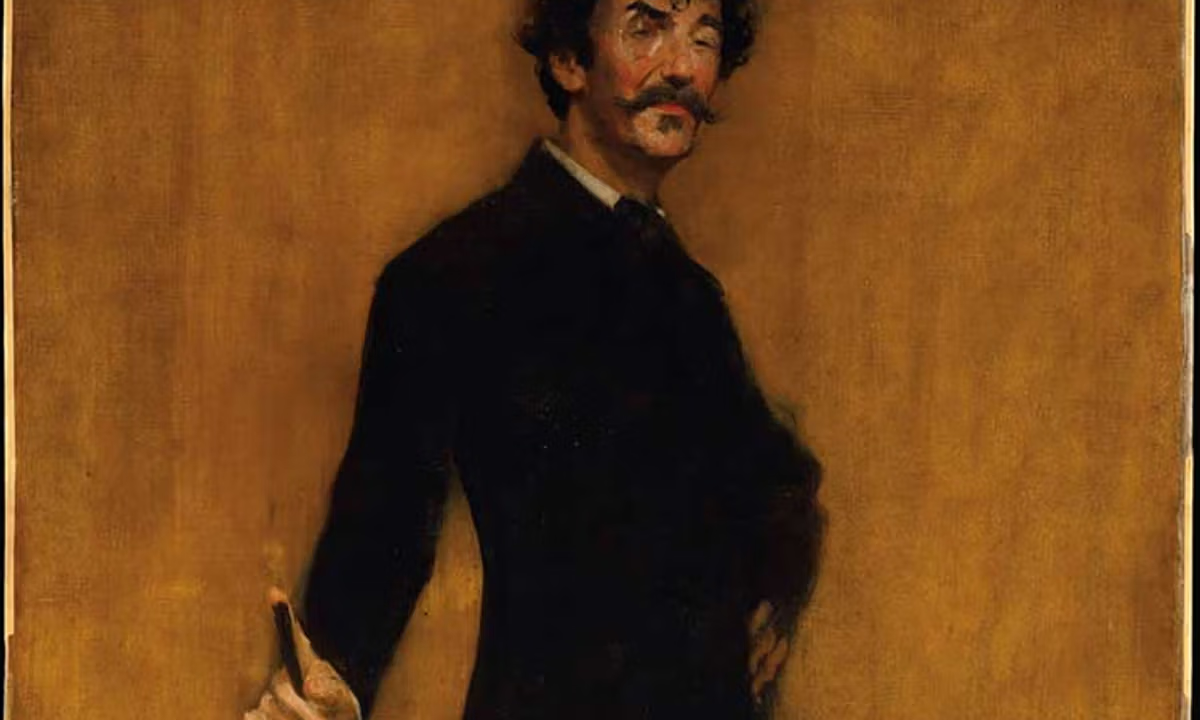
“Whistler loves to wrap mystery around him as a cloak—and then go off in it and be photographed,” Edgar Degas complained about his mercurial friend, the painter James Abbott McNeill Whistler (1834-1903). The French Impressionist might have explained, better than most, why Whistler has become the resident weirdo in the annals of transatlantic art history. As Daniel Sutherland here acknowledges, the artist, who chose as his personal emblem a butterfly with a stinger, is a bundle of paradoxes: an American who preferred to live in Europe; a self-declared Southerner who was born in Lowell, Massachusetts; a capricious showman who worked himself to exhaustion; and a loud-mouthed provocateur who believed in the purity of the artistic enterprise.
In the 1850s, Whistler attended the military academy at West Point, as his father had done before him. His ignorance of chemistry, he alleged, got him canned: “Had silicon been a gas, I would have been a major general.” Sutherland, though, reminds us there were other reasons why Whistler was sent packing. He went on to create an art of dreamily oscillating surfaces in which everything solid appears to tremble and melt, from the people he portrayed—like the musician Pablo de Sarasate, popping out, ghostlike from the dark abyss behind him—to his exquisite pastels of Venice, where the façades of the palazzi wobble like the waters of the canal below, and the paintings he called “nocturnes”, shimmering views of the River Thames at twilight.
Sutherland, a professor of history at the University of Arkansas and author of a 2014 biography of the artist (Whistler: A Life for Art’s Sake), has spent much of his career seeking to rescue the “real Whistler” from the falsehoods told about him (although some of these, mind you, were Whistler’s own). Whistler’s Legacy is a continuation of that project. Sutherland pulls no punches when criticising those who got Whistler wrong, first and foremost that benighted pair of early biographers, Joseph and Elizabeth Pennell, who said they had been “authorised”, though they clearly were not; Whistler’s sister-in-law, Rosalind Birnie Philip, had banned them from quoting the artist’s letters. The list of the Pennells’ infractions is long, ranging from factual errors to doctored excerpts from the interviews Elizabeth had conducted.
A print of Whistler as a butterfly by an unknown artist (19th-20th century); the artist chose, as his personal emblem, a butterfly with a stinger Courtesy Metropolitan Museum of Art, New York
Held to account
Sutherland also takes to task some of Whistler’s contemporaries, ranking their accounts according to how “valuable” they are. But he is deeply sympathetic to those Whistler left behind, not only his long-suffering sister-in-law, buckling under the burden of administering Whistler’s enormous estate, but also the artist’s illegitimate son Charles, passed over in his father’s will, who died as unfussily as he had lived, on the same street where he was born, as if he had wanted to give the finger to his peripatetic progenitor.
Not so Sutherland. Unabashedly partisan, he defends Whistler against charges that he was a publicity-seeking Baudelairean dandy or, more damningly, “a terrible man” (a visitor’s comment Sutherland overheard in a museum). In fact, Sutherland argues, Whistler courted controversy for art’s sake. When John Ruskin remarked that Whistler’s Nocturne in Black and Gold–The Falling Rocket (around 1875) was a “pot of paint” flung in “the public’s face”, Whistler took him to court, relishing the opportunity to tell everyone what a seasoned professional he was. In his criticism of Ruskin, rehashed in Whistler’s not very gentle book The Gentle Art of Making Enemies (1890), he pointed out, in reference to Ruskin’s illustrious career as an art critic, that “a life passed among pictures makes not a painter”. For, if that were true, “the policeman in the National Gallery” could rightfully say he was an artist, too.
Modern responses
In the final section of Whistler’s Legacy, Sutherland investigates responses to Whistler in modern popular culture and finds them wanting, if intermittently amusing. Just think of the six-foot-four John Cleese embodying the diminutive Whistler in Monty Python’s Flying Circus. And look at the horrible Whistler portrait the US Postal Service put on its 1940 two-cent stamp! Like his hero Whistler, Sutherland is not a particularly forgiving man, lambasting everyone from gossipy biographers to uninformed art critics to art historians blinded by political correctness. If there is a major Whistler renaissance today—a large exhibition at Tate Britain opened last month—this is, Sutherland implies, thanks to serious modern scholars like himself.
To this reviewer at least, the beating heart of Whistler’s Legacy lies not in the polemical parts but in the book’s central chapter on the science behind Whistler’s nocturnes. Here, Sutherland cuts through the noise, created in part by Whistler himself, and shows how the painter, fully aware of what pollution had done to the skies over London, captures the quiet nuances of a fog-shrouded evening: the moment when, with the light almost gone, the bridges and buildings of the sooty city fade, and the water and the sky and the people appear to become one.
- Daniel E. Sutherland, Whistler’s Legacy, Penn State University Press, 274pp, 3 col. & 16 b/w illus., $42.99 (hb), published 5 May
- Christoph Irmscher is a critic and biographer
