







Archaeologists working in Guatemala have identified the name of a Maya mathematician-astronomer who lived around 1,250 years ago. The name is written at the end of a unique mathematical formula on the wall of a building at Xultun, an ancient city 340km south-west of Guatemala City. This discovery not only provides insight into the individuals behind Maya astronomy and mathematics but also the production of ancient codices.
“We were excited when we realised one of the room’s many mathematical texts actually had an attribution,” says Franco Rossi, an archaeologist at the Massachusetts Institute of Technology and lead author of the research paper, published in the journal Antiquity. “It is frankly surprising that more such signatures haven’t turned up in the archaeological record, since this kind of specialised work was both important and widespread within ancestral Maya society, particularly during the eighth century.”
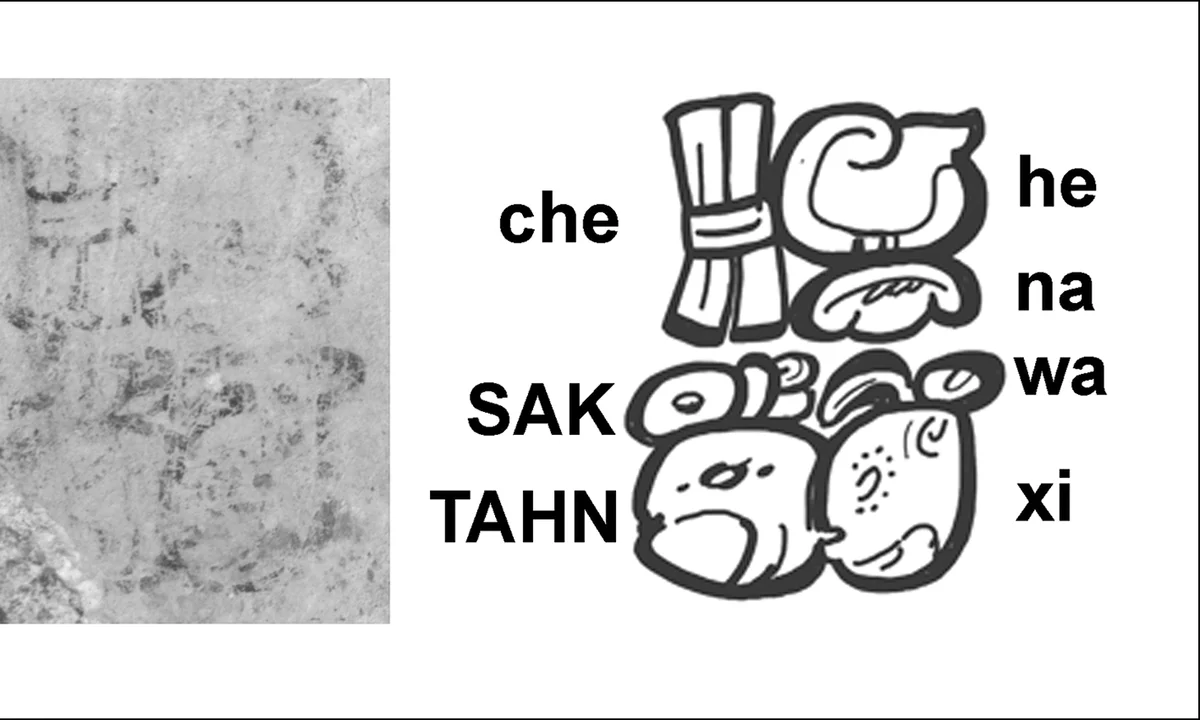
The inscription names the mathematician-astronomer as Sak Tahn Waax, meaning “White-chested Fox”. His role likely revolved around observing natural cycles of time and producing calculations, which the Maya could then use to decide when to construct monuments, for example, or crown their kings and queens.
“Across Classic Maya monuments and artefacts, glyphic texts and their dates are typically tied to historical events, political messaging and shared stories, often overlapping with particular cycles and celestial observations,” Rossi says.
Sak Tahn Waax’s mathematical formula, itself unique and including novel astronomical observations, perhaps explains why the ancient astronomer wanted to sign his work. Some of these observations involve a 260-day ritual day-count and the solar year, as well as the calculations associated with them. Notably, his formula takes a new approach to recording the movement of the planets, including Venus and Mars.
a) Drawing showing painted figures on north and east wall, and the location of the signed mathematical formula discussed in the text; b) Text as it appeared on the east wall of the structure Courtesy Antiquity Publications
Archaeologists found the inscription in a chamber at Xultun that is part of a residential complex. The Maya applied plaster to the chamber’s inner east wall, transforming it into a space to write mathematical “microtexts”. When revealed between 2010 and 2012, these painted writings were faded from time, leading the team to scan, draw and photograph the glyphs, before digitally enhancing them to make the symbols more legible. They discovered that, in total, the Maya scribes had written around 52 mathematical and astronomical microtexts on the wall.
Significantly, these inscriptions appear to be “rough draft” calculations for the content of codices produced by the Maya within the residential complex. The researchers liken this discovery to finding a sketch of a great work of art. The team also unearthed papermaking tools in and near the chamber, suggesting that it may have been a place where people were trained in calendrical calculations—based on the titles of scribes shown in the wall paintings.
Although the ancient Maya produced a great deal of writing on paper, fibre and wood, these organic materials have rarely survived the centuries in their tropical environment. The four pre-colonial codices that have been preserved to modern times were created in the later phases of Maya history—more than 500 years after the writings at Xultun. The inscriptions in the chamber therefore provide a rare insight into ancient bookmaking and the Maya’s mathematical and astronomical work.
Rossi notes that, for the moment, only a handful of the chamber’s often highly eroded texts have been fully analysed and deciphered. This makes the continued analysis of all the microtexts a focus for future research. The team also hopes to identify the different scribal hands at work in the painted chamber—it is possible that Sak Tahn Waax wrote other texts there, too—and they plan to continue their archaeological survey and documentation across the city of Xultun, of which 900 hectares of urban zone remain covered by forest.
“The most exciting and important aspect of this study is that this is the first direct mention of an ancestral Maya astronomer-mathematician by personal name,” Rossi says. “Whether this is an instance of the scribe himself signing his own calculation or attributing the intellectual work to another, we have a formula and the name of its creator, which serves to demonstrate the importance of this kind of intellectual contribution for Classic Maya people.”


