






To receive Morning Links in your inbox every weekday, sign up for our Breakfast with ARTnews newsletter.
Good Morning!
- Rare Kandinsky painting returned to Jewish heirs of Nazi-persecuted former owners, heads to Christie’s in London.
- The Smithsonian Institution formally selected an existing building to house the National Museum of the American Latino, avoiding congressional approval.
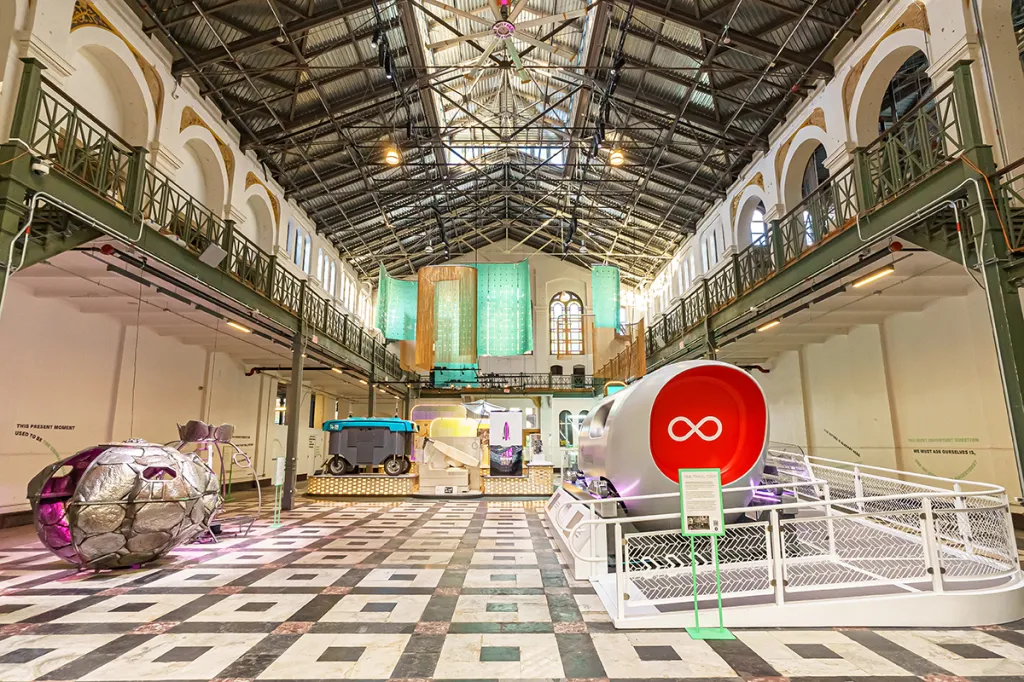
- A government misconduct investigation is underway into two senior executives at the soon-to-open Powerhouse Parramatta in Sydney.
The Headlines
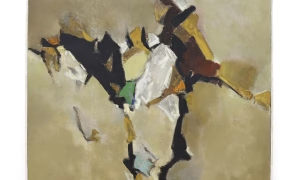
KANDINSKY AT CHRISTIE’S. Wassily Kandinsky’s joyful painting, The Colorful Life (1907), is headed to auction at Christie’s in London on October 14, after it was returned to the heirs of Nazi-persecuted Jews, reports the New York Times. For over 50 years, the artwork was held at the Lenbachhaus museum in Munich, on loan from a Bavarian bank. But in 2023, the German government’s special commission on Nazi-looted art concluded that the painting, which was auctioned in 1940 under unclear circumstances, should be returned to the heirs of its former owners, the Dutch Jewish director of a sewing machine factory Emanuel Albert Lewenstein, and his wife, Hedwig Lewenstein Weyermann. Christie’s estimates the large, rare tempera and gouache painting of a festive, folkloric Russian scene, which Kandinsky made in Paris, will fetch over $30 million.
SMITHSONIAN’S CONGRESSIONAL SIDESTEPPING. On Monday, the Smithsonian Institution’s Board of Regents approved plans to convert its existing Arts and Industries building on the National Mall into the permanent site for the National Museum of the American Latino, effectively avoiding the need for Republican-controlled approval from Congress and concluding its site-selection process, reports the New York Times. The board’s congressional sidestep comes as the Trump administration has led a sustained campaign against the institution. “We could not be more excited to build on the rich legacy of this historic building,” said the museum’s director, Jorge Zamanillio, referring to the newly designated, 19th-century structure. “Today marks a major milestone in a dream and effort of decades in the making,” he said.
The Digest
Following the surprise announcement that the chief executive of Sydney’s Powerhouse Museum, Lisa Havilah, stepped down 10 weeks before the cultural institution’s opening, a misconduct investigation is under way into Havilah and another senior executive at the museum, according to Arts Minister John Graham. [ABC News, Australia]
A court in Hamburg convicted and heavily fined two children of notorious German dealer Serop Simonian of money laundering related to the sale of allegedly looted ancient Egyptian artifacts, while also ordering the confiscation of 32 million euros ($37 million) in sale proceeds. [AFP, The Art Newspaper]
UK Prime Minister Andy Burnahm backtracked on previous statements calling for the return of the Parthenon Marbles to Greece, noting that “ultimately [returning the Marbles is] an issue for the British Museum,” while adding that “legally that’s where that issue rests.” [The Financial Times]
The FBI quietly returned as many as 48 looted ancient artifacts to Egypt last month after a private collector in Los Angeles surrendered them amid growing suspicions about their provenance. [The Pulse]
Some 300 personal items, including jewelry once belonging to French star Brigitte Bardot, are headed to auction at Hôtel Drouot in Paris, from September 15 to 20. [Le Figaro]
The Kicker
EMBASSY ART REMOVAL JUST THE BEGINNING? The Trump administration’s aim to sell a painting it called “very woke,” by Kehinde Wiley, which hung at the US Embassy in the Dominican Republic, is likely just the beginning, reports Vanity Fair. The head of Art in Embassies at the State Department, Erin Scavino, confirmed on Friday that “the same review and process would apply to other works of art for which similar concerns arise.” Scavino also stated that “with respect to the potential sale or other disposition of Young Artists After Siamesas 1960 [by Wiley], my answer remains the same: We are consulting with our legal team to determine what options are legally available and what course of action is appropriate.” She added that, “I would surmise that an auction would be the most appropriate,” despite this being highly unusual, given the artwork was commissioned to be permanently installed in the embassy.


