






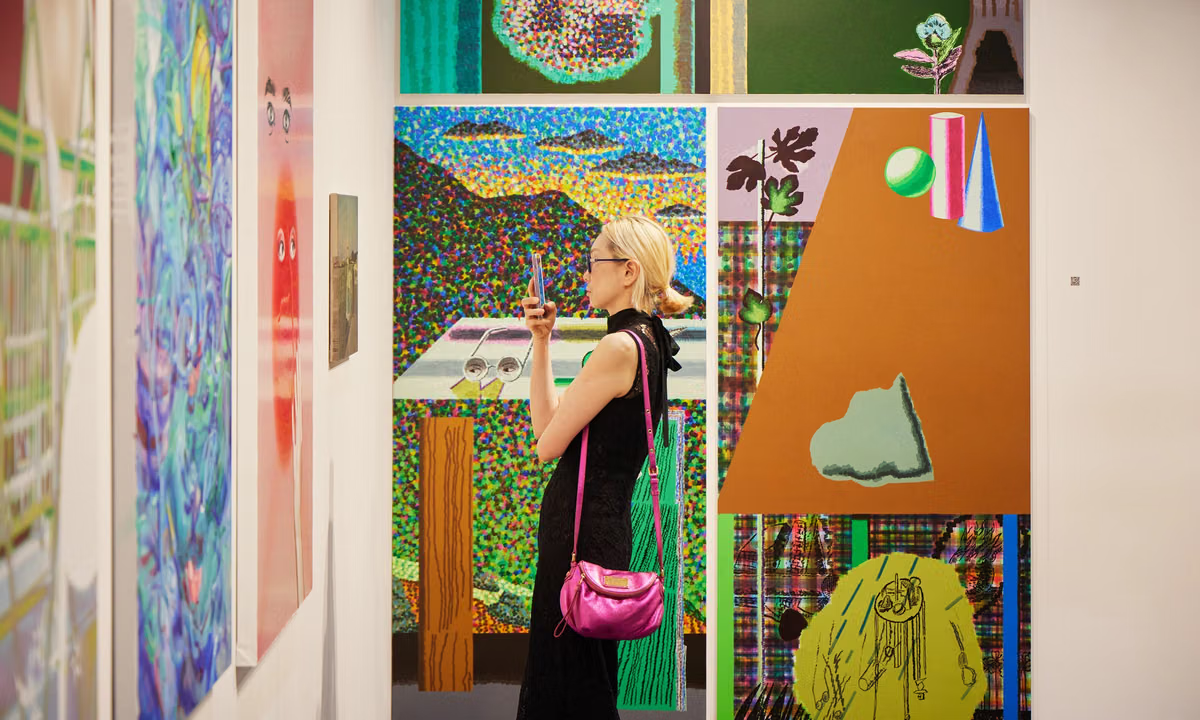
When Frieze Seoul debuted in 2022 via a five-year partnership with the homegrown fair Kiaf Seoul, it transformed the South Korean capital into a focus for the international art world. Today, the hype has subsided as the market has followed a global contraction from its 2022 peak. But this is not a decline, according to industry insiders, who view it as a necessary correction towards a more mature, diversified and sustainable ecosystem that sits within a wider Asian context.
“The Korean art market is now a destination in Asia for international galleries to stage exhibitions and operate spaces,” says the Hong Kong-based Yuki Terase, the founding partner of art advisory Art Intelligence Global. “It is also a sign of maturity for Asia, which can afford to have a number of fairs operating. It is not about one city replacing another; it is an expansion.”
Despite a 16.6% year-on-year increase in the auction market in 2025, driven by sales of big-ticket items, according to data from the Korea Arts Management Service (KAMS), political instability triggered by a scandal over a shortage of ballot papers in the country’s June elections and recent stockmarket volatility following AI-chip sell-offs put the market under another stress test.
Nevertheless, the show must go on. Frieze Seoul and Kiaf Seoul are set to renew their partnership for another five years and beyond as they both return to COEX in Gangnam. Frieze Seoul features 125 galleries (up from last year’s 120) from 30 countries. Kiaf marks its 25th anniversary with its largest edition ever, bringing together 175 galleries from 18 countries and territories.
Over 70% of Frieze Seoul exhibitors have spaces across the Asia-Pacific, a significant increase from 50% in 2022. Fifty of them operate in the South Korean capital, including outposts of global blue-chip galleries. The turnover rate of this edition’s gallery line-up is over 40%—more than 50 of them are new.
Patrick Lee, the director of Frieze Seoul, notes that while he respects some galleries’ decisions to “sit out” an edition during challenging times, the current line-up reflects an identity that sets the Seoul fair apart from its London and New York counterparts. “It’s a symbiotic relationship,” he says. “We’re in Korea, but Frieze Seoul isn’t just about a Korean audience.” With more galleries from the wider Asian region presenting alongside international galleries, the fair can help foster the “intra-Asian” dialogue and platform more diverse artistic practices, he adds.
Massimodecarlo, which opened a space in the city last year, will stage a pop-up with the artist Hejum Bä in a hanok (traditional Korean house) during the fair week rather than returning to the fair this year, as the gallery eyes on the wider ecosystem, notes SoYoung Kim, the gallery’s director in Seoul.
Domestic market realignment
KAMS’s data shows that after reaching a record 806.6bn won ($567m) in 2022, the value of the country’s domestic market contracted by 23.7% to 615.1bn ($433m) in 2024. But even after the contraction, the market remains 24.5% larger than the pre-pandemic, pre-Frieze Seoul peak in 2017, which was worth 494.2bn won.
Sunghoon Lee, the president of the Galleries Association of Korea, which organises Kiaf, says that the partnership between Kiaf and Frieze was a turning point that has broadened the domestic market and raised Korea’s international profile.
Younger collectors have formed a new core demographic, who see collecting as part of culture and lifestyle, not just a niche hobby, adds Lee, who is also the chairman of the Kiaf operating committee. Over the past three years, young professionals in their 40s accounted for the largest share of Kiaf’s membership, followed by those in their 30s. They are also buying works across a much wider range of prices, he says.
Henna Yeonhwa Joo, a professor of arts and cultural management professor at Hongik University and the founder of consultancy firm ArtLab Unlimited, noted in her recent survey that the younger generation plays an active role in collecting—while the majority (54.2%) are in their 40s and 50s, nearly a third (31.3%) are in their 20s and 30s. Among those under 40, 55.5% are women.
The initial hype of Seoul has clearly subsided, but this means those who continue to return see Korea as a solid art destination with potential for deeper dialogue and exhibition opportunities, “not necessarily just for the fair,” Terase observes. “It is quite healthy.”
The Seoul-based dealer Jason Haam observes that galleries from Europe and America have been paying closer attention to the art scene and artists working within the Korean cultural context. “As a result, more young Korean artists are finding opportunities and achieving meaningful success internationally,” he says. “Korean galleries themselves have become much more globally engaged.”
The Armory Show in New York, also owned by Frieze, which has been moved to a later date in September (24-27), may facilitate further growth. The New York-based adviser Adam Green notes that the emergence of Seoul has changed the Western art world’s perception of the Asian art market, which focused on Hong Kong and mainland China. His clients are also discovering more Korean artists. “Removing the scheduling conflict should translate into greater attendance from US-based collectors and advisers,” he says.
Looking ahead, Massimodecarlo gallery’s Kim expects Korea to play a greater role in Asia’s growth building on collaboration rather than competition. Kiaf’s Lee concurs: “The Asian art market will increasingly develop not around a single dominant city, but as an ecosystem in which different markets coexist, each building its own distinctive strengths.


