


The spring fixture of London’s biennial Islamic and Indian art auctions took place in their customary end of April slot and, aided by strong Indian buying, the results were surprisingly positive given the ongoing US-Israel war on Iran and wider tensions in the region.
“We’re used to periods of great geopolitical instability in this field, and there’s been quite a lot of that over the past 15-plus years,” says Sotheby’s head of Indian and Islamic art, Benedict Carter. While Carter says new museums in the Gulf were a little quieter this season, given conflict in the region, they were still buying as were other new museums—a delegation of four from the new Islamic Civilisation Center in Tashkent, which opened in March, was actively buying in the room, as they have been over the past few seasons.
At Sotheby’s, the Arts of the Islamic World & India, Orientalist art and Middle Eastern Art sales, totalled £14.8m (all prices include fees, estimates do not), while at Christie’s, the Art from the Islamic and Indian Worlds sale and single owner auction of the Mary and Cheney Cowles collection of Indian paintings and calligraphy amounted to £17.6m in total.
New records
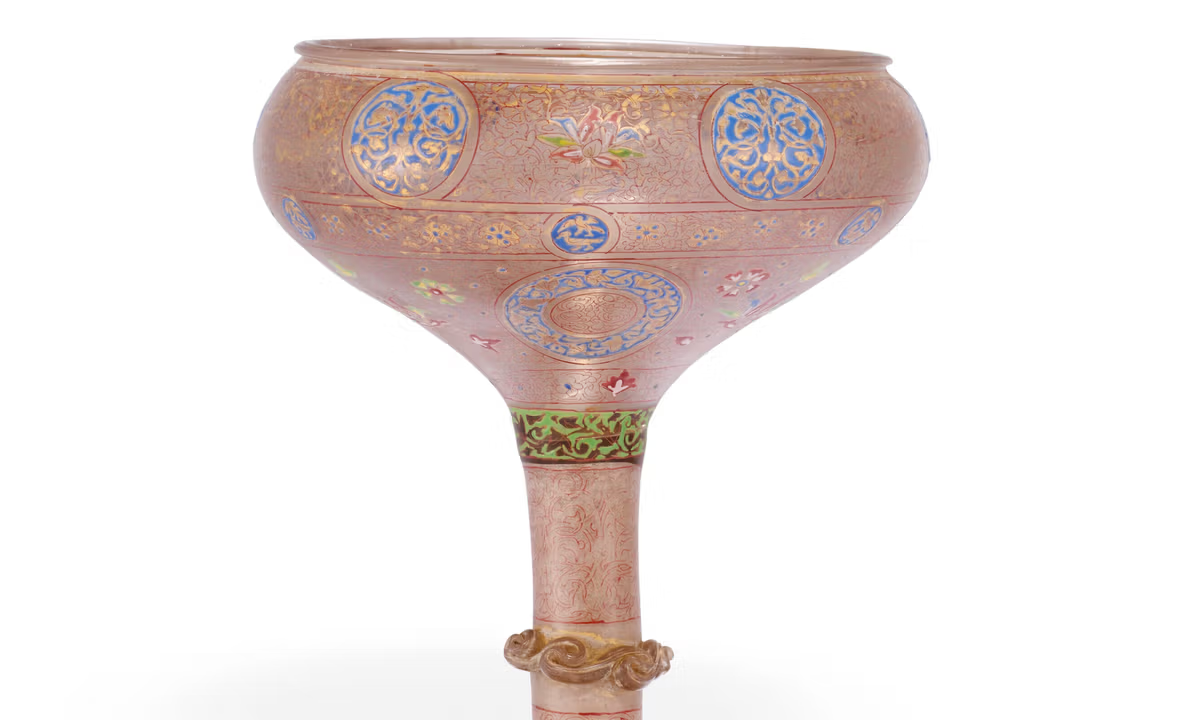
The top lot of the week was a rare 14th century Mamluk gilded and enamelled glass footed bowl, deaccessioned with four other pieces from the Toledo Museum of Art, which set a new auction record for Islamic glass, selling for over three times its high-estimate at £5.5m (estimate: £1.2m-£1.8m).
“Mamluk glass is exceptionally rare, as it was very difficult to make in the first place and is extremely fragile” says Sara Plumbly, Christie’s International Head of Islamic and Indian Art. “The footed bowl form is extremely unusual,” Pluymbly adds. “There are only three others that are know: one in the Royal Ontario Museum, one in the British Museum and one in the Metropolitan Museum of Art.” It was previously owned by the French artist Jules-Albert Goupil (1840-84), and at some point in the 19th century was repaired, the base reattached to the stem. Against global institutional, private and trade bidding, “it ended up selling to a European client,” Plumbly says.
A monumental 17th century Mughal astrolabe
Courtesy of Sotheby’s
At Sotheby’s the highest selling lot of the week was a 17th-century Mughal astrolabe, a sophisticated astronomical instrument used to tell the time and date, chart the position of the stars and calculate latitude. The monumental brass instrument was commissioned for Aqa Afzal, and made by Qaim Muhammad and Muhammad Muqim, sold for a mid-estimate £2m, an auction record for an astronomical instrument from the Islamic world. At 40cm high, it is thought to be the largest of these astronomical pre-modern computers in existence.
“We put that in at the highest estimate we’ve ever put on an Islamic scientific instrument,” Carter says, adding that it is a small but dedicated collecting field. “There’s always a few bids, rather than a feeding frenzy of interest. I felt confident about this one, because it was in perfect condition, was made by the two most famous makers of the particular 17th-century Lahore school. It was made for Aqa Afzal, who was prime minister under Shah Jahan and a chief courtier of Emperor Jahangir, two of the great Mughals. It was massive, one of the largest functional astrolabes in existence. So, it had everything going for it. We had three bidders on the telephone. It didn’t really take off, but it’s still a record for an Islamic scientific instrument.”
Iznik
Made in a small town in north-western Turkey between the late 15th century and 16th century, Iznik ceramics have been a mainstay of these Islamic sales for decades.
Two old English collections of Iznik pottery bolstered the bottom line at Sotheby’s, bringing in a combined £2m. The Ralph Brocklebank collection made over three times its high estimate at £994,560 while the Alan Barlow collection of nine lots was 100% sold, for £956,000 (est. £25,000-£35,000). Brocklebank (1840-1921), a Liverpool ship owner and art collector, was an influential collector of Iznik pottery, while Barlow (1881–1968), a civil servant and president of the Oriental Ceramic Society, amassed one of the largest collections of Islamic pottery in the UK.
“There’s always been an international demand for Iznik, buyers from the US, Europe and the Middle East, and museum buyers, too, for the top pieces,” Carter says. “It’s not just a Turkish market, so isn’t overly reliant on the Turkish economy.”
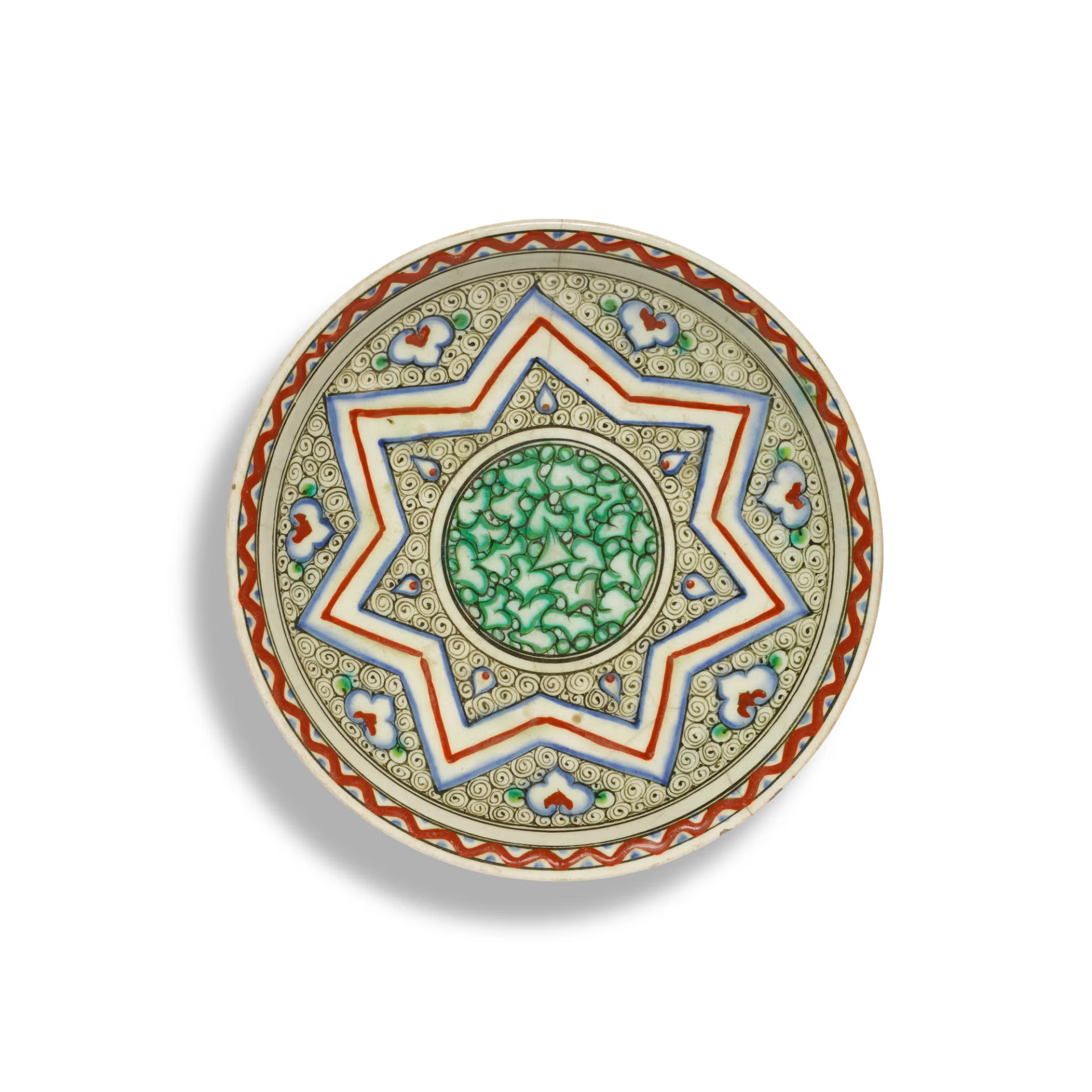
An Iznik polychrome pottery dish, around 1590, sold for £256,000, from the Brocklebank collection
Courtesy of Sotheby’s
The lack of big results in the past few years is because of a lack of supply of exceptional pieces, Carter says: “In 2018 we had a one-off wonderful early blue and white charger from 1481 which came out of the blue from the US and it made a world record price [£5.3m, still the record].” While there have been good individual items offered at auction, there has been a dearth of quality collections, until Barlow and Brocklebank appeared: “I think them coming together really helped…both had wonderful provenances, most of these dishes haven’t been on the market since the 19th century and you can’t say that about many objects in our field. That was reflected in the interest.”
The top performing lots from the Brocklebank collection were an Iznik dish with an unusual emerald green marbled medallion at the centre (around 1590) sold for £256,000 (est. £50,000 – £80,000) and a rimless pottery dish (around 1585-90) for £140,800 (est. £30,000-£50,000). A polychrome Iznik jug from around 1580 was top of the Barlow selection, at £230,400 (est. £25,000 – £35,000).
“Iznik has always been highly commercial,” says Brendan Lynch, a dealer specialising in Indian and Islamic art alongside his business partner Oliver Forge Lynch. “There are various buyers that wax and wane scattered around Europe in particular, where, of course, it’s always been collected—some Iznik was made for merchants in Genoa, quite early on in the 16th century.” Lynch describes the week’s sales as “extremely buoyant”.
Indian paintings
Indian paintings also continued something of a bull run. Last October at Christie’s, the collection of Prince Sadruddin Aga Khan made £45.8m from 95 lots, topped by the Indian miniaturist Basawan’s A Family of Cheetahs in a Rocky Landscape (around 1575-80) which sold for £10.2m, the most expensive classical Indian or Islamic painting ever sold at auction.
The Aga Khan sale buoyed the market, and, for the April sale series, Christie’s had another collection of Indian miniatures, plus calligraphy and drawing, from the collection of the Seattle-based couple Mary and Cheney Cowles. Cheney Cowles, a retired dealer in East Asian art, ran the Crane Gallery from 1975 until 2016. The 84-lot single owner sale was 100% sold, making three times the estimate at £5.3m (with fees).
“The market for Indian painting is clearly very strong, and this was a really nice group,” Plumbly says. “The estimates were attractive, the material was good and was generally relatively fresh to the market with good provenance.” She adds the range of estimates, down to the low hundreds, encouraged new collectors.
The top lot was an early 17th century Mughal painting of A Courtier Holding a Book, ascribed to Manohar and from the desirable Brabourne-Ardeshir album, which sold for £571,500 (est: £80,000-£120,000). The long provenance helped too. “We were able to trace its history back to 1937 when we know it was in the collection of Michael Knatchbull, 5th Baron Brabourne … there’s a lot of things going for it. And if I’m frank, I think the estimate was quite attractive.
“Cheney was very discerning,” Lynch says. “He bought some things from us in the past, and has very particular taste. The drawings are usually about ten times more difficult sell than any Indian painting, it’s just a different market. But Christie’s cleverly made very attractive estimates for the drawings. So it was a very well-constructed sale, obviously with compliance from the vendor who was brave enough to agree to those low estimates.”
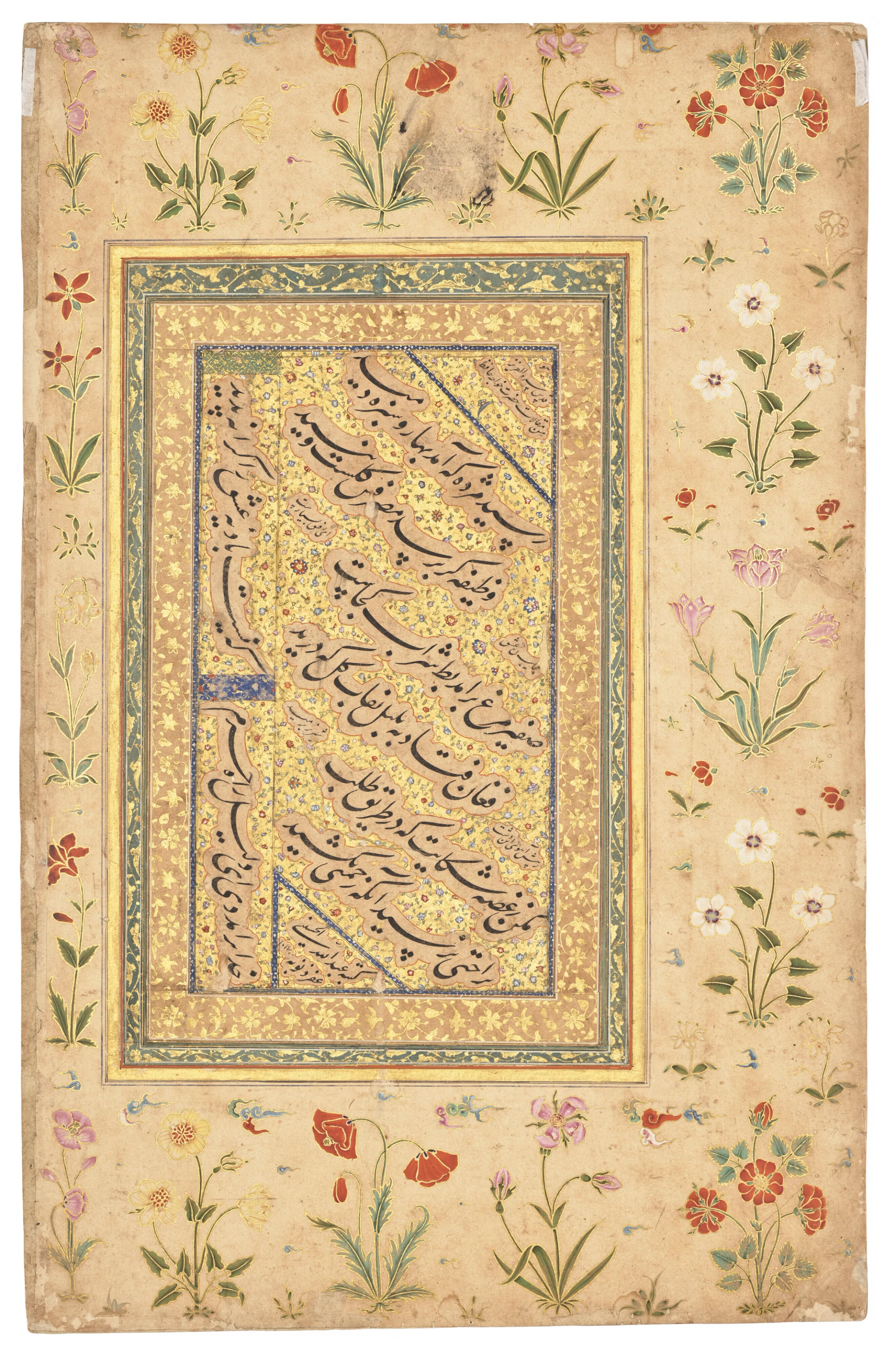
Calligraphy signed by Abdullah al-Husayni, Mughal India, with a painting of a courtier holding a book to the other side, which sold for £571,500 at Christie’s
Courtesy of Christie’s
Lynch adds that many of the works, with provenance listed simply as “American market”, were bought from Terence McInerney, “a very well-known dealer in New York in the 1970s, 80s and 90s.” One of those works, with provenance rather thinly defined as “American market 1988” was a Mughal drawing of demons banqueting (around 1590), the calligraphy signed Muhammad Husayn Kashmiri. Pitched at £50,000-£70,000, it sold for £444,500 (with fees). It sold to an Indian collector, Lynch says.
While the Cowles collection “is a very fine collection in its way”, Lynch says, it is not in the same league as the Aga Khan’s. “What was really remarkable about Sadruddin’s collection was the fact that when he was buying in the 1970s, there was so much on the market. Things were pouring out of India after Indira Gandhi [then prime minister] withdrew the Privy purses of the princes in 1971. There was a huge amount of material, and so to be quite so discerning, was really the remarkable thing about [the Aga Khan] collection.”
A recent phenomenon, noted by Carter, Lynch and Plumbly, is that Indian buyers who have previously concentrated on contemporary art have started to cross over into classical Indian painting. Plumbly comments that some collectors who bought miniatures for the first time in the Aga Khan sale returned to buy from the Cowles collection, plus some entirely new names.
“What’s actually changed in the last one-and-a-half or two years—and was really firstly manifest at the Aga Khan sale in October—is that new Indian buyers have come into the market,” Lynch says. “Almost all are collectors of Indian contemporary art and that market has been booming.” Lynch identifies “three very major Indian contemporary collectors” who have been active in the Indian miniatures market since the Aga Khan sale in October, and are particularly attracted to ascribed paintings from well-known albums such as the Brabourne-Ardeshir.
This strength is part of a broader upswelling in the Indian paintings market. Lynch mentions the sale at Pundoles in Mumbai in March 2025, in which a miniature by Raja Ravi Varma (1848-1906) sold for around $1.7m (160m Indian rupees, with fees), despite the fact it was listed as a national treasure therefore could not be exported. Only last month, Raja Ravi Varma’s Yashoda and Krishna (1890s) sold for $17.9m (or 1,672m Indian rupees, with fees) at Saffronart in Mumbai, setting a new record for any South Asian painting.
