


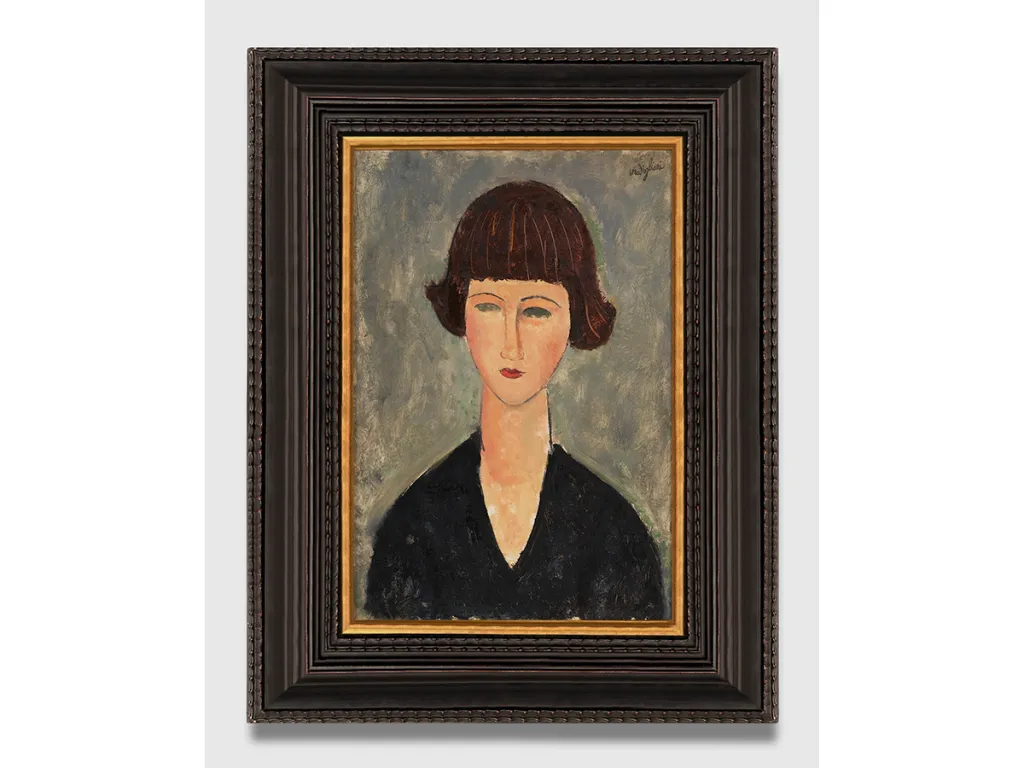
Just weeks after announcing a book launch for Institut Restellini’s decades-in-the-making Amedeo Modigliani catalogue raisonné, Pace is offering a painting by the artist at Art Basel Hong Kong that was only recently authenticated. The work has a long legal backstory.
Titled Jeune femme brune (1917–18), the work is the highest priced piece on offer at the Hong Kong fair, according to ARTnews’s Tessa Solomon, who is on the ground reporting from Art Basel. Pace CEO Marc Glimcher told Solomon that the work is being offered for €11.5 million—about $13.3 million—with several parties bidding on the work. (Glimcher also said that the gallery will be bringing a Modligliani work listed in the new catalogue to each fair this year, in celebration of its publication.)
That’s a far cry from the painting’s status nearly 30 years ago, when it was pulled from a sale at Phillips in 1997 due to authentication concerns. Marc Restellini, art historian and founder of Institut Restellini, told the auction house in the lead-up to the sale that he was not planning on including the painting in his then-in-the-works Modigliani catalogue raisonné, which led to the withdrawal.
The then-owner of the work, Moshe Shaltiel-Gracian, sued the Wildenstein Institute, a Paris-based research center that had provided Restellini an office and research assistant, as part of a collaboration agreement. (The institute, its worth noting, was run by the Wildenstein family, the longtime art dealers who for nearly 20 years were partners in Pace Wildenstein.)
While the lawsuit against the Wildensteins was dismissed in 2001, the issues around the painting resurfaced in 2020, when Restellini sued them over rights to his Modigliani research. The Wildenstein Institute’s defense in the Shaltiel case—that Restellini was not an employee of the organization and therefore the institute was not liable—formed a core part of Restellini’s argument in the 2020 case. The parties reached an undisclosed settlement last year.
As for Jeune femme brune, Restellini told ARTnews on Tuesday that he had never indicated to Phillips that the painting was a fake, but had told them that the catalogue photos were “extremely ugly” and that he could not determine its authenticity without having hands-on access to the work. The auction house, he said, told him that wasn’t possible, given how soon the sale was.
After the Shaltiel case was dismissed in 2001, he began trying to convince the painting’s owner to provide him access to examine the work. Several years ago, Restellini said, the owner did provide access, at which point he subjected the work to his scientific methods, which confirmed that the pigments in the painting match those used in two other authenticated works. Archival research then turned up a document confirming the painting was exhibited in 1929 at Leicester Galleries, a famed art gallery that gave Henri Matisse, Pablo Picasso, Camille Pissarro, and many others their first solo shows in the UK. The work has since been included in Restellini’s forthcoming publication, with the art historian telling ARTnews that it is “impossible [for the painting] to be a forgery.”
“This actually proves perfectly well that our judgements are based on reliable scientific and documentary evidence, and not on an impression formed by a poor-quality catalogue photo,” Restellini said in an email.
In the upcoming catalogue, Restellini and his team write of the work: “This painting’s authenticity, which had been challenged for a long time, was eventually proved by recent scientific examinations supported by a provenance going back to the beginning of the 1930s. Although the model’s identity remains unknown, this portrait of a young woman bears a resemblance to two other portraits of dark-haired women with bob hairstyles: Jeune fille à la robe bleu foncé (Young Girl in a Dark Dress, RP 254) and La Robe noire (The Black Dress, RP 255). The three works could presumably be portraits of the same model, executed as a series: the background, the hairstyle, and the neckline of the dress appear similar. Besides, it can also be observed that the same technique was used in each to draw the volume of the bangs by scratching the paint with the handle of the paintbrush.”
