


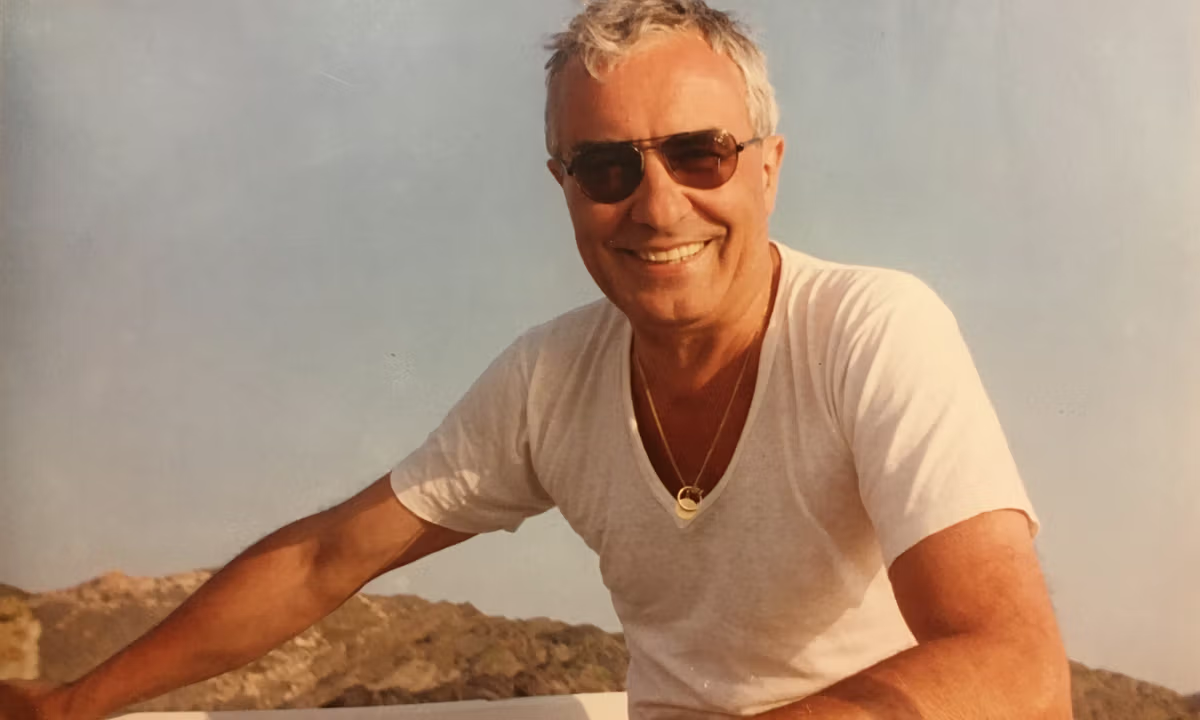
Umberto Allemandi’s passion for the printed word began early. During the Second World War his family was evacuated to Asti where, by the age of five, he had already learned to write. Even before starting school, he put this skill to use by producing a handwritten newspaper—only a single copy—which readers could consult in exchange for a few coins. It was an early sign of the entrepreneurial instinct that would later define his career. In the years that followed he continued producing small newsletters for the parish youth group, at secondary school and even during seaside holidays, publishing reports on marble games played on the beach.
His first experience working on an established publication came with the theatre magazine Il Dramma—subtitled quindicinale di commedie di grande successo, or a fortnightly magazine of highly successful comedies—edited by Lucio Ridenti. Allemandi contributed to the magazine while supporting himself through his studies. He enrolled in Political Science at the University of Turin, where Norberto Bobbio was among his professors, although he never completed his degree.
Soon afterwards he worked as a copywriter at the advertising agency of Armando Testa, an experience that proved decisive for his later work. There he learned the discipline of brevity and the power of the striking phrase. Testa liked to speak of the “punch”—a line capable of leaving a lasting impression on the reader. A single well-aimed blow, he would say, was more effective than a flurry of weak punches. For Allemandi this lesson proved fundamental: the art of the headline and the economy of language would become hallmarks of his editorial style. Among the campaigns produced during his time with Testa, he later recalled with affection the famous advertisements for Caffè Paulista featuring the character “Carmencita”.
His return to publishing came in the late 1950s thanks to Alberto Bolaffi, who was keen to develop editorial projects devoted to collecting alongside the philatelic catalogues that the Bolaffi family had produced for decades. Allemandi was asked to take charge of these new publications and remained involved in the enterprise for 23 years. During this period, he oversaw a wide range of catalogues and editorial initiatives covering subjects from wine collecting to Modern art.
From 1970 he directed Bolaffi Arte, an information magazine devoted to the art world founded by Giulio Bolaffi. The publication was distinguished by its covers, which featured original works by well-known or emerging artists of the time, many of whom Allemandi knew personally. Among those who contributed were Giorgio de Chirico, Salvador Dalí, Joan Miró, Man Ray, Andy Warhol and Joseph Beuys. The magazine quickly established itself as an important platform for discussion of contemporary art and collecting.
Following the sale of Bolaffi Arte to Giorgio Mondadori, Allemandi moved to Milan. There he received an offer to work for Rizzoli, which he declined. Instead, in 1982, together with a small group of collaborators who had worked with him in Milan, he decided to realise an idea he had long cherished: the creation of a publication that would not be a glossy magazine but a genuine newspaper devoted entirely to art. Conceived with the structure and seriousness of a daily newspaper but appearing monthly, it represented an innovative editorial experiment.
The graphic model was inspired by London’s The Times, while the newspaper’s logo derived from a decorative frieze discovered in a book from Turin’s Accademia Albertina. The editorial office was initially located in an apartment in Via Mancini, in the hills above Turin behind the church of the Gran Madre. The modest premises soon became a lively meeting place—what many described as a “port of ideas”—frequented by leading figures from the worlds of art and culture.
A few years later the editorial offices moved to larger premises on the ground floor of the same building, and in 2015 the headquarters relocated to central Turin in Piazza Emanuele Filiberto, in the Quadrilatero Romano district.
The first issue of Il Giornale dell’Arte, directed by Allemandi, appeared in May 1983. Gianna Marini was his partner in the enterprise, serving as chief executive and managing editor. From the outset the newspaper distinguished itself by the breadth of its coverage—from cultural policy and museum affairs to exhibitions, restoration, publishing and the art market—as well as by a clear and direct style that avoided the obscurities sometimes associated with art criticism. It was an immediate success and quickly attracted international attention for the originality of its format.
The growth of the enterprise was rapid. In 1982 the initial budget amounted to 350 million lire; by 1986 it had reached three billion. The small team of five collaborators, including director and managing editor, had expanded to 14 by the end of the decade. Alongside Il Giornale dell’Arte, the publishing group launched several other periodicals, including the quarterly Antologia di Belle Arti, directed by Giuliano Briganti, Alvar González-Palacios and Federico Zeri. Highly prestigious though aimed at a specialised readership, it achieved an international circulation of around 3,500 copies. Other titles included Il Giornale della Musica, founded in 1985 (later entirely acquired by its co-publisher EDT), and La Gazzetta Antiquaria.
Allemandi’s ambitions, however, extended beyond Italy. The “universal” vocation of the Italian newspaper soon found expression abroad. In 1990 the London-based English-language edition The Art Newspaper was founded, published under the imprint Umberto Allemandi & Co. Publishing Ltd. The paper was co-founded and directed until 2002 by the art historian Anna Somers Cocks, formerly of the Victoria and Albert Museum and Apollo magazine. She would later become Allemandi’s wife.
Further editions followed in subsequent years. In 1992 the Greek edition, Ta Nea tis Technis, was launched in Athens. In 1994 the Paris-based Le Journal des Arts appeared, later replaced in 2018 by The Art Newspaper France. A Spanish-language edition, El Periódico del Arte, was published between 1997 and 2002. In the 21st century the network expanded further with The Art Newspaper Russia, founded in Moscow in 2012; The Art Newspaper China, launched in Beijing in 2013; and, from 2023, The Art Newspaper Turkey. Together these publications formed a global network of art journalism based on the editorial independence of each title and its publisher while maintaining shared editorial principles and a continuous exchange of content.
Between 2002 and 2014 Allemandi also created and published Il Giornale dell’Architettura, a monthly publication conceived as an equivalent instrument of information for the fields of architecture, construction, design, urban planning and the environment. After a period of suspension, the publication resumed online in 2014 thanks to a group of former editors and the cultural association The Architectural Post, under licence from Allemandi.
Alongside his newspapers, Allemandi also developed an important publishing house. In 1983, at the same time as Il Giornale dell’Arte, he founded Umberto Allemandi & C., soon recognised for its distinctive aquamarine-coloured books —known internally as “Allemandi blue”. The colour was chosen deliberately in place of black, which had already been adopted by the publisher Franco Maria Ricci. The inspiration, once again, came from England, from the shade of a particular type of writing paper. One of Allemandi’s guiding principles, learned from Armando Testa, was the importance of a strong visual identity—an element that readers could immediately recognise.
Over time the publishing house built a catalogue distinguished by its scholarly quality. It now includes nearly 2,800 titles covering art history, architecture, the economics of art and literature. Authors published by Allemandi include Luigi Carluccio, Federico Zeri, Giuliano Briganti, Francis Haskell, John Pope-Hennessy, Jean Clair, Alvar González-Palacios, Jennifer Montagu, Clement Greenberg, Erwin Panofsky, David Sylvester, Rafael Moneo, Renzo Piano and Antonio Paolucci.
Among the publisher’s most important works are major scholarly studies such as Caravaggism in Europe, a monumental project of more than a thousand pages and two thousand illustrations completed after the death of its editor Benedict Nicolson by his wife Luisa Vertova. Other landmark publications include the works of John Pope-Hennessy on Raphael and Renaissance sculpture; Federico Zeri’s Giorno per giorno dell’arte; the Italian translation of Clement Greenberg’s essays Art and Culture; Jean Clair’s Critique de la modernité; and Francis Haskell’s Patrons and Painters, a fundamental study of the relationship between art and society in the Baroque period.
The publishing house also produced multimedia series such as I Video del Louvre and managed bookshops in several major Italian museums, including the Galleria Nazionale d’Arte Moderna in Rome, the Castello Sforzesco in Milan, the Egyptian Museum in Turin and the Reggia di Venaria. It published exhibition catalogues for leading international institutions such as the Museum of Modern Art in New York, the Musée d’Orsay in Paris, the Vatican Museums and the Dalí Museum in Figueres.
One of its most ambitious editorial undertakings was the Universal Dictionary of 20th-Century Architecture, completed in 2001 in six volumes with contributions from more than 400 scholars from ten countries. In 2004 a four-volume edition was produced in collaboration with the Treccani Institute.
Over the years Allemandi received numerous honours, including the Italian National Prize for Culture awarded in 1992 by Prime Minister Carlo Azeglio Ciampi. Further recognitions followed from the National Art Collection Fund in London, the Art Directors Club in New York and other cultural institutions.
From the early 2000s Il Giornale dell’Arte expanded its reach through the launch of its online edition. The print newspaper continued to appear monthly with between 100 and 200 pages, providing extensive coverage of international artistic life and cultural policy. In 2025 the entire archive of the publication was made accessible online, offering a comprehensive record of global artistic activity over more than four decades.
Umberto Allemandi died on 9 March 2026, his eighty-eighth birthday. His legacy endures in the international network of newspapers he created and in a publishing house that has played a significant role in shaping contemporary debate on art, architecture and culture.
A tribute to Umberto Allemandi from Anna Somers Cocks, his wife and founder of The Art Newspaper
I had just become editor of Apollo magazine, fresh from 13 years at the Victoria and Albert Museum, when—reading the final issue produced by my predecessor—I realised that, for all its prestige, the magazine had lost the constituency it had once served when it was founded in the early 20th century. There was no such thing any more as a general reader for random essays on the entire spectrum of art. As with science, the subject had become professionalised and super-specialised, not to mention the fact that art historians had given up writing in such a way as to seduce the general reader. Too much of it had become grist for career art historians, with their deadening need to publish articles for the sake of academic scoring.
Then a newspaper arrived on my desk, the Giornale dell’Arte, and I was immediately seduced. It offered real, up-to-date news about what was happening internationally, covering every branch of the arts, including archaeology and conservation. It also devoted an entire section to the art market, rigorously separated—both physically and editorially—from the rest of the paper. Kipling’s rules—who, where, what, when, and most important of all, why—were being applied. By its topicality, the Giornale dell’Arte implicitly reconnected the scattered elements of the art world and showed how art influences the world beyond it and vice versa.
The coup de foudre I experienced on seeing this newspaper was repeated a few months later when I met the man behind it, Umberto Allemandi. We became lovers and three years later got married. Just as important for my life, however, was that he taught me the skills of the trade—above all, how to sense what passed the “So what?” test and what did not. It is a question even academics should apply to whatever they might be writing about.
The first issue of the Giornale dell’Arte came out in 1983, so long ago that people may have forgotten what a revolutionary idea it was at the time. Despite the flood of PR blandishment that is pumped at us every day, for those who care, it has given us the tools by which see it for what it is. The art world owes him a great debt. And so do I. A.S.C.
