

Close Menu
  • News
  • Stocks
  • Bonds
  • Commodities
  • Collectables
    • Art
    • Classic Cars
    • Whiskey
    • Wine
  • Trading
  • Alternative Investment
  • Markets
  • More
    • Economy
    • Money
    • Business
    • Personal Finance
    • Investing
    • Financial Planning
    • ETFs
    • Equities
    • Funds

Subscribe to Updates

Get the latest markets and assets news and updates directly to your inbox.

Trending Now

Texas Man Who Orchestrated $20 M. Crypto Scam Based on Fictitious Van Gogh and Picasso Masterpieces Sentenced to 23 Years in Prison

April 30, 2026

Rare pigment worth more than its weight in gold found in Roman infant burials in York, UK – The Art Newspaper

April 30, 2026

Picasso Painting That Cost S. I. Newhouse a MoMA Board Position Heads to Christie’s for $55 M. 

April 30, 2026
Facebook X (Twitter) Instagram
The Asset ObserverThe Asset Observer
Newsletter
LIVE MARKET DATA
  • News
  • Stocks
  • Bonds
  • Commodities
  • Collectables
    • Art
    • Classic Cars
    • Whiskey
    • Wine
  • Trading
  • Alternative Investment
  • Markets
  • More
    • Economy
    • Money
    • Business
    • Personal Finance
    • Investing
    • Financial Planning
    • ETFs
    • Equities
    • Funds
The Asset ObserverThe Asset Observer
Home»Art Market
Art Market

Oldest astronomical observatory in the Americas discovered in Peru – The Art Newspaper

News RoomBy News RoomApril 30, 2026
Share
Facebook Twitter LinkedIn Pinterest Email

On the coastline of Supe Puerto, where the desert meets the ocean on Peru’s Pacific coast, the oldest civilisation in the Americas continues to reveal the complexity of its worldview. Earlier this month, Peru’s cultural ministry announced the discovery of an architectural structure that was once used for astronomical purposes at the ancient settlement of Áspero.

Áspero forms part of the urban network of the Caral, the oldest known civilisation in the Americas (3000BC-1800BC). This latest discovery adds to previous major findings that have highlighted the site’s social and symbolic complexity.

According to archaeologists at Áspero, astronomy was a vital and practical tool consistent with the tradition of observation that has already been documented in other areas ruled by the Caral. The archaeological site’s director, David Palomino, notes that the structure reveals a direct relationship between knowledge of the sky and maritime activities. By observing the sun, moon and stars, ancient residents were able to anticipate changes in weather, tides and the availability of marine resources—all key factors to successful fishing and shellfish gathering.

The archaeologist Aldemar Crispín says that measuring time played a crucial role in establishing a series of activities around which the population’s everyday life was organised. This linked natural cycles to economic exchange between fishers on the coast and the farming communities of the valley.

A window into the cosmos

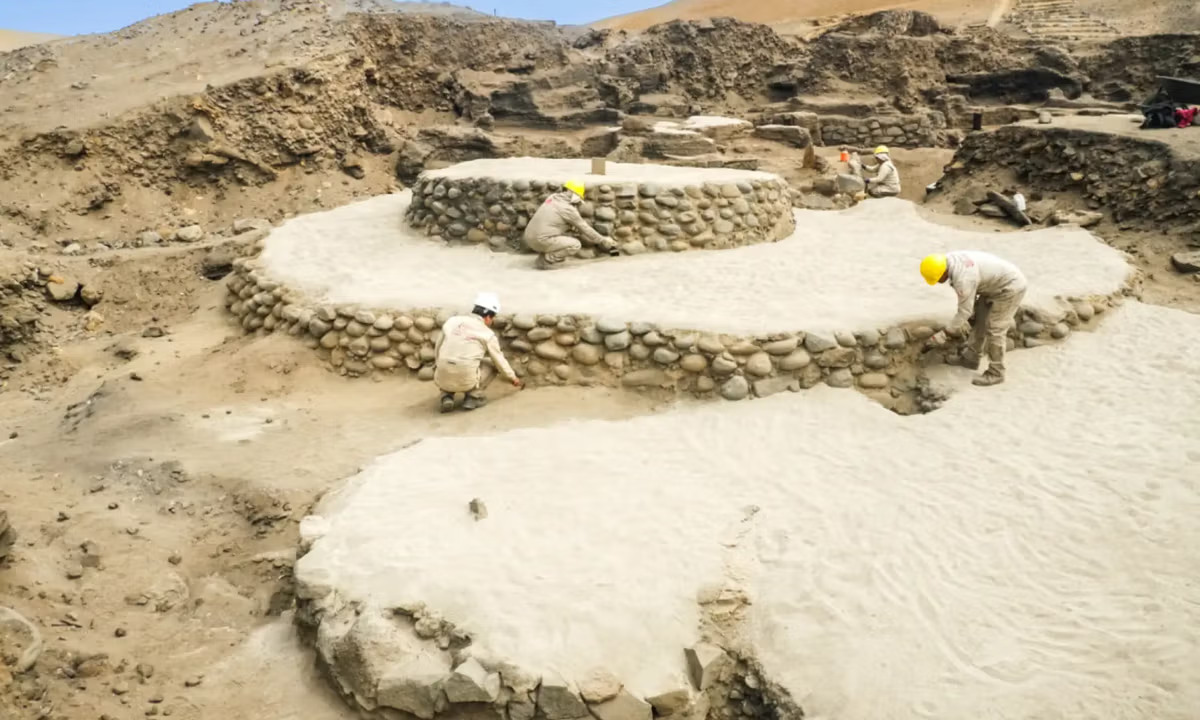
A team led by the archaeologist Ruth Shady—who discovered the Caral sites in Peru in 1994—has identified a specialised area used to record celestial phenomena and their interactions with the natural landscape. The location of the two-level stone observatory is hardly accidental. Strategically situated near pyramidal buildings, it offers a panoramic view that includes both the seacoast and the lower basin of the Supe Valley.

Researchers have identified four distinct construction periods, revealing the architectural and functional changes that occurred there over time. Initially, the space is believed to have been used as a public ceremonial building. It was later remodelled to include an oval-shaped platform with a vertical stone (huanca) located at its centre—a symbolic Andean element associated with ritual ceremonies. These characteristics suggest the intensification of ritual activities, possibly related to the observation of the stars.

This latest Caral discovery supports the theory that the Americas’ oldest civilisation was able to sustainably manage its environment, thanks to a deep understanding of its territory and the cosmos, thousands of years before other societies around the globe. A multidisciplinary team is currently evaluating the soil layers and materials recovered at the site to determine a precise timeline using radiocarbon dating.

Share. Facebook Twitter Pinterest LinkedIn Tumblr Email

Keep Reading

Texas Man Who Orchestrated $20 M. Crypto Scam Based on Fictitious Van Gogh and Picasso Masterpieces Sentenced to 23 Years in Prison

Rare pigment worth more than its weight in gold found in Roman infant burials in York, UK – The Art Newspaper

Picasso Painting That Cost S. I. Newhouse a MoMA Board Position Heads to Christie’s for $55 M. 

Venice Biennale’s jury resigns – The Art Newspaper

Montclair Art Museum Hires Esteemed Curator Kate Kraczon After Layoffs at Brown University

Georg Baselitz, German artist who turned figurative painting on its head, has died, aged 88 – The Art Newspaper

Banksy statue appears in Central London. 

Italian Culture Minister Launches Inspection of Venice Biennale’s Russian Pavilion

Meet the London Perfumer Building a Collection Around Humor and Instinct

Recent Posts
  • Texas Man Who Orchestrated $20 M. Crypto Scam Based on Fictitious Van Gogh and Picasso Masterpieces Sentenced to 23 Years in Prison
  • Rare pigment worth more than its weight in gold found in Roman infant burials in York, UK – The Art Newspaper
  • Picasso Painting That Cost S. I. Newhouse a MoMA Board Position Heads to Christie’s for $55 M. 
  • Venice Biennale’s jury resigns – The Art Newspaper
  • Montclair Art Museum Hires Esteemed Curator Kate Kraczon After Layoffs at Brown University

Subscribe to Newsletter

Get the latest markets and assets news and updates directly to your inbox.

Editors Picks

Rare pigment worth more than its weight in gold found in Roman infant burials in York, UK – The Art Newspaper

April 30, 2026

Picasso Painting That Cost S. I. Newhouse a MoMA Board Position Heads to Christie’s for $55 M. 

April 30, 2026

Venice Biennale’s jury resigns – The Art Newspaper

April 30, 2026

Montclair Art Museum Hires Esteemed Curator Kate Kraczon After Layoffs at Brown University

April 30, 2026

Georg Baselitz, German artist who turned figurative painting on its head, has died, aged 88 – The Art Newspaper

April 30, 2026
Facebook X (Twitter) Instagram
© 2026 The Asset Observer. All Rights Reserved.
  • Privacy Policy
  • Terms
  • Press Release
  • Advertise
  • Contact

Type above and press Enter to search. Press Esc to cancel.