

Close Menu
  • News
  • Stocks
  • Bonds
  • Commodities
  • Collectables
    • Art
    • Classic Cars
    • Whiskey
    • Wine
  • Trading
  • Alternative Investment
  • Markets
  • More
    • Economy
    • Money
    • Business
    • Personal Finance
    • Investing
    • Financial Planning
    • ETFs
    • Equities
    • Funds

Subscribe to Updates

Get the latest markets and assets news and updates directly to your inbox.

Trending Now

Texas Man Who Orchestrated $20 M. Crypto Scam Based on Fictitious Van Gogh and Picasso Masterpieces Sentenced to 23 Years in Prison

April 30, 2026

Rare pigment worth more than its weight in gold found in Roman infant burials in York, UK – The Art Newspaper

April 30, 2026

Picasso Painting That Cost S. I. Newhouse a MoMA Board Position Heads to Christie’s for $55 M. 

April 30, 2026
Facebook X (Twitter) Instagram
The Asset ObserverThe Asset Observer
Newsletter
LIVE MARKET DATA
  • News
  • Stocks
  • Bonds
  • Commodities
  • Collectables
    • Art
    • Classic Cars
    • Whiskey
    • Wine
  • Trading
  • Alternative Investment
  • Markets
  • More
    • Economy
    • Money
    • Business
    • Personal Finance
    • Investing
    • Financial Planning
    • ETFs
    • Equities
    • Funds
The Asset ObserverThe Asset Observer
Home»Art Market
Art Market

Rare pigment worth more than its weight in gold found in Roman infant burials in York, UK – The Art Newspaper

News RoomBy News RoomApril 30, 2026
Share
Facebook Twitter LinkedIn Pinterest Email

Some 1,700 years ago two infants were buried in York, UK, with the care, respect and expense usually reserved for Roman emperors and aristocrats, their little bodies wrapped in Tyrian purple-dyed cloth embroidered with gold thread.

The intense purple dye was among the most prized luxuries of the Roman empire, made in specialist dye works in Tyre, modern-day Lebanon, by crushing millions of murex sea snails. It is estimated that it took up to 12,000 of the molluscs to produce one gram of the dye, and it was literally worth more than its weight in gold.

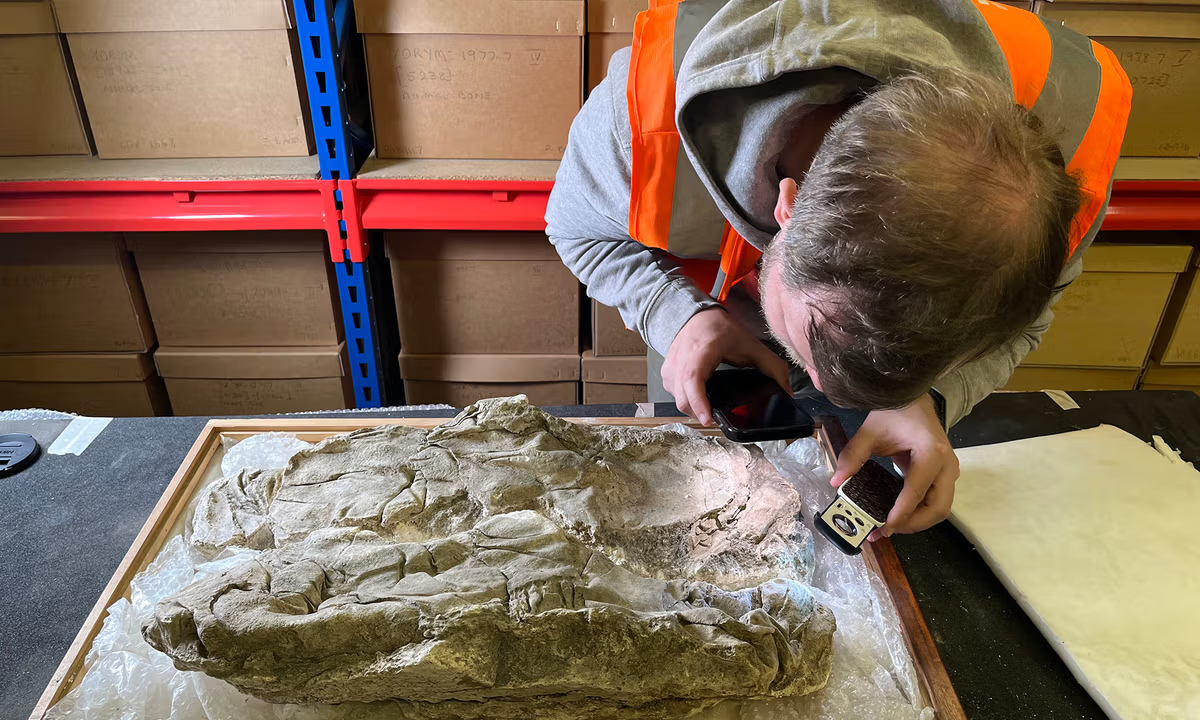
The Tyrian purple dye up close

Photo: University of York

The discovery, by scientists at the University of York, is the first time traces of the dye have been found in textiles from York, one of a handful of examples from the UK and an exceptionally rare find among child burials across the Roman empire.

Maureen Carroll, a professor of Roman archaeology at the University of York, is overseeing the multidisciplinary Seeing the Dead project, which is studying an unusual group of burials from York, many excavated over a century ago on the land now covered by the railway station and museum. In a statement, she said the new discovery shed new light on the importance of children in Roman York.

“This remarkable discovery tells us a lot about the importance of children in Roman York and the willingness of the family to give their baby the best possible send off in tragic circumstances,” she said in a statement. It offers a counterpoint to some early Roman legal texts, which state that it was improper even to mourn publicly the death of a child under one year old, at a time when infant mortality was as high as one in three.

York has the largest group in the UK of the “gypsum burials”, a funeral rite—still not fully understood by archaeologists—in which liquid gypsum was poured into an open coffin or sarcophagus before it was closed. The result was effectively a layer of plaster preserving the impression of the body and even traces of the fabric shrouds, usually centuries after the actual remains decayed. In some of the York cases the Victorian excavators kept only the coffins and the gypsum casts, discarding any surviving organic material—to the dismay of modern scientists.

The burials date from the late third- or early fourth-century AD—the same period as the famous Spitalfields Woman in London, whose intact coffin and sarcophagus was opened on live television in 1999 at the Museum of London, revealing contents including a Tyrian purple and gold wrap. In York one infant, aged around two, was buried between two adults in a stone sarcophagus now on display at the Yorkshire Museum. The other much younger baby, no more than a few months old, was remarkably given its own tiny lead coffin, and covered in two layers of textiles, a tassled shawl and over that a fine textile of Tyrian purple-and-gold embroidery—a visible symbol of wealth and status—before the coffin was closed.

In both burials, although the fabric had decayed, the gypsum preserved clear impressions of the Tyrian-dyed fabric, and even faint traces of colour. Scientists extracted minute samples of the colour and subjected it to tests including liquid-chromatography tandem mass spectrometry, which revealed the main chemical compound of Tyrian purple.

Tests continue on these and others of the gypsum burials, as part of the project funded by the Arts and Humanities Research Council.

Share. Facebook Twitter Pinterest LinkedIn Tumblr Email

Keep Reading

Texas Man Who Orchestrated $20 M. Crypto Scam Based on Fictitious Van Gogh and Picasso Masterpieces Sentenced to 23 Years in Prison

Picasso Painting That Cost S. I. Newhouse a MoMA Board Position Heads to Christie’s for $55 M. 

Venice Biennale’s jury resigns – The Art Newspaper

Montclair Art Museum Hires Esteemed Curator Kate Kraczon After Layoffs at Brown University

Georg Baselitz, German artist who turned figurative painting on its head, has died, aged 88 – The Art Newspaper

Banksy statue appears in Central London. 

Italian Culture Minister Launches Inspection of Venice Biennale’s Russian Pavilion

Oldest astronomical observatory in the Americas discovered in Peru – The Art Newspaper

Meet the London Perfumer Building a Collection Around Humor and Instinct

Recent Posts
  • Texas Man Who Orchestrated $20 M. Crypto Scam Based on Fictitious Van Gogh and Picasso Masterpieces Sentenced to 23 Years in Prison
  • Rare pigment worth more than its weight in gold found in Roman infant burials in York, UK – The Art Newspaper
  • Picasso Painting That Cost S. I. Newhouse a MoMA Board Position Heads to Christie’s for $55 M. 
  • Venice Biennale’s jury resigns – The Art Newspaper
  • Montclair Art Museum Hires Esteemed Curator Kate Kraczon After Layoffs at Brown University

Subscribe to Newsletter

Get the latest markets and assets news and updates directly to your inbox.

Editors Picks

Rare pigment worth more than its weight in gold found in Roman infant burials in York, UK – The Art Newspaper

April 30, 2026

Picasso Painting That Cost S. I. Newhouse a MoMA Board Position Heads to Christie’s for $55 M. 

April 30, 2026

Venice Biennale’s jury resigns – The Art Newspaper

April 30, 2026

Montclair Art Museum Hires Esteemed Curator Kate Kraczon After Layoffs at Brown University

April 30, 2026

Georg Baselitz, German artist who turned figurative painting on its head, has died, aged 88 – The Art Newspaper

April 30, 2026
Facebook X (Twitter) Instagram
© 2026 The Asset Observer. All Rights Reserved.
  • Privacy Policy
  • Terms
  • Press Release
  • Advertise
  • Contact

Type above and press Enter to search. Press Esc to cancel.