


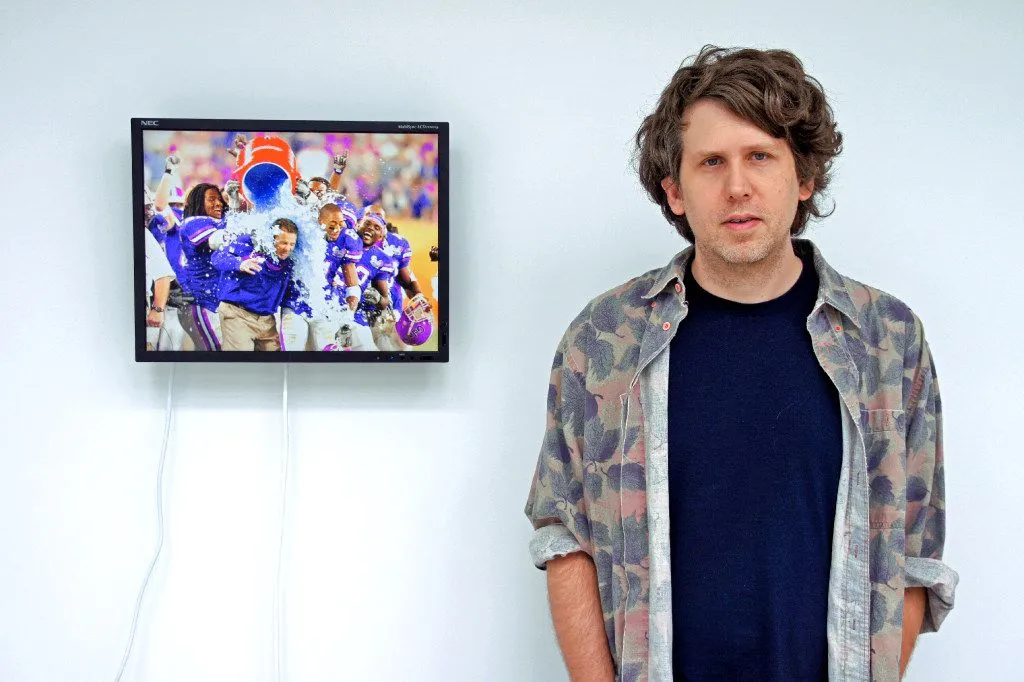
This past week, Paul Slocum celebrated 20 years of And/Or gallery, a pioneering space for the exhibition of new media art. Founded in 2006 with a show featuring works by Tom Moody and Saskia Jorda, Slocum’s ad hoc gallery became a home for outsider artists exploring the cutting edge of art made with computers and the internet. Many of these artists, like Cory Arcangel and Petra Cortright, have come to define the first waves of computer- and internet-based art and have enjoyed significant institutional recognition.
Yet Slocum is an outlier, seemingly unconcerned with the vagaries of the art market or the quest for institutional stamps of approval. Over the past 20 years, his focus on celebrating and preserving the fringes of creative internet subcultures has been central to his work as a gallerist, artist, and restorer.
For this week’s edition of Link Rot, I sat down with Slocum to talk about the growth of the gallery, his first computer, and the trick to selling digital art sustainably.
Shanti Escalante-De Mattei: What were your first interactions with computers?
Paul Slocum: Texas Instruments is huge in Dallas, where I grew up, and my dad worked for TI. When I was in third or fourth grade, I took a class at a nearby college sponsored by Texas Instruments because they had a class on the TI-99. I was obsessed. I was staying late, just learning everything I could. After that, I was actually programming stuff on the Atari 2600 game console. When the Commodore 64 dropped in price—I think it was around 1984 or ’85—it dropped to like $200, and that’s when a lot of people got theirs, and that’s when I got mine. Then I had access to something where I could really do a little more serious programming. And I just loved it.
What was programming for you at that age? When did you start to see programming in the context of art?
I was making generative music, generative graphics, I made games. I remember I made a thing that played the Ghostbusters theme song. I never really saw stuff in museums. Really, the biggest inspiration for me, by far, was PBS. When I was a kid, I submitted a generative art program to 3-2-1 Contact magazine, which was put out by the Television Workshop that does Sesame Street. I got one published. Then PBS used to show Alive from Off Center, where they showed video art. There was also one called Frame of Mind, a local show that I think ran throughout Texas, and they also showed video art. I would record it on VHS tapes and watch it over and over again. So that was really my big art inspiration when I was younger.
Later on, I’d start posting what I was doing on my websites and people began to reach out to me, saying that some of the stuff I was making should be in a gallery or museum. Then I started getting shows. I got an art residency and free rent for a year. My friend Lauren Gray and I started doing these audiovisual performances called https://www.qotile.net/treewave.html—most of the music and visuals were coded by me on an Atari 2600 game console and a Commodore 64 computer—and we were getting flown out to Europe to do this pretty regularly.
What was going on in Europe at that time [early 2000s]?
I was seeing these spaces that were a combination of DIY but also somewhat professional, doing stuff related to digital art, and I hadn’t really seen that before. There was a big event called Read_Me in 2004 in Denmark that I participated in, and that introduced me to a lot of people in the digital art scene.
How did you go from making work to curating it?
I wanted to start a performance art series, and I ended up doing a show with Cory Arcangel related to his Super Mario Clouds. Then Lauren [Gray] got the idea to start a gallery because she took a class on running one. She found a space in Dallas, I got involved, and then she got busy with other things. As it went on, it became my thing. I lived in the back of the space.
An installation view of And/Or’s 2016 solo show for Brenna Murphy.
Courtesy And/Or Gallery
I’m curious about what it was like to see the shift from digital art as programming to something that was then referencing and appropriating features of the internet.
Well, our first show was Tom Moody, who was all about treating his blog posts as art. We were literally showing blog posts on a screen. That was pretty wild to me at the time. Then Nasty Nets started, and that was kind of the beginning of post-internet art to some degree. Members included Petra Cortright, Guthrie Lonergan, and Tom Moody, and I started showing their work.
You started seeing these internet surf clubs, internet curatorial clubs. Artists were curating random things from the internet onto blogs, and it sort of walked the line between creating and curating. A lot of what Guthrie Lonergan was writing about and making work about concerned how the internet was changing—particularly how it was shifting from early GeoCities homepages into social networking, what we call Web 1.0 moving to Web 2.0.
What’re your definitions for what Web 1.0 and 2.0 are?
Web 1.0 felt more personal. It was people’s personal web pages that they were building themselves. Web 2.0 was when corporations came along and got much more involved, being in control of what everything looks like to some degree. A lot of the artwork was addressing how corporate culture was taking over the internet—changing the aesthetics, and I guess the vibe of everything that was going on. Olia [Lialina] wrote about this, and we had her essays at the show. She described the early internet as a Vernacular Web, and now people see that as having shifted to a corporately controlled web.
How do you feel like the transformation from Web 1.0 to Web 2.0 changed the way people make digital art?
We were focused more on how the whole world was changing in regard to this shift. But it’s a change that feels more evident now than it did then. A lot of the artists I’m most interested in are posting on Instagram—that’s their practice. I like what they’re doing, but it’s very limited in terms of what you can post on Instagram compared to what you could do on your own website. WordPress was a big thing because it allowed you to make your own blog and have it work and look the way you wanted. Artists would build their own RSS readers, which allowed people to follow different blogs and see updates, while still controlling their own sites. That control was a strong aesthetic component that set apart what artists were doing.
Now everybody’s on the main platform. That’s kind of all there is.

An installation view of the 2018-2019 exhibition “Video Game Art 1970-2005.”
Maybe we should talk about Web3, then—NFTs and all that. Often when I speak with people in the digital art space, this big problem that is invoked is that the work isn’t properly valued, that it lacks a financial base. Kevin McCoy, who I believe came up in a similar time as you, framed that period as one in which new media artists were getting shows and there was a lot of energy but there was a value problem, and that’s why he ended up creating the NFT. How do you feel about the financial aspect of digital art as an artist but also a gallerist?
Well, I had collectors from the very beginning. After I did my first show, a collector from Europe reached out to me, and I thought it was a scam, but it was totally legitimate. Collectors are definitely out there, but there just aren’t a whole lot. In terms of NFTs, there’s nothing preventing us from selling the work from a technical standpoint. Part of what I do at the gallery is try to wrangle digital artwork into a more stable form where we can sell it. I archive it, make all kinds of notes on it, deal with complicated technologies, try to simplify it for a collector, and then we make editions, just like you would with photographs.
There’s never been a huge market for it, and there definitely seemed to be more adventurous collectors in the past, but I don’t totally understand why that changed. For years, I kept thinking, Oh, this is eventually gonna break through—collectors will be much easier to find. But that never happened.
I see the financial stuff as a problem across the board, honestly. And basically, I gave up on the idea of turning this into a real business. I’ve survived because I run on a very small budget, and I’m a software developer as my main job. I’m here at the gallery every day, even though we’re really only doing about one three-month show a year right now, because it’s also my office.
What made you resistant to the NFT moment?
Personally, I felt like the NFT thing was a bubble, and it sure seems like it was. Every time I’ve kind of made peace with it… my problem is that when NFTs came along, the people involved gained a lot of power through connections to museums and money and claimed to be championing digital art in general, but ended up supporting only those involved in NFTs. A lot of the stuff that sold—and still sells—for big money is really safe, easy work being marketed as more innovative than it really is.
What’s keeping you motivated to do this work?
I mean, I’m just about to cut a huge check to my artist, and it feels good when I do that. It would be great if there were a lot more collectors focused on digital art, but I’m not holding my breath. I think the stuff I’m showing and doing is important. A big focus of what I do—and a big purpose of the shows—is to document and archive this work. I’m archiving about 500 Commodore 64 games and programs right now. I want to support artists I think are important who have lost their galleries.
Is there something in the new generations of digital art that inspires you?
One of my favorite recent shows was curated by my buddy Sebastian Demian, also known as Dem Passwords. The show was about this incredible logo-editing community. We estimate the average age of the kids making this work is around 15.
They seek out logo identification videos—like a Viacom logo you’d see at the end of a show in the ’80s or other small graphic animations—and apply video effects to make them look different, then rework the sound. Most of the videos are five to 10 seconds long, and there are thousands of them. It was one of the most interesting things I’ve seen in recent history, but it was hard to convey to people what these kids are doing.
Want to close out on any lessons from 20 years in the biz?
My biggest thing is that it’s important to keep costs down. We find clever ways to make elaborate shows. But it’s not for everybody. There have been a lot of times when I thought about quitting, especially when I was in New York. I tried to open the space there, and I just couldn’t figure out how to make it work. It was a tough decision to reopen here [in Pasadena]. But I’m glad I did. It’s interesting, it’s important.
I don’t always love the term outsider art, but for lack of a better term, it’s outsider art—and it’s just as important, just as interesting. I feel like if you create the right stuff, it just kind of falls into place.
