


The 1974 Venice Biennale has gone down in history less for what went on view than what didn’t: the show itself. The explanations for why the exhibition didn’t happen are diverse. Some accounts attribute the show’s cancelation to an embarrassing disagreement among warring Italian factions. Others follow the narrative laid out by then-Biennale president Carlo Ripa di Meana, a socialist who said he shuttered the show as a means of political engagement.
Certainly, the project that he did mount looked more like a protest than a traditional art exhibition—which may be why the Biennale did not consider the show an official edition at all. (Biennale history places the 36th show in 1972 and the 37th in 1976.) Termed the “New Biennale” by Ripa di Meana, the initiative was explicitly labeled “antifascist” and planned as a demonstration against the repressive policies of Augusto Pinochet, a dictator who rose to power in Chile after a military coup the year before. Rather than trotting out fresh paintings and big sculptures, the Biennale put on view posters denouncing fascism worldwide in public settings. The show was officially titled “Libertà al Cile,” or “Freedom in Chile,” and its political character could not be missed. Ripa di Meana himself called this Biennale “an act of dutiful solidarity and democratic faith.” Fast-forward 52 years, and that kind of gesture is now unimaginable.
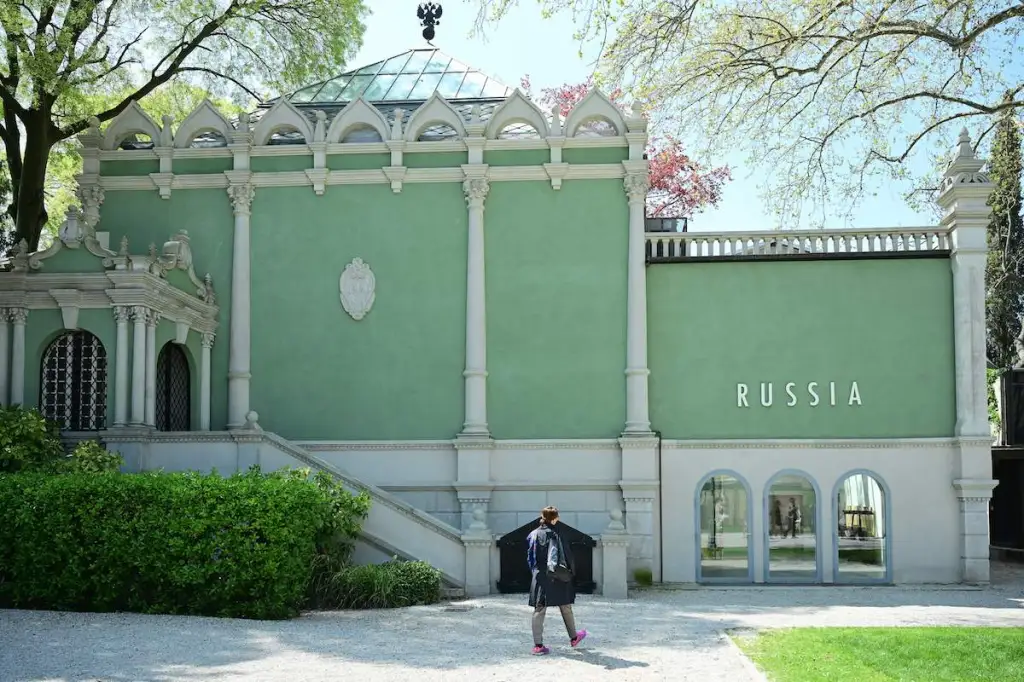
For much of this month, the Biennale has been trying to position itself as a nonpartisan arbiter in an increasingly unsettled world. This week, the 2026 Biennale continued to face the wrath of international politicians after the show confirmed that its 99 national pavilions would include one by Russia, which has not shown at the Biennale since the country invaded Ukraine in 2022.
On Wednesday, 22 high-ranking politicians representing European nations from France to Poland signed an open letter to the Biennale initiated by Latvia. The letter called Russia’s presence “deeply troubling” and said the pavilion “raises serious questions about the risk of state-directed cultural diplomacy being presented under the guise of artistic exchange.” Ukraine and Lithuania had already issued their denouncements, with the former writing that the Biennale could soon become “a stage for whitewashing the war crimes that Russia commits daily,” and the EU has threatened to stop funding the show. Thousands of artists and curators signed another open letter calling for the Biennale to kick Russia out altogether. “The claim that ‘culture is above politics’ is never neutral,” that letter reads.
This was an allusion to the Biennale’s own statement on the matter from earlier this month, which said that the show accepts pavilion applications from any nation recognized in Italy. To do otherwise, the Biennale suggested, was tantamount to cultural suppression. “In response to the communications and requests for participation from Countries, La Biennale di Venezia rejects any form of exclusion or censorship of culture and art,” the exhibition wrote in its statement.
While the statement was new, it was an echo of an old one issued in 2024, when groups such as the Art Not Genocide Alliance (ANGA) protested the presence of Israel, which began its brutal military bombardment of Gaza the year before, following the October 7 Hamas attack. (Palestine has never had an official Biennale pavilion because it is not recognized as a nation in Italy.) Iran’s pavilion was also scrutinized that year: a mass protest movement against the nation’s oppressive regime led some to call for the ejection of that pavilion as well. In response, the Biennale told the Art Newspaper that it “may not take into consideration any petition or call to exclude the participation of Israel or Iran,” since those countries had applied on their own. (Artist Ruth Patir ended up shuttering her Israeli Pavilion and calling for a ceasefire in Gaza and the release of Hamas’s hostages; the Iranian Pavilion went on view.)
Israel’s Venice Biennale pavilion was shuttered to the public on opening day by artist Ruth Patir.
Photo Luc Castel/Getty Images
In that statement, the Biennale said it had not made the call in 2022 to shutter the Russian Pavilion. This is true: the decision came from the artists and curator representing Russia that year, who called the war in Ukraine “unbearable.” But the Biennale also failed to note that the show had weighed in on the conflict that year through the creation of the Piazza Ucraina, an ad-hoc exhibition in support of Ukraine that was staged outdoors. A release announcing that show stated that the Piazza Ucraina was mounted “in solidarity with the people of Ukraine in the aftermath of the brutal invasion by the Russian government, and to create a space for debate, conversation and support to Ukrainian culture.” The gesture recalled 1974’s “Libertà al Cile,” albeit on a smaller scale.
In fact, “Libertà al Cile” was even surveyed in 2020, in a Biennale-organized show about “moments when historical events have burst into the most important art exhibition in the world,” as Roberto Cicutto, then the Biennale’s president, put it. He noted in 2022 that these moments were “not unique,” and that Russia’s war in Ukraine was yet one more of them.
Has the Biennale since stopped recognizing those moments? It certainly appears that way. The exhibition never issued a release about the Israeli and Iranian Pavilions in 2024, and it has so far not responded specifically to the controversy over the Russian Pavilion in 2026, since the statement on “exclusion” preceded the wave of open letters. How the Biennale can maintain its stance of neutrality amid all this is tough to imagine, especially because other institutions of its stature do not maintain similar positions. The Biennale is often called the Olympics of the art world, for example. But even the Olympics has banned Russia since 2022 because, as the International Olympics Committee said the following year, the nation had violated the Olympic charter by trying to include athletes from regions it invaded. (If the Biennale has any similar charter, it has not been released to the public. A Biennale spokesperson did not respond to ARTnews’s request for comment.)
This suggests that it might be time for the Biennale to do some thinking, not just about what goes on view, but about its role in the world more broadly. As art historian Vittoria Martini pointed out in a 2024 essay, Italian newspapers referred to the Biennale as the “UN of the arts” during the postwar years, implying that the show functioned as an international congress. Perhaps the show ought to start working like one, too. The UN, for one, has an ethics committee that facilitates disputes among the assembly’s members. Maybe it is time, then, for the Biennale to convene a similar panel.
Certainly, something along those lines is necessary this year, not least because the Biennale can expect more pushback to come. ANGA wrote in a Hyperallergic op-ed this February that it planned to renew its calls for a protest against the pavilion mounted by Israel, whom the group accused of “barbaric crimes against humanity, committed in full view of the world.” The dissident Russian collective Pussy Riot has promised a protest against Russia at the Biennale, and the US pavilion may garner no small amount of scrutiny in light of the country’s repeated military actions in Iran and Lebanon, staged with the partnership of Israel. (And that’s not even mentioning the US’s January strike on Caracas and the seizure of Venezuelan president Nicolás Maduro, an action that has been condemned by numerous governments in Latin America and Europe.)
All of this suggests that the Biennale cannot exist apart from all that happens around it—something that president Pietrangelo Buttafuoco even suggested himself when he stated that the 2026 edition, curated by Koyo Kouoh, is about “the joy of authentic art, that which so faithfully resembles real life.” If art really does so closely resemble real life, the Biennale needs to recognize that global unrest does not end at its doors.
