


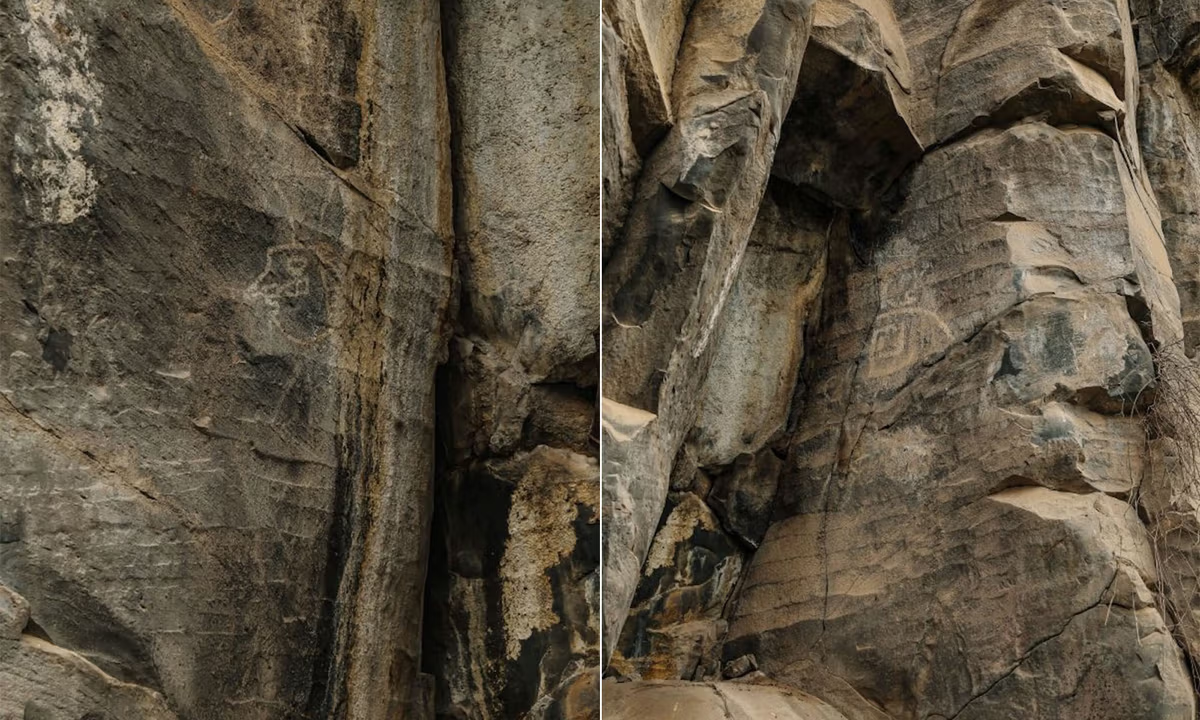
Specialists from Mexico’s Instituto Nacional de Antropología e Historia (INAH) announced this week that they have recorded 16 petroglyphs and cave paintings dating from prehistory and the Mesoamerican Postclassic period (AD900-AD1521) located on two cliffs near the Tula River and the La Requena Dam, in the state of Hidalgo.
The discovery comes on the heels of other recent discoveries of Mesoamerican and colonial-era sites and artefacts during archaeological salvage work associated with planning a new 232km passenger rail line between Mexico City and Querétaro. Earlier this month, INAH revealed the discovery of a 1,000-year-old Toltec altar nearby, at the Tula Chico site.
The site of the most recent rock art discovery is one of four active excavations along the Querétaro route, where construction began in April 2025, with current progress at around 10% of the total project. In October 2025, Mexican president Claudia Sheinbaum Pardo announced a change to the railway route to preserve this heritage site, given the impossibility of relocating the paintings to a museum.
The site was registered in the 1970s as part of the Tula Archaeological Project, when a painted element depicting a deer was found, and it has since been called El Venado. In a statement, an INAH spokesperson said: “The location of the artwork suggests a mythical-religious purpose, perhaps related to astronomical or calendrical phenomena.”
The figures found in what INAH describes as a rock shelter are striking. They include one carrying what appears to be a macana (a type of club) with a headdress and goggles reminiscent of Tláloc, the Aztec god of rains, storms and fertility, who is often associated with caves and springs.
In the same rock shelter, the institute identified the stylised image of an anthropomorphic figure rendered in red, as well as an image resembling a snake or lightning bolt. The paintings were made with mineral or vegetable pigments, while the petroglyphs were made using pointillism. According to INAH, some of the artworks are more than 4,000 years old.
Archaeologists in the salvage team say the paintings are in good condition. They estimate that those of pre-Hispanic origin are possibly related to the final stage of Tula, the great Toltec capital that left vast remains full of monuments and artistic treasures.
Among the figures found near the Tula River are a representation of a deer and a figure with fangs, antennae, a breastplate and goggles, similar to those of Tláloc, with bird-like legs, reminiscent of representations made by the Mogollon culture, which inhabited the southwestern United States and northern Mexico, and whose art has been found at sites in Puebla.
A figure with an anthropomorphic face and hair, with four legs resembling those of a bird or the hooves of a horse, that likely dates from the time of contact with the Spanish, was also identified. While the paintings and petroglyphs were only recently identified officially, according to INHA, they had previously known the region’s local communities.
According to José-Miguel Perez Gomez, an expert on Latin American rock, the discovery represents “a transformative milestone for Mexican archaeology and rock art studies”.
The findings are exceptionally significant, he tells The Art Newspaper, because of its “vast chronological span, documenting human activity from over 4,000 years ago through the Mesoamerican Postclassic and into the early colonial period. By providing a continuous record of cultural evolution,” he says, “the site allows researchers to analyse the transition of symbolic languages and artistic techniques within a single geographic context.”
Gomez adds that the site’s iconography “suggests deep-rooted cultural exchanges between central Mexico and the Mogollon cultures of the north. Located near the Tula River, the site functions as a lithic archive of ritual life and environmental interaction. This discovery not only enriches our understanding of regional pre-Hispanic heritage but also reinforces the Tula Valley’s status as a critical corridor for long-term cultural synthesis and spiritual expression.”
