


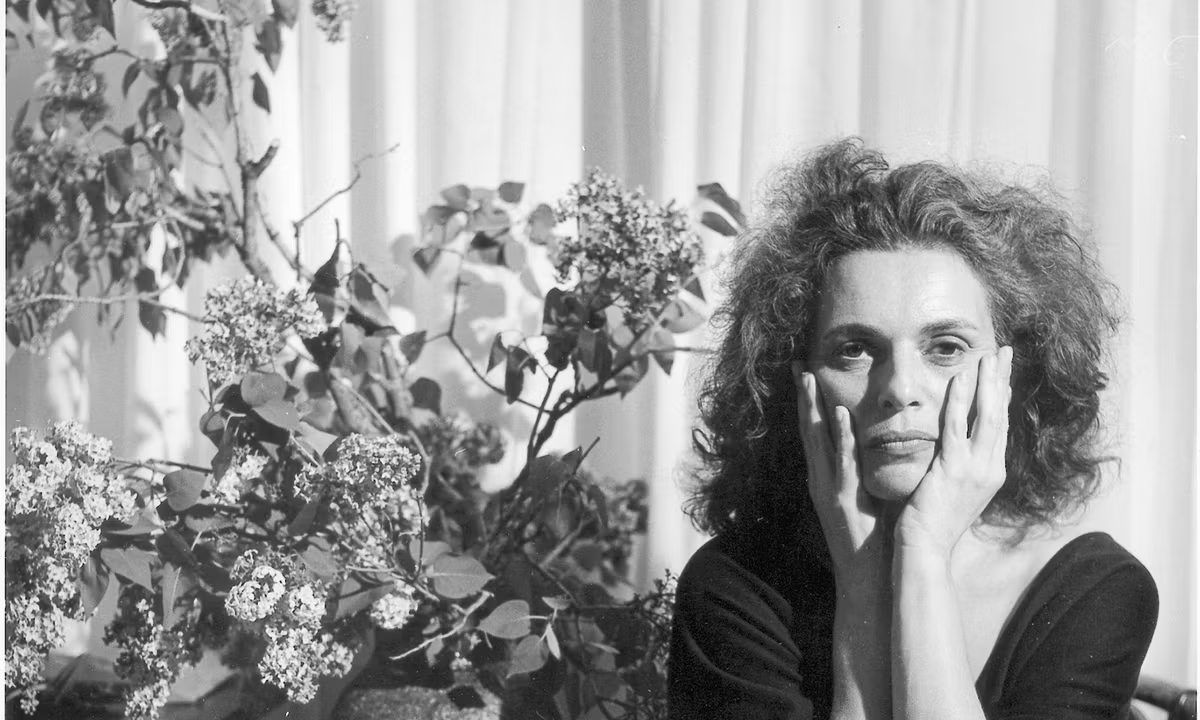
In the early 1970s, while teaching painting at the California Institute of the Arts (CalArts), Pat Steir found herself temporarily billeted in Bruce Nauman’s house in Pasadena while the artist was away. Nauman had told her there would be another guest. That guest turned out to be Sol LeWitt. The encounter would reshape her practice as decisively as any formal influence. “He taught me not to judge a work while you’re making it,” she recalled. “That whole Abstract Expressionist struggle—fighting with the paint, having a hard time, thinking, ‘This painting is killing me!’ He didn’t believe in all that.” Neither, from that point forward, did Steir.
Steir, who died in Manhattan on 25 March aged 87, was one of the most significant American painters of her generation: a figure who came of age alongside the men of Minimalism and Conceptualism, absorbed their rigour without accepting their dogmas and eventually arrived at a body of work entirely her own. Her Waterfall series, begun in the late 1980s and continued until nearly the end of her life, placed her among the great late-blooming artists of the century—a painter who did not achieve widespread recognition until her fifties and who responded to the wait not with bitterness but by intensifying her ambition. She was, as a former collaborator put it, “devoted body and soul to the medium of painting itself”.
Professional ambition
Born Iris Patricia Sukoneck in Newark, New Jersey in 1938, she was the first of four children of Larry Sukoneck, who ran various businesses in window design, silk-screen printing and neon signs, and Judith Lila Sukoneck. Both parents, from Russian and Egyptian Jewish families, had attended art school without becoming professional artists—a trajectory their daughter was determined not to replicate. As a child she would sometimes skip school to visit the Philadelphia Museum of Art. She enrolled at Pratt Institute in Brooklyn in 1956, studying under Richard Lindner and Philip Guston, before spending two years at the Boston University College of Fine Arts, where her classmates included Brice Marden. She returned to Pratt and earned her BFA in 1962.
Her early career was far from straightforward. After graduating, she worked as a freelance illustrator—“I wasn’t good at it, because I couldn’t follow instructions,” she later said—and then as an art director at Harper & Row, negotiating a three-day working week to leave time for painting. She quit at the end of the 1960s and taught at Parsons and CalArts, where her students included Ross Bleckner, David Salle and Amy Sillman. Her first solo show was at the Terry Dintenfass Gallery in New York in 1964, the same year her work appeared in a group exhibition at the Museum of Modern Art (MoMA). But the art world of the period was not inclined to take women painters seriously on the same terms as men, a situation Steir addressed through both work and institutional commitments. She was a founding board member of the feminist journal Heresies and of Printed Matter, the New York bookshop dedicated to artists’ publications; she sat on the editorial board of Semiotext(e). These responsibilities reflected a serious engagement with the politics of culture that ran through everything she did.
The change inspired by Brueghel
Her painting in the 1970s deployed a kind of deadpan iconoclasm. Monochromatic canvases featured roses crossed out with X-marks—a simultaneous invocation and erasure of symbolic language, at once quoting Shakespeare (“a rose by any other name”) and Gertrude Stein (“a rose is a rose is a rose”) and refusing both their consolations. The grid became a recurring structural motif, connecting her practice to Agnes Martin, LeWitt and Piet Mondrian.
Then, in the early 1980s, came the breakthrough that changed everything. Steir had been looking hard at a reproduction of a flower painting by the 17th-century Flemish master Jan Brueghel the Elder. She cut it into 64 panels and repainted each one in a different historical style, from Velázquez to Van Gogh to Abstract Expressionism. The result, The Brueghel Series (A Vanitas of Style) (1982-84), shown first at the Brooklyn Museum in a travelling exhibition that crossed the United States and Europe before entering the collection of the Kunstmuseum Bern, was a tour de force of art-historical wit—a painting that contained, in compressed form, the entire history of painting and quietly asked what, after all that, remained possible. In working through it, Steir came close to an answer.
Brushes abandoned
She had been travelling to Japan, studying woodcuts and Chinese literati landscape painting, particularly ancient shan shui (mountain-water) imagery, which evoked nature rather than attempting to transcribe it. She had been deepening her friendship with John Cage, whose embrace of chance and non-intention had opened new possibilities. By the late 1980s she had abandoned the brush entirely. Climbing a ladder—or, in later years, using a mechanical lift—she would pour thinned paint from the top of the canvas and allow gravity to determine its path downward, the streams interacting, layering, pooling, drying at speeds that varied with temperature and air currents.
“Gravity becomes my collaborator,” she told Artnews in 2012. “The way the thing works is always in part a surprise.” This was characteristically modest. What it did not convey was the paradox at the centre of the enterprise. Writing in the New York Review of Books about her series for the Barnes Foundation, Colm Tóibín noted that Steir’s Waterfall paintings are “concerned much more with the potential of paint than the need to represent something in nature” and are “dynamic rather than completed; they happened by an arranged accident”. Steir herself acknowledged this structure of controlled surrender: she mixed no colours, never cropped or rotated her canvases, applied paint one layer at a time, and retained precise command over palette, scale and placement. The chance was real, but the frame within which it operated was exact.
A late work renaissance
When the philosopher Sylvère Lotringer told Steir that her entire career had been “a long effort to disappear”, she agreed—adding that she had been trying to take her ego out of the art, to let paint express “something in the will of nature”. The disappearance, however, required extraordinary discipline to arrange. She preferred the term “non-objective” to “abstract” and bristled at comparisons to Jackson Pollock, whose drips she understood as essentially egocentric. Her pours were about the opposite: the removal of the self, the collaboration with forces larger than intention.
The Waterfall series brought her international recognition at an age when many artists are winding down. She had one-person painting shows at the Brooklyn Museum and the New Museum that travelled widely in Europe; a print retrospective from Geneva’s Cabinet des Estampes reached the Tate in London. Site-specific installations followed at the Whitney Museum of American Art and MoMA PS1, and—in 2019, when she was 81—a floor-encircling commission at the Hirshhorn Museum and Sculpture Garden in Washington, DC, and a parallel show at the Barnes Foundation in Philadelphia. In 2021, the Long Museum in Shanghai mounted the first comprehensive survey of her work in China. Her paintings entered the collections of the Metropolitan Museum of Art, MoMA, the Whitney, the National Gallery of Art, the Guggenheim Museum and the Tate, among many others. She received a Guggenheim Fellowship in 1982, a National Medal of Arts in 2017 and was elected to the American Academy of Arts and Letters in 2016. Throughout, she continued to paint almost until the end. Her last gallery show in Europe, Song, was held at Hauser & Wirth Zürich in 2025.
Steir was “forgotten and rediscovered many times”, as she told The New York Times in 2019, attributing her later prominence in part to the art world’s tendency to treat older women artists as hidden treasure. The observation was wry rather than wounded: she had spent 50 years making work of extraordinary ambition, and she knew it.
• Pat Steir, born Newark, New Jersey, 10 April 1938; studied Pratt Institute 1956-58, Boston University College of Fine Arts 1958-60, BFA Pratt 1962; founding board member, Printed Matter Inc and Heresies; Guggenheim Fellowship 1982; National Medal of Arts 2017; married Merle Steir 1956, divorced; married Joost Elffers 1984; died Manhattan, 25 March 2026
