


The funeral of Sliman Mansour, one of the defining voices in Palestinian visual art, took place on Wednesday (26 August) at the Anglican Church in his hometown of Birzeit in the occupied West Bank. Mansour died on Monday (24 August) aged 79, according to an Instagram post from his family.
Tributes have poured in from across the Palestinian art world and beyond, where Mansour is widely regarded as a pioneer of the contemporary Palestinian art movement and a key figure in shaping a distinctly Palestinian visual identity.
Among them, A.M. Qattan Foundation—a UK- and Ramallah-based organisation that supports culture and education in Palestine and the Arab world—said in a post on Instagram that Mansour’s art was inseparable from the Palestinian people, land and memory, and that he had helped build a prominent place for Palestinian art on both the regional and global stage.
Similarly, Basel El-Maqosui, co-founder of Shababeek Group for Contemporary Art in Gaza, remembered Mansour as one of the leading pioneers of the Palestinian visual art movement, saying his work gave voice to the suffering of the Palestinian people and their pursuit of freedom and independence. “He left a clear mark on the journey of Palestinian visual art and his works will remain a testament to his genius and creativity.”
Mansour was born in Birzeit in 1947, a year before the creation of the State of Israel and the beginning of the 1948 Arab-Israeli war. He grew up against the backdrop of the forced expulsion of more than 700,000 Palestinians from their homes during what is known as the Nakba (Arabic for “catastrophe”). He showed an interest in drawing from an early age and was accepted to study at the School of the Art Institute of Chicago. But the events of 1967, when Israel defeated a coalition of Arab armies and captured and occupied the West Bank, Gaza, the Sinai Peninsula and the Golan Heights, changed his plans. Fearing he might not be able to return to Jerusalem if he left, he decided to remain and study at the Bezalel Academy of Art and Design.
These experiences, and what he saw as a deliberate erasure of Palestinian identity, profoundly shaped his work. In 1973, he and other young artists founded the League of Palestinian Artists, the first official Palestinian art body. They began organising exhibitions in any available public spaces, using their art to raise awareness of the national struggle for liberation and an end to the occupation. The popularity of the exhibitions eventually led to international shows for the League.
By the age of 26, Mansour had created one of his most famous paintings, Jamal al-Mahamel [Camel of Hardships] (1973). The work, created as part of the League’s activities, depicts a stooped old porter carrying the city of Jerusalem on his back within an endless void, symbolising the Palestinian homeland and the dream of return. Palestinian landscapes and symbols, including new ones that he and others developed, would dominate his work.
Sliman Mansour, Revolution was the Beginning (2016, detail)
© The Palestinian Museum
In 1987, Mansour and fellow artists Vera Tamari, Tayseer Barakat and Nabil Anani founded the New Visions group, a form of cultural resistance to the Israeli occupation that coincided with the First Intifada—a major Palestinian uprising. In response to national movements calling for a boycott of products made or purchased in Israel, the group began making art without Israeli art supplies, instead using materials around them such as mud, straw, wood, herbs, henna and natural dyes.
Mansour and the group went on to establish the al-Wasiti Art Center in Jerusalem in 1994, after, Mansour explained in an interview, Israel eased its restrictions on the creation of Palestinian cultural institutes. It became a hub for showcasing Palestinian art and hosting workshops.
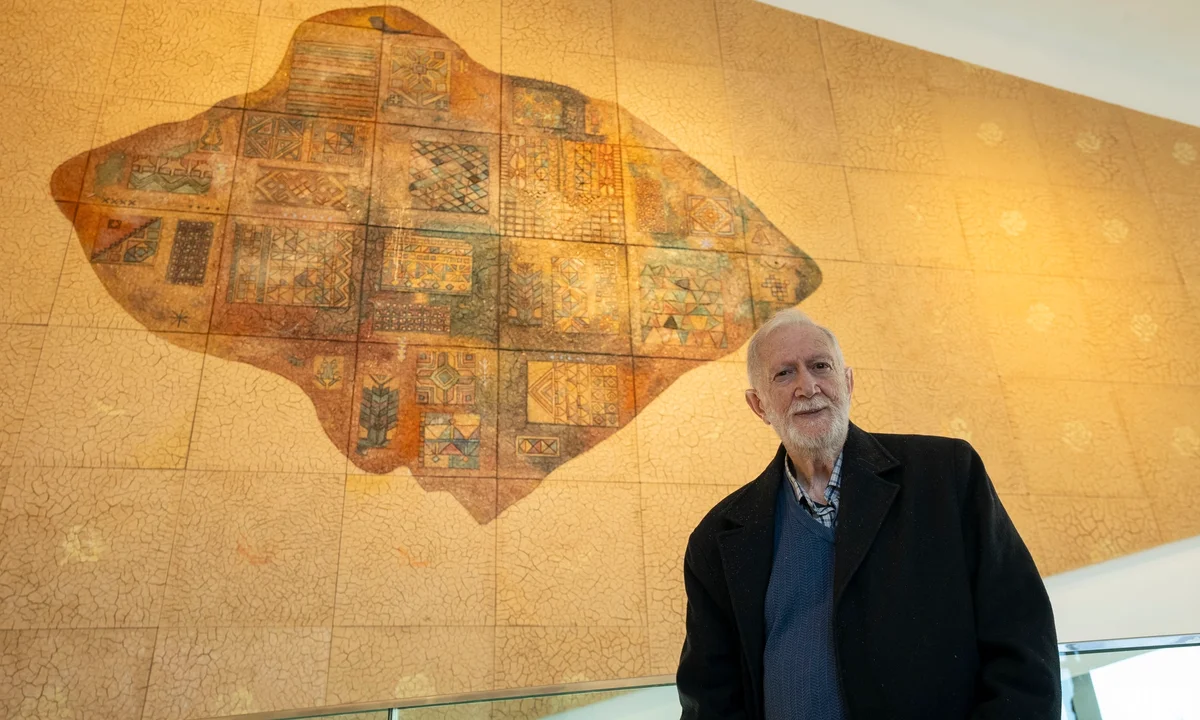
Mansour spent the following decades working, mentoring and inspiring generations of Palestinian artists. In 2024, despite his ailing health, Mansour created On the Wing of an Angel, a 12m by 6m mural for the Palestinian Museum in Birzeit, with the assistance of the artist Al-Aziz Atef and a group of volunteers from Birzeit University’s faculty of art, music and design. Made using clay, straw and henna, the work is now part of the museum’s permanent collection.
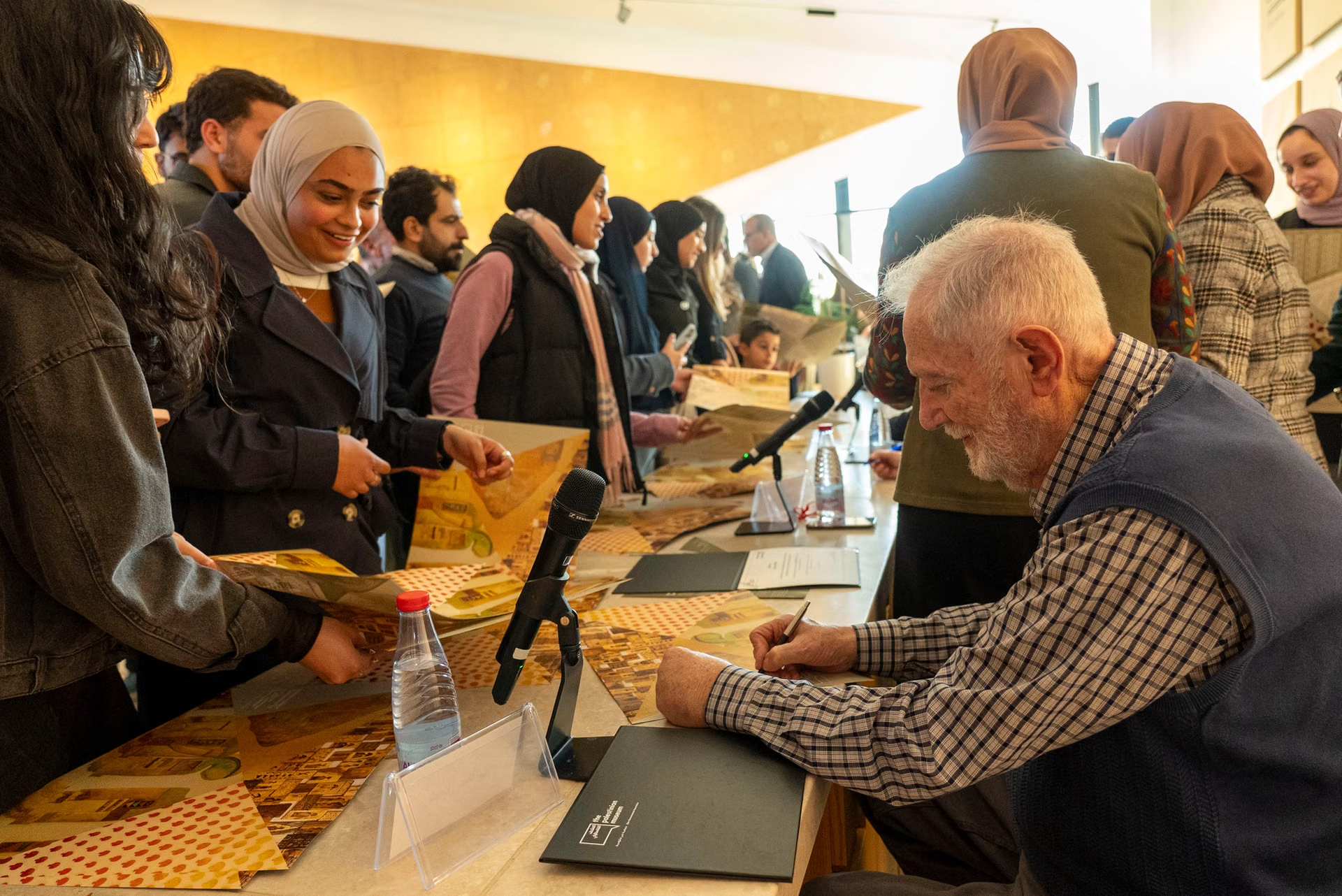
Sliman Mansour at the opening of New Visions at the Palestinian Museum in Birzeit
© The Palestinian Museum
Amer Shomali, the Palestinian Museum’s director general and an artist who attended Mansour’s funeral on Wednesday, says the artist’s connection to the land went far beyond it being a subject for his art—it was closer to an obsession, particularly with olive, fig and pine trees. Shomal recalls that a decade ago, when he had a studio with a fig tree outside, Mansour would regularly visit to eat its fruit. Shomali would use the visits to ask for feedback on his own work. Mansour could be blunt, joking that he should find another career, but at other times he encouraged Shomali to pursue and develop a piece.
That connection to the land was reflected in Mansour’s only “payment” request for his work On the Wing of an Angel: that a fig tree be planted in the museum’s garden in his name. For Shomali, this captured just how rooted Mansour was in the land.
Shomali also recalls Mansour’s work being analysed and studied at university for its composition, art-historical references and texture. But whenever the artist himself was present, he would say that he cared less about such analysis than about how the work made the viewer feel. “For him it was about how to get all of this history of art and all of those references and all of those details to make the artwork accessible and easy to be understood and felt by the average Palestinian,” Shomali says.
Mansour’s creativity also extended to illustrations, books and cartoons. He was the recipient of several awards, including the 2019 Unesco-Sharjah Prize for Arab Culture, and his work is held in collections around the world, including at the British Museum in London, Qatar’s Mathaf: Arab Museum of Modern Art and the Guggenheim Abu Dhabi.
Memorial events for the artist have continued to be held throughout the week, including a tribute at the Palestinian Museum on Thursday (27 August).
