

Close Menu
  • News
  • Stocks
  • Bonds
  • Commodities
  • Collectables
    • Art
    • Classic Cars
    • Whiskey
    • Wine
  • Trading
  • Alternative Investment
  • Markets
  • More
    • Economy
    • Money
    • Business
    • Personal Finance
    • Investing
    • Financial Planning
    • ETFs
    • Equities
    • Funds

Subscribe to Updates

Get the latest markets and assets news and updates directly to your inbox.

Trending Now

Liquidity a ‘limiting factor’ to wider investment trust adoption

April 20, 2026

Partner Insight: US debt is surging — but is the dollar’s global dominance really at risk?

April 20, 2026

Emyria Launches Global Services Platform Targeting International Drug Sponsors

April 20, 2026
Facebook X (Twitter) Instagram
The Asset ObserverThe Asset Observer
Newsletter
LIVE MARKET DATA
  • News
  • Stocks
  • Bonds
  • Commodities
  • Collectables
    • Art
    • Classic Cars
    • Whiskey
    • Wine
  • Trading
  • Alternative Investment
  • Markets
  • More
    • Economy
    • Money
    • Business
    • Personal Finance
    • Investing
    • Financial Planning
    • ETFs
    • Equities
    • Funds
The Asset ObserverThe Asset Observer
Home»Art Market
Art Market

Researchers Find 60,000-Year-Old Poisoned Arrowheads in Africa

News RoomBy News RoomJanuary 9, 2026
Share
Facebook Twitter LinkedIn Pinterest Email

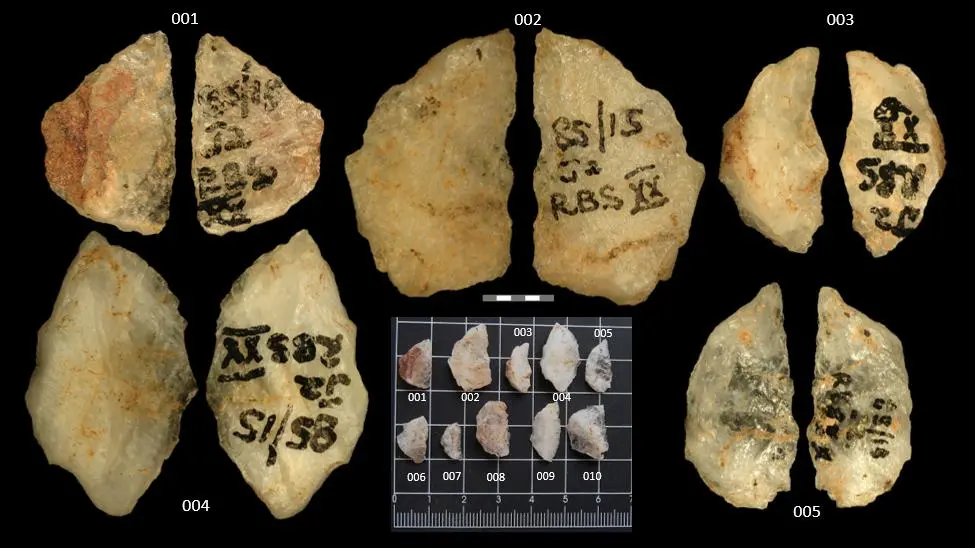
Researchers from South Africa and Sweden have found traces of poison on 60,000-year-old arrowheads in South Africa. Their discovery, reported by Stockholm University in the journal Science Advances, is the earliest direct evidence of the use of poisoned hunting weapons in the world so far. The oldest poisoned arrowheads known prior to the present study date to approximately 6,700 years ago.

The quartz arrowheads were collected from sediment at Umhlatuzana Rock Shelter in KwaZulu-Natal, South Africa dated to the Pleistocene age. By analyzing the chemical structure of residue on the arrowheads, researchers identified a poison made from gifbol (Boophone disticha), a plant still used by traditional hunters in the region.

“[The find] shows that our ancestors in southern Africa not only invented the bow and arrow much earlier than previously thought, but also understood how to use nature’s chemistry to increase hunting efficiency,” says study co-author Marlize Lombard, a researcher at the Palaeo-Research Institute at the University of Johannesburg.

Similar poisons have been found arrowheads collected in South Africa in the late 1700s, offering evidence of a continuity of knowledge between prehistoric and historical times. Furthermore, plant poisons like the ones used on these arrowheads were not immediately lethal, meaning that ancient hunters were cognitively quite sophisticated, according to lead researcher Sven Isaksson, a professor of archaeological science at Stockholm University.

“It takes a developed working memory to be able to predict that if I put this arrowhead into that plant, it will shorten the delay before I get my hands on this meat,” he told the New York Times.

Share. Facebook Twitter Pinterest LinkedIn Tumblr Email

Keep Reading

Ruins of a ‘Unique‘ Temple Complex Discovered in Northern Sinai

Theresa Hak Kyung Cha’s Art Speaks in a Language Left for Us to Translate

What Not to Miss at the San Francisco Art Fair, According to Curator Mara Gladstone

Finland Pulls Back Venice Biennale Presence Over Return of Russian Pavilion

Dallas Art Fair brings Texas’s relationship-driven collecting community into focus – The Art Newspaper

Catalan Museum Has Yet to Follow Through on Court Order to Return Contested Murals to Aragon Monastery

Sotheby’s Paris Notches a $41 M. Modern and Contemporary Sale, Led by a $12 M. Monet Unseen for a Century

The Big Review: Rothko in Florence ★★★★★ – The Art Newspaper

The 5 Best Booths at miart 2026

Recent Posts
  • Liquidity a ‘limiting factor’ to wider investment trust adoption
  • Partner Insight: US debt is surging — but is the dollar’s global dominance really at risk?
  • Emyria Launches Global Services Platform Targeting International Drug Sponsors
  • Ruins of a ‘Unique‘ Temple Complex Discovered in Northern Sinai
  • Theresa Hak Kyung Cha’s Art Speaks in a Language Left for Us to Translate

Subscribe to Newsletter

Get the latest markets and assets news and updates directly to your inbox.

Editors Picks

Partner Insight: US debt is surging — but is the dollar’s global dominance really at risk?

April 20, 2026

Emyria Launches Global Services Platform Targeting International Drug Sponsors

April 20, 2026

Ruins of a ‘Unique‘ Temple Complex Discovered in Northern Sinai

April 19, 2026

Theresa Hak Kyung Cha’s Art Speaks in a Language Left for Us to Translate

April 18, 2026

What Not to Miss at the San Francisco Art Fair, According to Curator Mara Gladstone

April 18, 2026
Facebook X (Twitter) Instagram
© 2026 The Asset Observer. All Rights Reserved.
  • Privacy Policy
  • Terms
  • Press Release
  • Advertise
  • Contact

Type above and press Enter to search. Press Esc to cancel.