


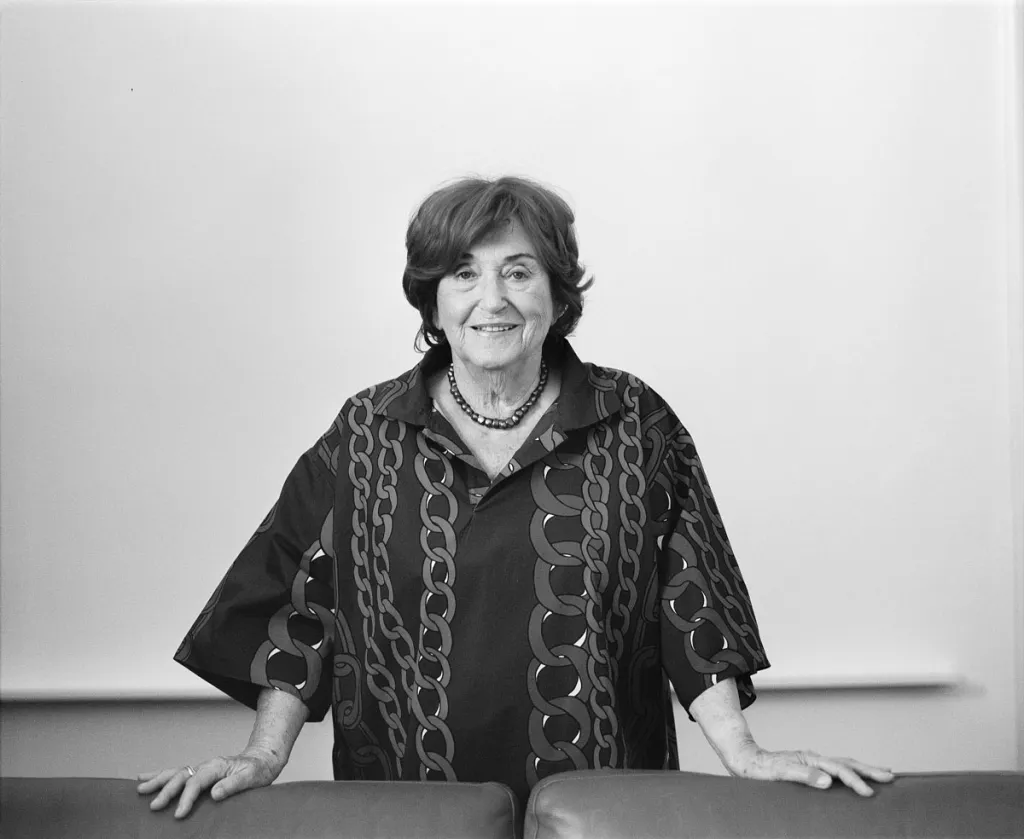
Valie Export, whose groundbreaking work questioned the very nature of art and cinema, all through an explicitly feminist lens, has died at 85. The news was confirmed by Thaddaeus Ropac Gallery, which represents her. Her death on May 14 came three days before her 86th birthday, according to AFP.
“VALIE was one of the most visionary feminist artists to emerge in Europe in the second half of the 20th century,” dealer Thaddaeus Ropac said in a statement. “Her passing marks the loss of a singular perspective in contemporary art, one that influenced artists across generations. Her pioneering work continues to be of such great urgency.”
Over the course of six decades, Export created a body of work that sought to rethink the very nature of first film and then art. Key to this concern was the body and how both disciplines could be approached and redefined through a more tactile approach. “The center of my work is the body, and moreover, the female body,” she told Tate in 2020.
At the center of Export’s oeuvre was her own self-invention. She was born Waltraud Lehner in 1940 in Linz, Austria, and she was raised by a single mother. From an early age, her thinking exhibited a feminist bent: As she recounted in the 2023 book VALIE EXPORT: In her own words, at the age of 13 she wrote, “In the beginning was the word and the word was a man.”
In 1967, Export decided that she wanted a new name, one that did not include her father’s surname, Lehner, or the of her husband, Höllinger. While with Höllinger, she had started going by Valie, a nickname for Waltraud, and in a popular cigarette brand she found Export, a way to encapsulate the idea that “I export my own thoughts,” as she told Tate in 2020. And thus, Valie Export—or VALIE EXPORT, as she preferred it stylized—was born.
In the following year, Export made her “Identity Transfer” self-portraits, in which she took on the role of a pimp as a way to question prescribed gender norms. “I’m very happy I chose that name because I created my own identity with it,” she said in the Tate video. “But that wasn’t just dissatisfaction, it was also during the time of feminism that people said you are allowed to choose who you are.”
Arriving in Vienna from Linz in 1960, Export had become acquainted with the Viennese Actionists, including Hermann Nitsch and Günter Brus. “I wasn’t doing things with them—I began with expanded cinema,” she told Gary Indiana in 1981. “[But] I was very influenced, not so much by Actionism itself, but by the whole movement in the city. It was a really great movement. We had big scandals, sometimes against the politique; it helped me to bring out my ideas.”
Export’s adventures in expanded cinema were twofold. Firstly, she created formalist works that questioned the importance of the physical celluloid to cinema, as she did in Abstract Film No. 1 (1967–68), which wasn’t a film at all. Instead, Export put on view a film projector without any film; projected onto a wall was the view of a water running over a mirror as it passed through the projector’s light.
Secondly, she made distinctly feminist works that also questioned what could be considered cinema and, as well, countered the work of the Actionists, who were all men and whose avant-garde reactions to the buttoned-up conservative society of 1960s Vienna she found lacking. In 1968, she would stage two of her most memorable actions: TAP and TOUCH CINEMA and Action Pants: Genital Panic. (Both works would be memorialized in a set of photographs taken by Peter Hassmann.)
VALIE EXPORT, TAPP und TASTKINO 1968.
Photo: Werner Schulz
For TAP and TOUCH CINEMA, she donned a box with cut-out holes and a curtain through which men could reach to touch her breasts. Speaking to Indiana, she recalled the newspapers at the time decrying TAP and TOUCH CINEMA: “‘She lets people touch her breasts, and she says, celluloid you can burn but Valie Export you can’t.’ There was a great campaign against me in Austria.” Speaking of the work more seriously, she said it “explored the body as material for film in an entirely new way. By replacing the screen with skin, for example, you made cinema into much more than just a visual experience. It became a physical experience for the entire body.”
Action Pants took that impulse and made it a step more explicit. She walked into an art-film house in Munich, wearing crotchless trousers, her genitals exposed. (One legend reported that she did this at a theater screening pornography, touting a gun, but in the Tate video, she corrected that myth, stating with a laugh, “as if I would’ve gone with a machine gun into a porn cinema.”) Later, Export printed Hassmann’s photographs as posters, which she pasted around Vienna, though they would often get torn down.
Though both TAP and TOUCH CINEMA and Action Pants took expanded cinema to a more corporeal end, it was Action Pants that was often considered too explicit for even the most open-minded of tastes. “From 1970 onwards, I often suggested this work for exhibitions, but nobody wanted to show it,” she told Tate, adding “You’ve got to admit it was very punky.”
Works from this era oscillated between these two concerns. Ping Pong (1968) would see her hit the titular ball against a film screen, illuminated yet blank, while for Eros/ion (1971), she rolled naked across a bed of glass shards. Her work could also take on more lyrical aspects, as in Finger Poem (1968) in which she spells out a poem with her fingers in front of the camera. What her fingers are making only becomes clear at the work’s end when the poem flashes across the screen: “I say the showing with the signs of the legend.”

VALIE EXPORT, Einkreisung, 1976.
©VALIE EXPORT
Soon would come her “Body Configurations” series (1972–76). In these photographs, Export contorted her body in various ways, creating striking images of her body defying the expected. Some of them have sections painted over in red or black that further amplify these configurations. “I wanted to give some attributes back to the female body that were taken away,” she told Tate.
Thinking back to this time period, Export told Tate, “In Austria and in Vienna, strong feminist aspirations didn’t really exist. I always thought women should have as much power as men. It’s about power, the power to change things.”
At the time she produced it, Export’s work was embraced for its conceptual rigor and she featured in numerous important exhibitions, including Documenta 6 in 1977 and Documenta 12 in 2007. With Maria Lassing, she was one of the first two women to represent Austria at the Venice Biennale, doing so in 1980. More recently, she has had surveys at institutions like the Centre Pompidou (2007), the Museum der Moderne in Salzburg (2015), the Neuer Berliner Kunstverein, Albertina in Vienna (2023), and the MAK Center for Art and Architecture at Schindler House, Los Angeles (2024).
In 2019, for her first exhibition with Ropac, the gallery restaged Export’s Biennale works at its London space, which it described as “a combination of investigative photography, sculpture and novel image-making techniques, challenging audiences by examining the politics of the body, eroticism, the male gaze and liberation.” She received the Max-Beckmann-Prize of the City of Frankfurt 2022.
Export also taught throughout her career, at venues like the San Francisco Art Institute and the University of the Arts in Berlin, with a 20-year tenure, from 1995–2005, as professor of multimedia and performance at the Academy of Media Arts in Cologne.
Reflecting on her career and artistic motivations, she said in 2019, “My art was aggressive. . . . aggression is provocation, and my viewers do not have to think like me, but they have to be provoked into forming their own opinions, their own reactions.”
