


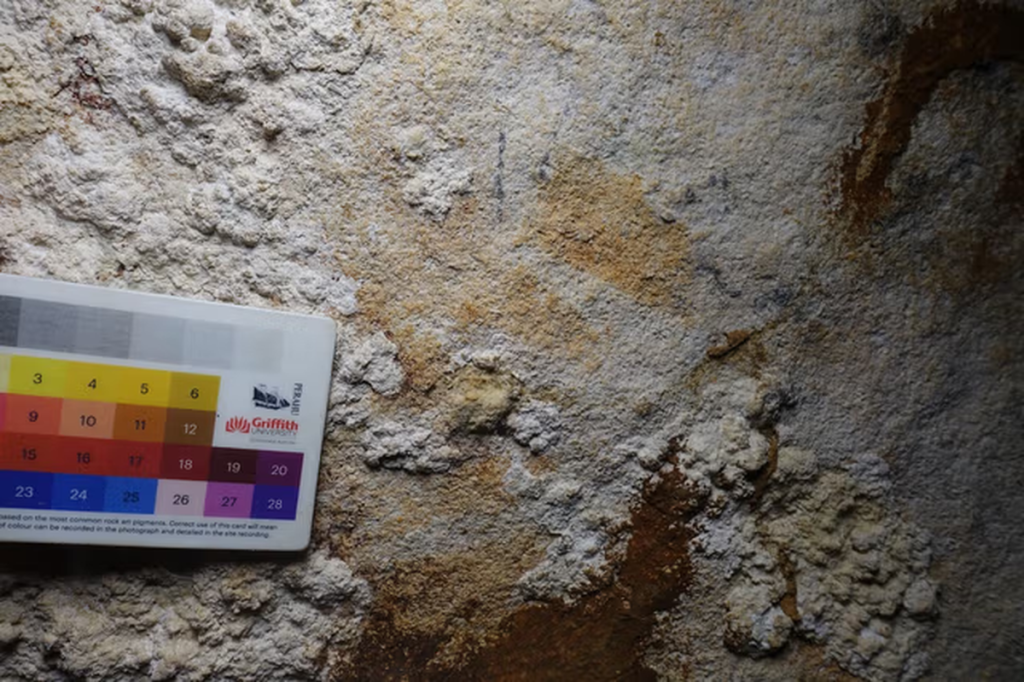
Less than two years after discovering a 51,200-year-old cave painting of a pig on the Indonesian island of Sulawesi, in what was then declared the oldest known figurative artwork, the same researchers have discovered an even older work.
The newly dated work, located on the southeastern peninsula of Sulawesi, is a hand stencil dating to 67,800 years ago. Little of the work remains: it exists now as “only a 14 × 10 cm patch of faded pigment bearing a portion of the fingers and the adjoining palm area,” according to an article published in the journal Nature Wednesday.
The new discovery, like the 2024 pig painting discovery, came out of long-running research from archaeologists at Griffith Univerisity in Australia, as well as several Indonesian archaeological organizations and state’s National Research and Innovation Agency.
Starting in 2019, researchers documented 44 cave painting sites in southeast Sualwesi and dated 11 individual rock art motifs—seven hand stencils and four other paintings—using a new method of Uranium-series dating to establish minimum ages. The oldest such hand stencil was found in a cave on the small island of Muna.
“We were able to date this art by analysing thin mineral crusts that formed on top of the paintings,” Maxime Aubert, an archaeologist from Griffith University and a co-author of the study, told the Art Newspaper. “Because these crusts grew after the art was made, they tell us the youngest possible age of the images.”
To create the stencils, ancient peoples blew pigment over their hands while they were laid on the rock. The Sulawesi stencils are unique, according to the study, because the people reshaped the tips of the fingers to be pointed, something that Aubert said may have had “symbolic meaning” linked to animals.
The earlier discovered pig painting was found on the southwestern peninsula of Sulawesi, in the Maros-Pangkep karsts, which, as the researchers write, has received far greater attention from researchers than the southeastern region.
“Our dating investigation in Southeast Sulawesi shows that extremely old rock art is not just concentrated in the Maros-Pangkep district in the southwestern peninsula but occurs in other parts of this large Wallacean island (about 174,000 km2),” they write in the study. “These findings support the growing view that Sulawesi was host to a vibrant and longstanding artistic culture during the Late Pleistocene epoch.”
The researchers further assert that the new discovery suggests that Sahul, the paleocontinent comprising Australia, New Guinea, and Tasmania, was initially peopled through maritime journeys between Borneo and Papua. It also lends credence to the “long chronology” theory that postulates that people arrived in Australia and the surrounding region as early as 60,000–65,000 years ago, rather than the previous theory of 50,000 years ago.
“Together, the archaeological and genetic evidence now strongly supports the long chronology and shows that the ancestors of Indigenous Australians were moving through Southeast Asia and creating symbolic art as they travelled,” Aubert said.
